|
|
|
|
|
FIE 封面文章 | P2型层状氧化物钠离子电池正极中“柔性”Al-O共价键促进氧的快速氧化还原 |
|
|
论文标题:Fast oxygen redox enabled by flexible Al–O bonds in P2-type layered oxides for sodium batteries
期刊:Frontiers in Energy
作者:Xinyin Cai, Nan Wang, Xun-Lu Li, Haobo Bai, Lu Ma, Zulipiya Shadike, Junliang Zhang
发表时间:25 Jun 2025
DOI:10.1007/s11708-025-1020-6
微信链接:点击此处阅读微信文章
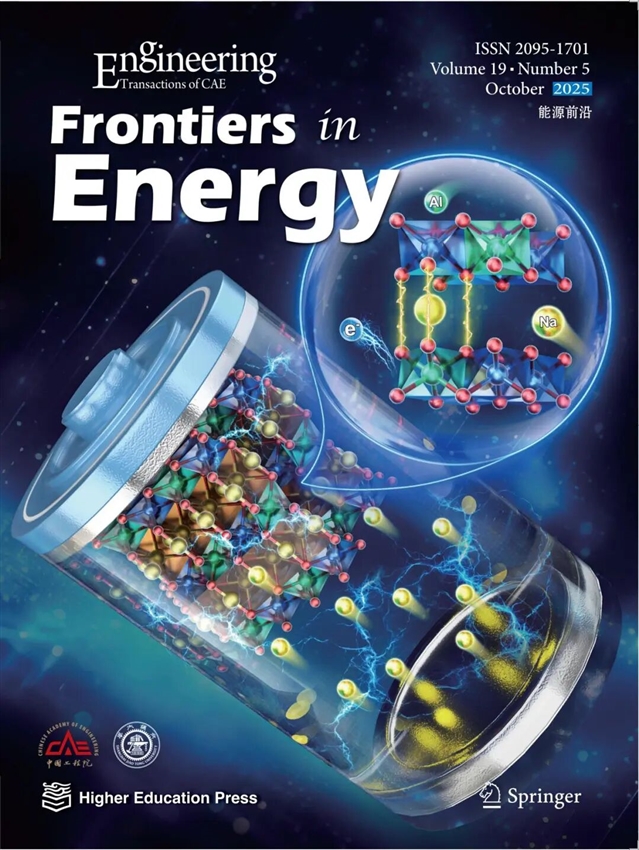
本期封面文章
Xinyin Cai, Nan Wang, Xun-Lu Li, Haobo Bai, Lu Ma, Zulipiya Shadike, Junliang Zhang. Fast oxygen redox enabled by flexible Al–O bonds in P2-type layered oxides for sodium batteries.
——Front. Energy, 2025, 19(5): 670-680
上海交通大学章俊良教授与祖丽皮亚·沙地克副教授等在Frontiers in Energy发表了题为“Fast oxygen redox enabled by flexible Al–O bonds in P2-type layered oxides for sodium batteries”的研究论文,并被遴选为2025年第5期封面文章。研究通过铝(Al)取代策略在P2型层状氧化物中构建“柔性”Al−O共价键,成功实现了晶格氧的快速氧化还原(LOR)反应,有效抑制了传统材料因相变导致的结构退化问题。
文章主要内容
钠离子电池因钠资源丰富、成本低、安全性高等优势,在大规模储能系统中具有广阔应用前景。过渡金属层状氧化物作为其主流正极材料之一,尤其是P2型结构,因具备高比容量和良好的钠离子传导性而备受关注。通过触发晶格氧的氧化还原反应,可进一步提升其工作电压与容量,但也常伴随不可逆的P型向O型堆叠相变,导致结构畸变和钠离子扩散动力学下降,严重限制了其实际应用。
为解决这一问题,研究团队设计并合成了P2型Na2/3Li1/6Al1/6Mn2/3O2(简称LAM)正极材料。通过X射线衍射、电子显微镜及X射线吸收光谱等多种表征手段,确认材料具有典型的P2型结构,过渡金属层中铝、锂、锰元素分布均匀。电化学测试显示,LAM在100 mA/g电流密度下首次放电容量达172 mAh/g,显著高于未掺杂铝的对比材料Na2/3Li2/9Mn7/9O2(LM)。在1 A/g的高倍率下,LAM仍能保持86 mAh/g的容量,而LM仅为32 mAh/g,表明Al取代显著提升了材料的倍率性能。
进一步通过原位X射线衍射分析发现,LAM在充电过程中未出现有害的O型堆叠相变,而是形成了有利于钠离子传输的Z相。该相通过氧层的可逆滑移维持了三棱柱配位环境,保障了钠离子扩散通道的畅通。恒电流间歇滴定技术测试结果显示,LAM的钠离子扩散系数在10-9至10-11 cm2/s之间,扩散势垒低至0.47 eV,与当前最优的Sb掺杂材料相当。
理论计算从电子结构层面揭示了Al−O键的“柔性”机制:其共价强度介于离子性的Li−O和强共价的Sb−O之间,能在钠离子脱嵌过程中通过键长收缩与畸变缓解局部结构应力,维持晶格完整性。晶体轨道哈密顿布居分析进一步证实,Al−O键在态占据变化中表现出良好的适应性,从而有效抑制了结构退化。
本研究不仅阐明了柔性共价键在促进氧氧化还原和稳定晶体结构中的关键作用,也为发展高性能层状氧化物正极材料提供了新的设计思路。未来,通过多元掺杂或界面工程等手段,有望进一步提升钠离子电池的循环稳定性,推动其在大规模储能系统中的实际应用。
原文信息
Fast oxygen redox enabled by flexible Al–O bonds in P2-type layered oxides for sodium batteries
Xinyin Cai1, Nan Wang2, Xun-Lu Li3, Haobo Bai1, Lu Ma4, Zulipiya Shadike1, Junliang Zhang1
Author information:
1. Institute of Fuel Cells, School of Mechanical Engineering, Shanghai Jiao Tong University, Shanghai 200240, China
2. Department of Materials Science, Department of Chemistry, Shanghai Key Laboratory of Molecular Catalysis and Innovative Materials, Fudan University, Shanghai 200433, China
3. Future Battery Research Center, Global Institute of Future Technology, Shanghai Jiao Tong University, Shanghai 200240, China
4. National Synchrotron Light Source II, Brookhaven National Laboratory, Upton, NY 11973, USA
Abstract:
Sodium-ion batteries (SIBs) exhibit significant potential for large-scale energy storage systems due to the abundance and low cost of sodium resources. Triggering lattice oxygen redox (LOR) in P2-type transition metal oxides is considered a promising approach to enhance energy density in SIB cathodes, providing high operating potential and substantial capacity. However, irreversible phase transitions associated with LOR, particularly from prisms (P-type stacking) to octahedrons (O-type stacking), lead to severe structural distortions and sluggish Na+ diffusion kinetics. In this work, an Al-substitution strategy is proposed to suppress the formation of O-type stacking and instead promote the formation of a beneficial Z phase. The flexible Al–O bonds accommodate asymmetric variations in their occupied states during the sodiation process, mitigating local structural distortions through Al–O bond contraction. Stabilization of the local structure ensures the maintenance of a robust Na+ diffusion pathway. As a result, the Al-substituted cathode achieves a low Na+ diffusion barrier of 0.47 eV and delivers a capacity of 86 mAh/g even at a high current density of 1 A/g within 1.5–4.5 V, maintaining 62.5% capacity retention over 100 cycles.
Keywords:
Al-substitution; phase transitions; local structure; sodium diffusion kinetics; lattice oxygen redox
Cite this article:
Xinyin Cai, Nan Wang, Xun-Lu Li, Haobo Bai, Lu Ma, Zulipiya Shadike, Junliang Zhang. Fast oxygen redox enabled by flexible Al–O bonds in P2-type layered oxides for sodium batteries. Front. Energy, https://doi.org/10.1007/s11708-025-1020-6
扫描二维码,阅读原文

通讯作者简介
章俊良,上海交通大学“致远”讲席教授,机械与动力工程学院燃料电池研究所所长,上海市“东方学者”特聘教授。主要从事界面电化学、电催化、纳米材料、燃料电池、电解水、电化学能源系统中的传热传质研究。主持项目包括国家“863”计划及科技部支撑计划、重点研发计划项目、国家自然科学基金重点项目、教育部科研重点项目、上海市新能源汽车重大专项、上汽集团大功率燃料电池电堆专项以及上汽燃料电池基金项目等。研究成果发表在Science, Nature Energy, Journal of the American Chemical Society, Energy & Environmental Science等期刊共计180余篇,累计他引1.5万余次,撰写中英文专著两部。申请美国及国际专利20余项,中国专利50余项。担任Fuel Cells、《物理化学学报》、Frontiers in Energy期刊编委,上海市电化学能源器件工程技术研究中心副主任,中国燃料电池汽车产业联盟理事。获2020年上海市技术发明奖一等奖、2024年中国汽车工程学会科技进步一等奖。
祖丽皮亚·沙地克,上海交通大学机械与动力工程学院副教授,博士生导师,入选国家和上海市高层次人才计划、小米青年学者、《麻省理工科技评论》中国区“35岁以下科技创新35人”、上海科技青年35人引领计划。主要研究方向是高比能二次电池关键材料开发与失效机理研究,在Nature Energy、Nature Nanotechnology和Nature Communications、Journal of the American Chemical Society 等期刊发表学术论文80余篇,被引6500次,申请发明专利6项。主持国家级、省部级项目/课题5项。担任SusMat、Chinese Chemical Letters、Renewables等期刊青年编委。
特别声明:本文转载仅仅是出于传播信息的需要,并不意味着代表本网站观点或证实其内容的真实性;如其他媒体、网站或个人从本网站转载使用,须保留本网站注明的“来源”,并自负版权等法律责任;作者如果不希望被转载或者联系转载稿费等事宜,请与我们接洽。