
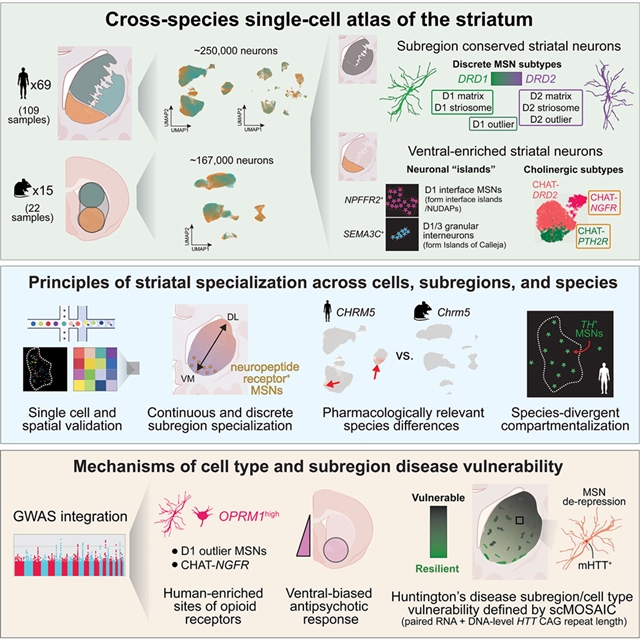
2026年,美国麻省理工学院Myriam Heiman等科学家在《细胞》发表研究,构建了跨人类和小鼠的纹状体单细胞图谱,揭示了纹状体神经元亚型的区域差异及在神经退行性和精神疾病中的差异性易感机制。
纹状体对于决策、运动和奖赏处理至关重要,这些功能通过亚区域的细胞和分子特化来实现。纹状体细胞类型和亚区在神经退行性和神经精神疾病中的受累程度不同,但造成这些易感性的机制尚不清楚。通过对涵盖背侧和腹侧纹状体的109个人类和22个小鼠样本进行单核RNA测序,研究人员提供了一个全面的亚区域神经元特化图谱。他们定义了罕见的神经元亚群以及沿背外侧-腹内侧轴的转录梯度,物种间存在显著差异,提示了不同的药理学靶点、连接性和疾病机制。与全基因组关联和药理学研究的整合,识别出人类富集的阿片受体表达位点和腹侧偏向的慢性抗精神病作用。最后,配对单细胞转录组和体细胞三核苷酸重复扩增测量,识别出亨廷顿病中亚区域和神经元亚型易感性的差异。这些发现为理解纹状体细胞类型和亚区如何参与脑功能和神经系统疾病奠定了基础。
附:英文原文
Title: Cross-species single-cell atlas of the striatum defines cell-type and subregion disease vulnerabilities
Author: Raleigh M. Linville, Benjamin T. James, Kyriaki Galani, Li-Lun Ho, Jung Hoon Shin, Esaria Oliver, Stuart B. Fass, James C. Cameron, Brent E. Fitzwalter, Roland Bock, Erin M. Murray, Mathilde Lou, Oluwamayowa Oke, Charlotte Wang, Erica Engelberg-Cook, Michael DeTure, Vanessa Farrell, Sergio Sebastian Pineda, Suphinya Sathitloetsakun, Xinyue Liang, Bertha Madras, Dennis W. Dickson, Deborah C. Mash, Gustavo Turecki, Vanessa C. Wheeler, Veronica A. Alvarez, Dana Gabuzda, Manolis Kellis, Myriam Heiman
Issue&Volume:
Abstract: The striatum is critical for decision-making, movement, and reward processing, functions achieved through subregional cellular and molecular specialization. Striatal cell types and subregions are differentially implicated in neurodegenerative and neuropsychiatric disorders, but the mechanisms underlying these vulnerabilities are poorly understood. Using single-nucleus RNA sequencing across 109 human and 22 mouse samples spanning dorsal and ventral striatum, we provide a comprehensive atlas of subregional neuronal specialization. We define rare neuronal subpopulations and transcriptional gradients along the dorsolateral-ventromedial axis with notable differences between species, suggesting divergent pharmacological targets, connectivity, and disease mechanisms. Integration with genome-wide association and pharmacological studies identifies human-enriched sites of opioid receptor expression and ventral-biased chronic antipsychotic action. Lastly, paired single-cell transcriptomic and somatic trinucleotide repeat expansion measurements identify differences in subregion and neuronal subtype vulnerability in Huntington’s disease. Our findings lay the foundation for understanding how striatal cell types and subregions contribute to brain function and neurological disorders.
DOI: 10.1016/j.cell.2026.08.006
Source: https://www.cell.com/cell/abstract/S0092-8674(26)00933-5