
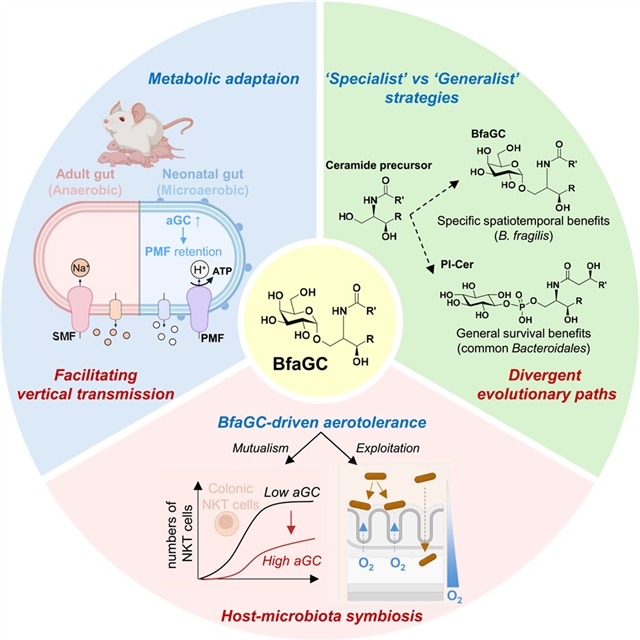
2026年9月5日,美国布莱根妇女医院Sungwhan F. Oh等科学家在《细胞》发表研究,揭示了脆弱拟杆菌通过膜鞘糖脂BfaGC响应新生儿肠道短暂氧环境,同时促进自身定植和宿主免疫系统发育的双重机制。
共生肠道细菌必须在每一代宿主中重新定植,但实现这种遗传的分子策略仍知之甚少。在此,研究人员表明脆弱拟杆菌利用一种膜糖脂——α-半乳糖神经酰胺(BfaGC)——来定植新生儿肠道。全基因组适应性分析显示,BfaGC生物合成在生命早期被选择性需要,此时短暂的有氧环境对专性厌氧菌构成了生理瓶颈。机制上,BfaGC降低膜质子通透性,维持支持有氧呼吸的质子动力。这种氧响应性适应同时产生了一个面向宿主的免疫调节信号,校准新生儿自然杀伤T(NKT)细胞发育,通过单一代谢物将细菌适应性与免疫成熟联系起来。同样的机制也使产肠毒素菌株能够扩展生态位,揭示了情境依赖的后果。值得注意的是,这一策略在肠道拟杆菌目中具有独特性:其他主要成员合成不同的鞘脂亚类以支持更广泛的适应性,暗示了不同的进化策略。研究人员的发现提供了时间分辨的见解,揭示细菌代谢物如何塑造宿主-微生物群落在发育过程中的共生关系。
附:英文原文
Title: Oxygen-responsive bacterial glycosphingolipid links symbiont fitness and immune development in neonatal host
Author: Kyoo Heo, Da-Jung Jung, Ji-Sun Yoo, Byoungsook Goh, Dennis L. Kasper, Sungwhan F. Oh
Issue&Volume:
Abstract: Symbiotic gut bacteria must re-establish themselves in every host generation, yet the molecular strategies enabling this inheritance remain poorly understood. Here, we show that Bacteroides fragilis uses a membrane glycolipid, alpha-galactosylceramide (BfaGC), to colonize the neonatal gut. Genome-wide fitness profiling revealed that BfaGC biosynthesis is selectively required during early life, when transient oxygenation creates a physiological bottleneck for strict anaerobes. Mechanistically, BfaGC reduces membrane proton permeability, sustaining the proton-motive force that supports aerobic respiration. This oxygen-responsive adaptation simultaneously generates a host-facing immunomodulatory signal that calibrates neonatal natural killer T (NKT) cell development, linking bacterial fitness to immune maturation through a single metabolite. The same mechanism also enables niche expansion by enterotoxigenic strains, revealing context-dependent consequences. Notably, this strategy is distinct among gut Bacteroidales: other prominent members synthesize a different sphingolipid subclass supporting broader fitness, implying divergent evolutionary strategies. Our findings provide time-resolved insight into how bacterial metabolites shape host-microbiota symbiosis across development.
DOI: 10.1016/j.cell.2026.08.011
Source: https://www.cell.com/cell/abstract/S0092-8674(26)00938-4