
2026年9月2日,美国哈佛医学院Ruaidhrí Jackson等科学家在《自然》(Nature)发表研究,发现了炎症诱导的嵌合mRNA(Gsdmd-Tmem106a)编码蛋白,参与调控细胞焦亡和宿主防御与免疫病理之间的平衡。
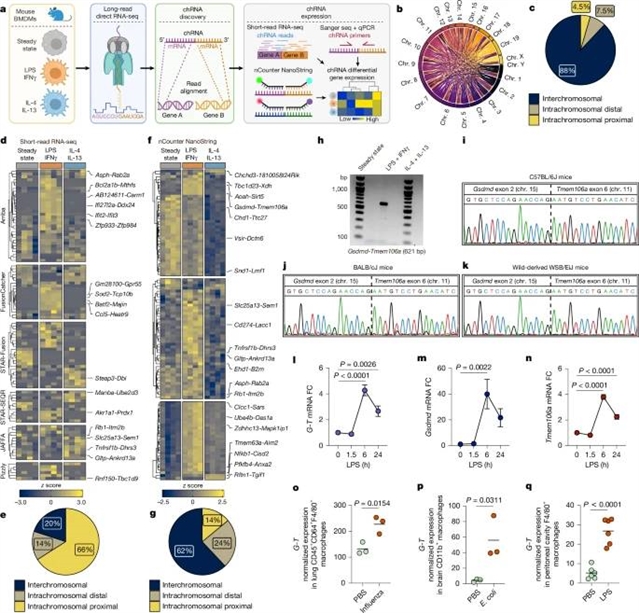
单个哺乳动物mRNA和蛋白质通常被认为源自单个基因组位点,异构体多样性通过前体mRNA的顺式剪接产生。来自远处基因的mRNA是否能发生反式剪接以产生功能性相关嵌合转录本,此前尚不清楚。在此,研究人员开发了一种结合长读长直接RNA测序与非靶向和靶向验证的流程,以鉴定巨噬细胞中的嵌合转录本。染色质构象捕获研究揭示,炎症诱导了染色体间DNA相互作用,使亲本基因靠近以促进嵌合mRNA的形成。值得注意的是,他们鉴定出小鼠中一个编码蛋白质的嵌合mRNA,代表成孔蛋白gasdermin D(GSDMD)与Tmem106a移码翻译的C端结构域之间的融合(Gsdmd-Tmem106a)。研究人员发现,炎症小体启动上调了Gsdmd-Tmem106a,其蛋白定位于质膜。在炎症小体激活后,GSDMD–TMEM106A直接与经典的GSDMD N端相互作用,加速并增强孔形成和IL-1β释放。最后,他们证明GSDMD–TMEM106A在体内平衡宿主防御和免疫病理:其缺失可防止致死性败血症但削弱抗菌防御,而过表达则增强宿主保护但增加败血症致死率。该研究确立了由调控性转录本融合事件形成的蛋白质编码嵌合mRNA在炎症和免疫过程中发挥功能。
附:英文原文
Title: Functional chimeric mRNAs encode proteins in mammalian immunity
Author: Venezia, Olivia, Kane, Harry, Du, Gang, Coughlan, Hannah D., Johanson, Timothy M., Wang, Hongshen, Tilstam, Pathricia, Kazer, Samuel W., Gunner, Georgia, Hoagland, Daisy A., Basavappa, Megha G., Ravichandran, Kanchana, Ada, Eren, Zhakyp, Ademi, Kumar, Sandhya, Duizer, Coco, Searle, Owen, Provido, Chris Geo, Joannas, Leonel, Yang, Shilong, Healy, Liam B., Wang, Qiankun, Capocchi, Joia, Dhillon, Bahawar Sharif, Slavoff, Sarah, Shan, Liang, Henao-Mejia, Jorge, Franklin, Ruth A., Chiu, Isaac M., Ordovas-Montanes, Jose, Jeffrey, Kate L., Lieberman, Judy, Allan, Rhys S., Kagan, Jonathan C., Wu, Hao, Jackson, Ruaidhr
Issue&Volume: 2026-09-02
Abstract: Individual mammalian mRNAs and proteins are typically believed to originate from single genomic loci, with isoform diversity arising through cis-splicing of pre-mRNA. Whether mRNA from distant genes can undergo trans-splicing to generate functionally relevant chimeric transcripts has remained unclear. Here we develop a pipeline combining long-read direct RNA sequencing with non-targeted and targeted validation to identify chimeric transcripts in macrophages. Chromatin conformation capture studies reveal that inflammation induces interchromosomal DNA interactions, positioning parent genes proximally to facilitate the formation of chimeric mRNA. Notably, we identify a protein-coding chimeric mRNA representing a fusion between the pore-forming protein gasdermin D (GSDMD)1,2 and a C-terminal domain translated out of frame from Tmem106a (Gsdmd-Tmem106a) in mice. We show that inflammasome priming upregulates Gsdmd-Tmem106a, with the protein localizing to the plasma membrane. After activation of the inflammasome, GSDMD–TMEM106A directly interacts with canonical GSDMD N termini to accelerate and enhance pore formation and IL-1β release. Finally, we show that GSDMD–TMEM106A balances host defence and immunopathology in vivo: its loss protects against lethal sepsis but compromises antibacterial defence, whereas overexpression enhances host protection while increasing sepsis lethality. We establish that protein-coding chimeric mRNAs formed by regulated transcript fusion events are operative during inflammation and immunity.
DOI: 10.1038/s41586-026-10982-x
Source: https://www.nature.com/articles/s41586-026-10982-x
Nature:《自然》,创刊于1869年。隶属于施普林格·自然出版集团,最新IF:69.504
官方网址:http://www.nature.com/
投稿链接:http://www.nature.com/authors/submit_manuscript.html