
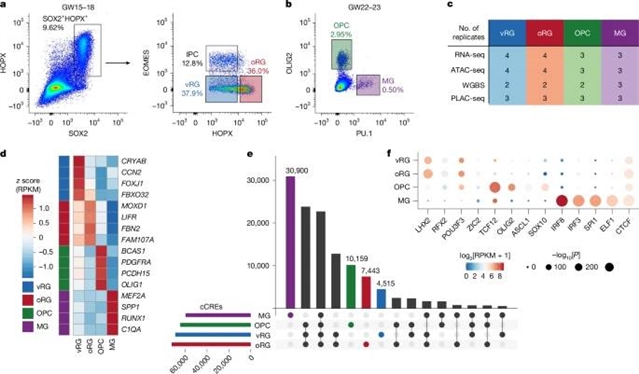
2026年9月2日,美国加利福尼亚大学Yin Shen等科学家在《自然》(Nature)发表研究,对发育中人类新皮层四种主要胶质细胞类型进行了3D表观基因组分析,鉴定了细胞类型特异的顺式调控元件,并揭示了其在精神分裂症风险变异和人类加速进化区域中的富集。
人类大脑皮层是复杂且异质的,在发育过程中经历广泛的扩张。研究人员先前对神经发生(包括放射状胶质细胞、中间祖细胞、兴奋性神经元和中间神经元)的研究表明,染色质环状结构是谱系特异性基因转录调控的基础,揭示了非编码遗传变异如何通过细胞类型特异性基因调控参与神经精神疾病。放射状胶质细胞在通过神经发生和胶质发生产生细胞多样性方面具有关键作用,并可进一步分为脑室区放射状胶质细胞(vRG)和外放射状胶质细胞(oRG)。鉴于它们在皮层发育中的重要性,研究人员对来自妊娠中期人类新皮层的四种主要胶质细胞群体(包括vRG、oRG、少突胶质细胞前体细胞和小胶质细胞)进行了全面的三维表观基因组分析。通过整合基因表达、染色质可及性、DNA甲基化和三维染色质相互作用,他们鉴定了细胞类型特异的候选顺式调控元件(cCREs),并利用转基因小鼠胚胎验证了其调控功能。利用机器学习,他们优先筛选了胶质细胞cCREs中的112个精神分裂症风险变异,并进一步在体内证实了rs4449074风险等位基因对预测的vRG增强子的破坏。与其他cCREs相比,oRG cCREs富集了人类加速进化区域,且一部分人类加速进化区域与其黑猩猩同源序列存在活性差异,这些区域与参与神经元发育的基因相互作用。研究人员的发现推进了对皮层发生过程中人类特异性基因调控的理解。
附:英文原文
Title: 3D epigenome of glial cell types in developing human cortex
Author: Jones, Ian R., Wang, Li, Kosicki, Michael, Battle, Stephanie L., Narayan, Vivek JJ, Bi, Qiuli, Gemenes, Kaila, Liu, Yuxi, Zhou, Lingbo, Song, Mengyi, White, Matthew, Olson, Wendy, Beuchat, Gabriel, Dickel, Diane, Li, Yun, Pennacchio, Len A., Hawkins, R. David, Kriegstein, Arnold, Shen, Yin
Issue&Volume: 2026-09-02
Abstract: The human cortex is complex and heterogeneous, undergoing extensive expansion during development1,2. Our prior study of neurogenesis, including radial glia (RG), intermediate progenitor cells, excitatory neurons and interneurons demonstrated that chromatin looping underlies transcriptional regulation for lineage-specific genes, shedding light on how non-coding genetic variants contribute to neuropsychiatric disorders by means of cell-type-specific gene regulation3. RG have a crucial role in generating cellular diversity through both neurogenesis and gliogenesis and can be further classified into ventricular RG (vRG) and outer RG (oRG)4,5. Given their significance in cortical development, we conducted a comprehensive three-dimensional (3D) epigenomic analysis of four main glial populations, including vRG, oRG, oligodendrocyte precursor cells and microglia, from the mid-gestational human neocortex. By integrating gene expression, chromatin accessibility, DNA methylation and 3D chromatin interactions, we identified cell-type-specific candidate cis-regulatory elements (cCREs) and validated their regulatory function using transgenic mouse embryos. Using machine learning, we prioritized 112 schizophrenia risk variants within glia cCREs and further confirmed the predicted vRG enhancer disruption by the rs4449074 risk allele in vivo. Finally, oRG cCREs are enriched for human accelerated regions compared with other cCREs and a subset of human accelerated regions show activity differences from their chimpanzee orthologues that interact with genes involved in neuronal development. Our findings advance the understanding of human-specific gene regulation during corticogenesis.
DOI: 10.1038/s41586-026-10987-6
Source: https://www.nature.com/articles/s41586-026-10987-6
Nature:《自然》,创刊于1869年。隶属于施普林格·自然出版集团,最新IF:69.504
官方网址:http://www.nature.com/
投稿链接:http://www.nature.com/authors/submit_manuscript.html