
2026年9月2日,德国亥姆霍兹慕尼黑研究中心发育遗传学研究所Christoph Gruber等科学家在《自然》(Nature)发表研究,利用人工智能设计的蛋白质组装体构建了超过100种RNA转运载体,并在小鼠和猪模型中验证了其基因编辑治疗潜力。
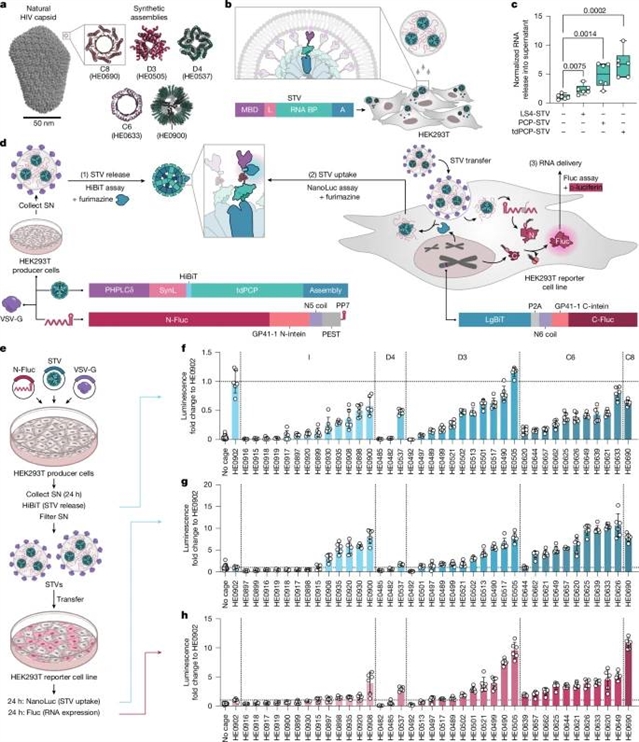
进化引导生物系统填充生态位,病毒是这一原理最成功的例子之一。病毒经过数十亿年的进化,能够高效转移遗传信息。尽管病毒高度多样化,但大多数病毒在衣壳的大小和形状上趋同于显著的相似性。相比之下,蛋白质设计的生成模型使得创造自然界中不存在的蛋白质架构成为可能。在此,研究人员探究了人工智能设计的蛋白质组装体是否可以被功能化,以构建独立于进化轨迹的核酸转运载体。通过将天然蛋白质结构域与合成蛋白质组装体相结合,他们创造了超过100种具有独特尺寸和形状的自下而上RNA转运载体。这些载体的RNA转移效率比广泛使用的递送载体高出数个数量级。此外,研究人员证明其趋向性可以通过整合计算设计的肽结合剂来编程,并利用它们将治疗相关的RNA货物递送到多种细胞模型中。他们以近单细胞分辨率展示了其中一种载体在小鼠体内的生物分布,确认了其安全性,并利用它在患者来源细胞和猪中进行了杜氏肌营养不良症的基因编辑治疗策略。这项工作展示了如何利用生成式人工智能创造的蛋白质,通过克服天然蛋白质多样性的局限性,来合理设计具有所需特性的RNA转运系统。
附:英文原文
Title: Creating bottom-up RNA transfer vehicles from synthetic protein assemblies
Author: Schuhmacher, Maren Kirstin, Gruber, Christoph, Lang, Christopher M. R., Ruijpers, Ricardo M. W., Mazneykova, Lyupka, Beinsteiner, Brice, Krus, Ariane, Tremmel, Barbara, Reinhardt, Friederike, Kadletz, Karoline, Ma, Zhe, Casalta, Lucie, Cambra Bort, Josep Miquel, Otify, Dina Y., Balken, Iolo, Hetzel, Leon, Merl-Pham, Juliane, Dorn, Tatjana, Luchner, Marina, Bauersachs, Lea, Ganea, Karin, Wieser, Natascha, Emrich, Alexander, Yamur, Emirhan, Rager, Katrin, Sagindykova, Gauhar, Armbrust, Niklas, Geilenkeuser, Julian, Westmeyer, Gil G., Becirovic, Elvir, Biel, Martin, Istvanffy, Rouzanna, Vogt Weisenhorn, Daniela M., Truong, Dong-Jiunn Jeffery, Theis, Fabian J., Ebert, Gregor, Moretti, Alessandra, Ertrk, Ali, Bhr, Andrea, Kupatt, Christian, Jasnin, Marion, Klymiuk, Nikolai, Giesert, Florian, Wurst, Wolfgang
Issue&Volume: 2026-09-02
Abstract: Evolution guides biological systems to populate ecological niches, with viruses among the most successful examples of this principle. Viruses evolved over billions of years to efficiently transfer genetic information. Although viruses are highly diverse, most have converged towards remarkable similarity in the size and shape of their capsids1,2. By contrast, generative models for protein design enable the creation of protein architectures that are absent from nature3,4,5. Here we investigate whether protein assemblies designed by artificial intelligence can be functionalized to construct nucleic acid transport vehicles that are independent of evolutionary trajectories. By combining natural protein domains with synthetic protein assemblies, we create more than 100 bottom-up RNA transfer vehicles with unique sizes and shapes. These vehicles surpass the RNA transfer efficiency of widely used delivery vehicles by several orders of magnitude. In addition, we demonstrate that their tropism can be programmed by incorporation of computationally designed peptide binders and use them to deliver therapeutically relevant cargo RNAs into a wide range of cellular models. We show the in vivo biodistribution of one of these vehicles in a mouse at near-single-cell resolution, confirm its safety, and use it to perform a gene-editing treatment strategy for Duchenne muscular dystrophy in patient-derived cells and a pig. Our work demonstrates how proteins created by generative artificial intelligence can be harnessed for the rational engineering of RNA transport systems with the desired properties by overcoming the limitations of natural protein diversity.
DOI: 10.1038/s41586-026-10952-3
Source: https://www.nature.com/articles/s41586-026-10952-3
Nature:《自然》,创刊于1869年。隶属于施普林格·自然出版集团,最新IF:69.504
官方网址:http://www.nature.com/
投稿链接:http://www.nature.com/authors/submit_manuscript.html