
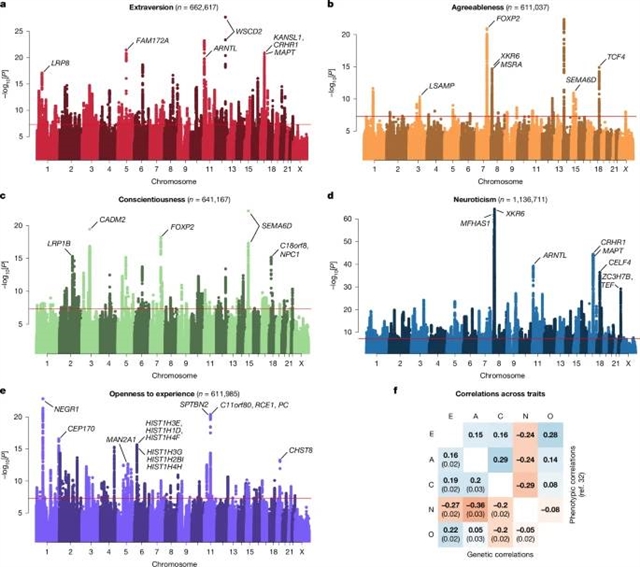
2026年9月2日,美国密歇根州立大学Ted Schwaba等科学家在《自然》(Nature)发表研究,通过对46个队列、超过110万参与者的荟萃分析,揭示了人格特质的遗传结构具有稳健的普适性、最小的混杂效应以及与人类行为和生活结局的广泛相关性。
人格特质描述了人们在思考、感受和行为方式上的稳定差异,以及他们如何与自身社会及物理环境互动和体验。关于DNA与人格特质之间的关联,仍有许多问题尚未解答,例如其稳健性、普适性以及其发挥作用的生物学和社会途径。在此,研究人员对46个队列的数据进行了荟萃分析,其中包括611,037至114万名具有欧洲样和非洲样基因组的参与者,用于大五人格特质(外向性、宜人性、尽责性、神经质和经验开放性)的全基因组关联研究,以及多达50,725名参与者的家庭内全基因组关联研究数据。他们识别出1,260个与人格相关的主导遗传变异,其中包括824个新变异。常见遗传变异解释了每种特质测量指标中度变异的4.8–9.3%,以及在具有典型测量信度的工具中变异的9.3–13.3%。人格的遗传关联在不同地理区域、报告者(自我与亲近他人)、年龄组和测量工具之间高度一致但并不完全相同,且研究人员发现近期历史中人格的配偶选择分类极少。与许多其他社会和行为特质不同,家庭内全基因组关联研究和多基因指数分析表明,人格的遗传关联受共享家庭环境的混杂影响极小。多基因预测、遗传相关性和孟德尔随机化分析表明,人格特质与重要行为和生活结局具有广泛的、潜在的因果关系。总体而言,研究人员发现人格的遗传结构具有稳健的普适性、最小的混杂效应,且与人类经验广泛相关。
附:英文原文
Title: Robust inference and correlates from genetic associations with personality
Author: Schwaba, Ted, Clapp Sullivan, Margaret L., Akingbuwa, Wonuola A., Ilves, Kerli, Tanksley, Peter T., Williams, Camille M., Dragostinov, Yavor, Mallard, Travis T., Tubbs, Justin D., Liao, Wangjingyi, Ackerman, Lindsay S., Fealy, Josephine C. M., Hemani, Gibran, de la Fuente, Javier, Smith, George Davey, Gupta, Priya, Stein, Murray B., Gelernter, Joel, Levey, Daniel F., Vsa, Urmo, Ausmees, Liisi, Realo, Anu, Vaht, Mariliis, Allik, Jri, Esko, Tnu, Mttus, Ren, Vainik, Uku, Jonsdottir, Gudrun A., Thorleifsson, Gudmar, Gunnarsson, rni Freyr, Bjornsdottir, Gyda, Thorgeirsson, Thorgeir E., Stefansson, Hreinn, Stefansson, Kari, Cheesman, Rosa, Qin, Qi, Corfield, Elizabeth C., Ask, Helga, Torvik, Fartein Ask, Ystrom, Eivind, Tesli, Martin, Boomsma, Dorret I., de Geus, Eco J. C., Hottenga, Jouke-Jan, Melo, Dener Cardoso, Snieder, Harold, Hartman, Catharina A., Xia, Charley, Campbell, Archie, Luciano, Michelle, Deary, Ian J., Hill, W. David, Jang, Seon-Kyeong, Vrieze, Scott I., Abecasis, Gonalo, Lupton, Michelle K., Mitchell, Brittany L., Viher, Petra V., Colodro-Conde, Luca
Issue&Volume: 2026-09-02
Abstract: Personality traits describe stable differences in how people think, feel and behave, and how they interact with and experience their social and physical environments1,2. Many questions remain unanswered about associations between DNA and personality traits, such as their robustness, their generalizability and the biological and social pathways through which they act. Here we meta-analyse data across 46 cohorts comprising 611,037 to 1.14million participants with European-like and African-like genomes for genome-wide association studies (GWAS) of the Big Five personality traits (extraversion, agreeableness, conscientiousness, neuroticism and openness to experience), and data from up to 50,725 participants for within-family GWAS. We identify 1,260 lead genetic variants associated with personality, including 824 novel variants3. Common genetic variants explain a moderate 4.8–9.3% of the variance in measures of each trait, and 9.3–13.3% among instruments with typical measurement reliability. Genetic associations with personality are highly consistent but not identical across geography, reporter (self versus close other), age group and measurement instrument, and we find minimal spousal assortment for personality in recent history. In contrast to many other social and behavioural traits4,5, within-family GWAS and polygenic index analyses indicate that genetic associations with personality are minimally confounded by the shared family environment. Polygenic prediction, genetic correlation and Mendelian randomization analyses indicate that personality traits have widespread, potentially causal associations with consequential behaviours and life outcomes. Overall, we find that the genetic architecture of personality is robustly generalizable, minimally confounded and widely relevant to human experience.
DOI: 10.1038/s41586-026-10992-9
Source: https://www.nature.com/articles/s41586-026-10992-9
Nature:《自然》,创刊于1869年。隶属于施普林格·自然出版集团,最新IF:69.504
官方网址:http://www.nature.com/
投稿链接:http://www.nature.com/authors/submit_manuscript.html