
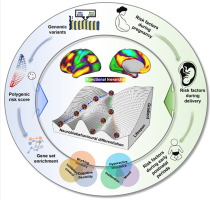
2026年9月2日,北京大学第六医院钱秋谨等科学家在《科学通报》发表研究,利用脑龄景观框架对ADHD患儿进行神经分型,识别出两种具有不同发育轨迹、遗传和围产期风险特征的多动症亚型。
本研究旨在利用脑龄景观框架中的全生命周期脑图表,解析注意缺陷多动障碍(ADHD)的神经发育多样性。首先,研究人员通过修订全球全生命周期脑图表(n=177,701),纳入31,894例中国健康样本——包括来自中国脑健康影像联盟(CHART)的25,768次扫描和来自中国儿童脑发育(CCBD)研究的6,126次扫描——生成了270名ADHD儿童年龄和性别参照的脑形态百分位分数。随后,研究人员基于这些作为偏离发育中对照参考的百分位分数,使用围绕中心点划分法对ADHD儿童进行分类,以识别ADHD景观异质性下的特质构型。脑龄景观识别出两种神经类型:体积较小儿童(SVC-ADHD)和体积较大儿童(LVC-ADHD),这两组在性别、影像中心、胎龄和母龄、分娩方式以及临床症状构成方面无差异。SVC-ADHD儿童年龄更小、平均出生体重更低,表现出神经认知障碍和默认模式网络内较差的半球分化,以及与机体发育过程相关的更多基因表达和更多产前危险因素(如母亲被动吸烟)。相比之下,LVC-ADHD儿童年龄较大,表现出更明显的行为和情绪障碍,而其语言、躯体感觉运动和认知控制网络的半球特化较差。遗传发现在LVC-ADHD中较不显著,仍处于探索阶段,且主要与神经发生相关。本研究绘制了ADHD的脑龄图谱,以反映遗传、产前和后期影响组合下不同的发育特征,提示了未来精准转化的临床潜力。
附:英文原文
Title: Landscaping neurodevelopment of attention-deficit hyperactivity disorder
Author: anonymous
Issue&Volume: 2026/09/02
Abstract: We aim to decipher the neurodevelopmental diversity of attention-deficit hyperactivity disorder (ADHD) using lifespan brain charts within a brainality landscape framework. It first generated age- and sex-referenced centile scores of brain morphology for 270 children with ADHD by revising the worldwide lifespan brain chart (n = 177,701) for 31,894 healthy Chinese samples, including 25,768 scans from the Chinese Brain Health Imaging Consortium (CHART) and 6126 scans from the Chinese Child Brain Development (CCBD) study. Children with ADHD were then classified using partitioning around medoids based on their centile scores as deviations from a developing control reference to identify trait constellations underlying ADHD’s landscape heterogeneity. The brainality landscape identified two neurotypes: children with smaller volume (SVC-ADHD) and children with larger volume (LVC-ADHD), who are not different between sex, imaging site, gestational and maternal age, delivery mode as well as clinical symptom composition. SVC-ADHD children are younger and have lower mean birth weight, and showed neurocognitive impairments and poorer hemispheric differentiation within the default-mode network as well as more gene expressions related to organism developmental processes, and more prenatal risk factors such as maternal passive smoking. In contrast, LVC-ADHD children are older and demonstrated more pronounced behavior and emotional impairments, while their language, somatomotor, and cognitive control networks exhibited poorer hemispheric specialization. Genetic findings were less pronounced in LVC-ADHD and remained exploratory and mainly linked to neurogenesis. Our work charted the brainality of ADHD to reflect distinct developmental profiles with combinations of genetic, prenatal, and later-life influences, implying clinical potential of future precision translation.
DOI: 10.1016/j.scib.2026.09.001
Source:https://www.sciencedirect.com/science/article/abs/pii/S2095927326010066
Science Bulletin:《科学通报》,创刊于1950年。隶属于SciEngine出版平台,最新IF:18.9
官方网址:https://www.sciengine.com/SB/home
投稿链接:https://mc03.manuscriptcentral.com/csb