
2026年9月3日,奥地利科学院分子生物技术研究所Flavia Corsi等科学家在《科学》(Science)发表研究,揭示了复制后人类姐妹染色单体在DNA链方向上存在持续错位现象,并探讨了其与复制叉不对称的关联。
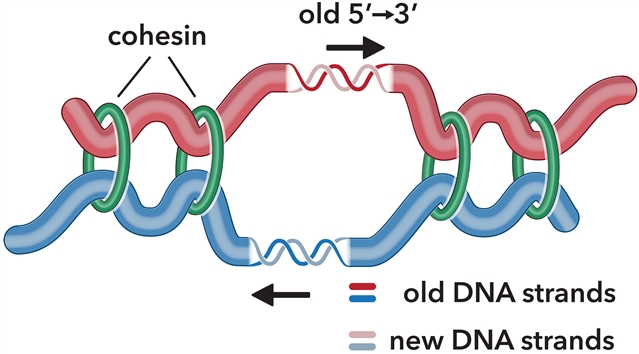
DNA复制产生序列相同的姐妹染色单体,但其机制根本上是不对称的:染色单体继承相反方向的DNA链,而复制叉通过不同的前导链和后随链机制合成新链。这种复制不对称性如何影响染色体组织尚不清楚。利用姐妹染色单体敏感的构象分析,研究人员发现人类姐妹染色单体在继承DNA链的5′→3′方向上存在持续错位。这种移位在缺乏黏连蛋白介导的环挤出时仍然存在,但在黏连蛋白被破坏后消失。聚合物模型表明,黏连蛋白的适度方向性错位可以解释观察到的移位,研究人员提出了两种模型来解释这种错位如何可能源于复制叉的不对称性。姐妹染色单体之间的这种记录移位对DNA修复过程中的同源搜索具有重要意义。
附:英文原文
Title: Conformational asymmetry of replicated human chromosomes
Author: Flavia Corsi, Thomas L. Steinacker, Sofia Kolesnikova, Zsuzsanna Takács, Paul Batty, Michael Mitter, Daniel W. Gerlich, Anton Goloborodko
Issue&Volume: 2026-09-03
Abstract: DNA replication generates sister chromatids with identical sequence, yet its mechanism is fundamentally asymmetric: Chromatids inherit strands of opposite orientation, whereas forks synthesize new strands by distinct leading- and lagging-strand mechanisms. How this replication asymmetry affects chromosome organization is unknown. Using sister chromatid–sensitive conformation analysis, we found that human sister chromatids are consistently misaligned in the 5′→3′ direction of inherited DNA strands. This shift persisted without cohesin-mediated loop extrusion but was lost upon disruption of cohesion. Polymer modeling showed that modest directional misalignment of cohesive cohesins can explain the observed shift, and we propose two models for how such misalignment could originate from replication fork asymmetry. This register shift between sister chromatids has implications for homology search during DNA repair.
DOI: 10.1126/science.aea4611
Source: https://www.science.org/doi/10.1126/science.aea4611