
美国康涅狄格州纽黑文耶鲁医学院Nenad Sestan研究团队研究出维甲酸控制前额叶运动实现的自动调节回路。相关论文于2026年9月16日发表在《自然》杂志上。
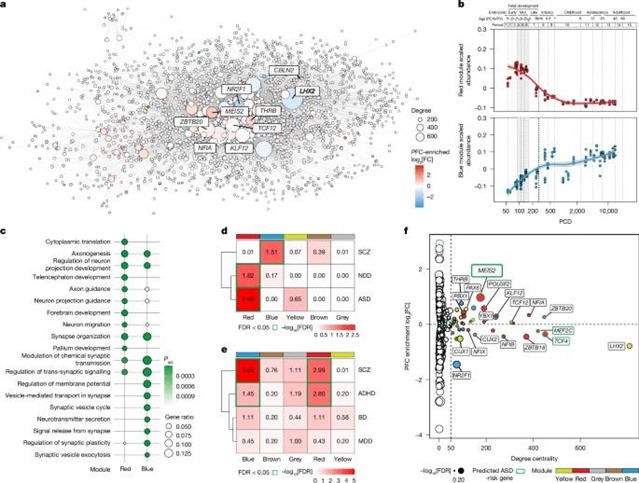
额叶包括支持复杂认知和目标导向行为的前额叶联合皮层(PFC),以及执行运动的运动皮层(MC)。沿感觉运动-联合轴建立不同的区域身份和连接,为皮层区域组织和功能提供了基本支架。视黄酸(RA)信号已成为PFC发育的关键调控因子。然而,在发育中的PFC内空间限制RA信号的机制以及下游RA响应基因网络仍知之甚少。在此,研究人员在发育中的人类PFC中定义了一个RA相关基因调控网络,并鉴定出MEIS2——其编码一种与智力障碍和自闭症谱系障碍相关的转录因子——是该网络的关键枢纽。在小鼠有丝分裂后皮层兴奋性神经元中条件性敲除Meis2,会导致预期前额叶联合区域部分重特化为运动样分子和连接特征,凸显了有丝分裂后神经元在建立和维持皮层区域身份中的关键作用。伴随Meis2缺失,表达RA合成酶ALDH1A3的兴奋性神经元群体,以及由此RA信号本身,在发育中的内侧PFC(mPFC)中显著减少。这些发现揭示了一个保守的自调控环路,RA→MEIS2→ALDH1A3→RA,该环路增强PFC富集的RA梯度并组织MC-PFC轴。总之,研究人员的发现揭示了一种有丝分裂后机制,通过该机制,神经元身份的特定特征增强RA信号,以定义前额叶和运动皮层区域的关键特征,将经典形态发生素与转录身份、神经回路形成和功能,以及潜在的神经精神疾病联系起来。
附:英文原文
Title: A retinoic acid autoregulatory loop governing prefrontal–motor arealization
Author: Yang, Lin, Shibata, Mikihito, Park, Saejeong, Liu, Yuting, Salamon, Iva, Liu, Jia, Kim, Suel-Kee, Shibata, Akemi, Deveau-French, Ashley, Blanco, Xoel Mato, Bai, Suxia, Nottoli, Timothy, Xing, Xiaojun, Rohani, Narjes, Sanders, Stephan J., Kovner, Rothem, Pattabiraman, Kartik, Sestan, Nenad
Issue&Volume: 2026-09-16
Abstract: The frontal lobe comprises the prefrontal association cortex (PFC), which supports complex cognition and goal-directed behaviour, and the motor cortex (MC), which executes movement1,2,3,4,5,6,7,8,9,10,11,12,13,14. The establishment of distinct regional identities and connections along the sensorimotor-to-association axis provides a fundamental scaffold for cortical areal organization and function15,16,17,18,19. Retinoic acid (RA) signalling has emerged as a key regulator of PFC development19,20,21,22,23,24,25,26. However, the mechanisms that spatially confine RA signalling within the developing PFC, and the downstream RA-responsive gene networks, remain poorly understood. Here we define an RA-associated gene regulatory network in the developing human PFC and identify MEIS2, which encodes a transcription factor linked to intellectual disability and autism spectrum disorder, as a key hub of this network. Conditional deletion of Meis2 in postmitotic cortical excitatory neurons in mice results in a partial respecification of prospective prefrontal association territories towards motor-like molecular and connectivity features, highlighting a critical role of postmitotic neurons in establishing and maintaining cortical areal identities. Concomitant with Meis2 loss, the population of excitatory neurons expressing the RA-synthesizing enzyme ALDH1A3, and consequently RA signalling itself, is substantially reduced in the developing medial PFC (mPFC). These findings reveal a conserved autoregulatory loop, RA→MEIS2→ALDH1A3→RA, that reinforces a PFC-enriched RA gradient and organizes the MC–PFC axis. Together, our findings reveal a postmitotic mechanism by which specific features of neuronal identity reinforce RA signalling to define key features of prefrontal and motor cortical territories, linking a classic morphogen to transcriptional identity, neural circuit formation and function, and potentially to neuropsychiatric disorders.
DOI: 10.1038/s41586-026-11014-4
Source: https://www.nature.com/articles/s41586-026-11014-4
Nature:《自然》,创刊于1869年。隶属于施普林格·自然出版集团,最新IF:69.504
官方网址:http://www.nature.com/
投稿链接:http://www.nature.com/authors/submit_manuscript.html