
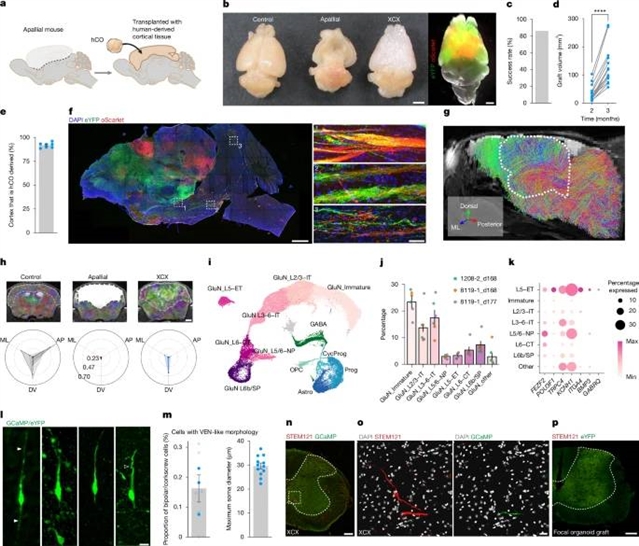
2026年9月16日,美国斯坦福大学Sergiu P. Pa?ca研究组在《自然》杂志发表论文,建立了使用人源类器官在小鼠中进行发育性异种皮层移植的平台。
人类脑组织的不可获取性限制了对其发育和功能的研究,而人干细胞来源的神经模型正开始应对这一挑战。将神经类器官移植到啮齿类宿主体内,使得能够在体内研究人类神经发育和环路功能的各个方面,同时还可对宿主动物进行行为表型分析。然而,空间限制以及与宿主环路的竞争制约了神经类器官的整合,而整合对于研究疾病至关重要。在此,研究人员建立了一个移植平台,利用遗传策略有效耗竭小鼠新皮层和海马的谷氨酸能神经元(无皮层),并在新生期将人干细胞来源的皮层类器官(hCO)植入皮层腔隙,从而生成异种皮层小鼠。这导致移植物稳健生长,hCO占据大部分皮层体积,并产生多样化的人类皮层细胞类型,包括第5层端脑外投射神经元。人类皮层神经元与小鼠神经系统整合,体内全移植物皮层钙成像和电生理分析揭示了类似发育中环路的有组织活动模式。对无皮层小鼠和异种皮层小鼠的行为分析显示,运动功能大体保留,同时伴有肢体协调的选择性差异以及自发行为组织的改变。最后,该平台使得在发育中人类皮层细胞损伤模型中开展行为学读出成为可能。研究人员设想,异种皮层移植将有助于利用人类神经元获得环路和行为层面的读出,以研究神经发育、模拟疾病和开发疗法。
附:英文原文
Title: Developmental xenocortication using human-derived organoids in mice
Author: Kaganovsky, Konstantin, Kelley, Kevin W., Gschwind, Tilo, Harary, Paul M., Kochalka, John, White, Alexander D., Lerma-Usabiaga, Garikoitz, Chen, Xiaoyu, Revah, Omer, Gore, Felicity, Aoyama, Ayano, Shadrach, Jennifer L., Yoon, Se-Jin, Valencia, Alfredo, Ogawa, Satoe, Reis, Noah, Vogel, Hannes, Wandell, Brian, Kaltschmidt, Julia A., Soltesz, Ivan, Deisseroth, Karl, Paca, Sergiu P.
Issue&Volume: 2026-09-16
Abstract: The inaccessibility of human brain tissue limits the study of human development and function, a challenge that human stem-cell-derived neural models are beginning to address1,2. Transplantation of neural organoids into rodent hosts enables the in vivo study of aspects of human neurodevelopment and circuit function, alongside behavioural phenotyping of the host animals. However, spatial limitations and competition with host circuits constrain the integration of neural organoids, which is critical for studying disease. Here we establish a transplantation platform using a genetic strategy to effectively deplete glutamatergic neurons from mouse neocortex and hippocampus (apallial) and neonatally engraft the cortical cavity with human stem-cell-derived cortical organoids (hCO) to generate xenocortical mice. This leads to robust graft growth with hCOs occupying most of the cortical volume and generating a diversity of human cortical cell types, including layer 5 extratelencephalic projection neurons. Human cortical neurons integrate with the mouse nervous system, and in vivo cortical graft-wide calcium imaging and electrophysiological analyses revealed patterns of organized activity resembling developing circuits. Behavioural analyses of apallial and xenocortical mice revealed broadly preserved locomotion alongside selective differences in limb coordination and altered organization of spontaneous behaviour. Lastly, this platform enabled behavioural readouts in a model of injury to developing human cortical cells. We envision that xenocortication will be useful for obtaining circuit- and behaviour-level readouts using human neurons to study neurodevelopment, model disease and develop therapeutics.
DOI: 10.1038/s41586-026-11032-2
Source: https://www.nature.com/articles/s41586-026-11032-2
Nature:《自然》,创刊于1869年。隶属于施普林格·自然出版集团,最新IF:69.504
官方网址:http://www.nature.com/
投稿链接:http://www.nature.com/authors/submit_manuscript.html