
近日,中国科学院海洋研究所李晓峰团队揭示了多年热带暖池变暖导致南极物质损失减缓。2026年8月19日出版的《自然》杂志发表了这一最新研究成果。
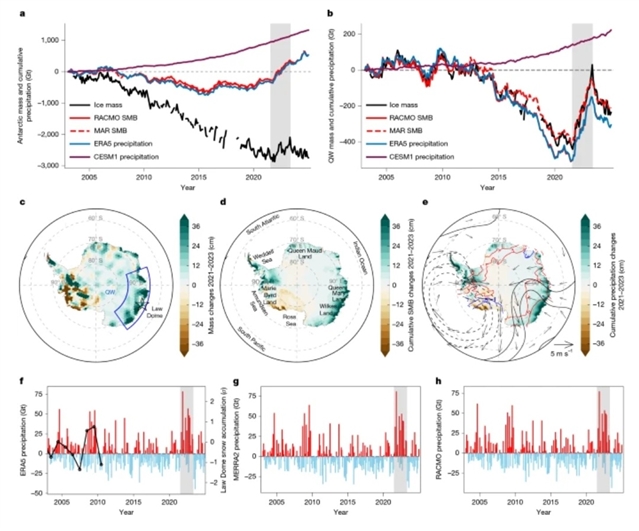
在过去几十年的大部分时间里,南极质量损失是全球海平面上升的主要贡献者,主要由西南极驱动。然而,在2021—2023年间,东南极玛丽皇后地及威尔克斯陆地的表面质量平衡急剧增加,抵消了西南极的损失,减缓了南极冰盖总质量的流失速率。尽管这一减缓与全球变暖导致的预期长期降水响应(风暴轴极向移动和南极大气增湿)相一致,但该结果表明了另一种机制。
研究组表明,近期冰盖质量增加与热带暖池海表温度异常驱动的一种反复出现的大气遥相关有关,该区域在2021至2023年间经历了相比过去二十年异常持久的增暖。基于观测和模型实验,研究组发现热带暖池增暖激发了一个极向传播的罗斯贝波列,诱导东南极上空出现高压异常,增强了玛丽皇后地和威尔克斯陆地的降水,并驱动了观测到的质量增加,其中水汽主要源自中纬度印度洋。
在观测和历史模拟中,类似的多年期热带暖池增暖约每十年重复出现一次,其对降水的影响与全球变暖的效应不同。因此,近期南极冰盖的质量增加很可能是暂时性的,尚不能反映全球变暖驱动的南极持续性增湿。
附:英文原文
Title: Multiyear tropical warm pool warming drives slowdown in Antarctic mass loss
Author: Wang, Yunhe, Ding, Qinghua, Li, Xiaofeng, Ballinger, Thomas J., Nakayama, Yoshihiro, Topl, Dniel, Steig, Eric J.
Issue&Volume: 2026-08-19
Abstract: Antarctic mass loss has been a major contributor to global sea-level rise for most of the last few decades, mainly driven by West Antarctica1. During 2021–2023, however, a sharp increase in surface mass balance over Queen Mary Land and Wilkes Land in East Antarctica offset West Antarctic loss and slowed the rate of total ice mass loss2,3. Although this slowdown is consistent with the expected long-term precipitation response to global warming through poleward-shifted storm tracks and Antarctic moistening4, our results point to a different mechanism. Here we show that the recent ice mass gain was linked to a recurrent atmospheric teleconnection driven by sea surface temperature anomalies in the tropical warm pool, which experienced unusually persistent warming from 2021 to 2023 relative to the previous two decades. On the basis of observations and model experiments, we find that tropical warm pool warming excites a poleward-propagating Rossby-wave train that induces a high-pressure anomaly over East Antarctica, enhancing Queen Mary Land and Wilkes Land precipitation and driving the observed mass gain, with moisture primarily sourced from the mid-latitude Indian Ocean. Similar multiyear warming in the tropical warm pool recurs about once per decade in observations and historical simulations, and its influence on precipitation is distinct from the effects of global warming. Therefore, the recent Antarctic Ice Sheet mass gain is probably temporary and does not yet reflect a sustained, global-warming-driven moistening of Antarctica.
DOI: 10.1038/s41586-026-10912-x
Source: https://www.nature.com/articles/s41586-026-10912-x
Nature:《自然》,创刊于1869年。隶属于施普林格·自然出版集团,最新IF:69.504
官方网址:http://www.nature.com/
投稿链接:http://www.nature.com/authors/submit_manuscript.html