
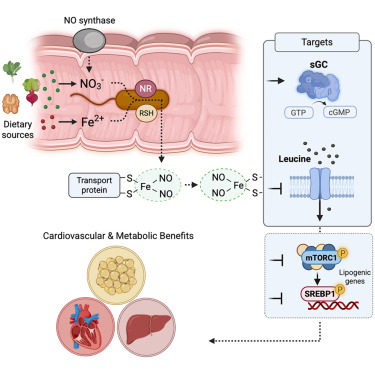
2026年8月19日,瑞典斯德哥尔摩卡罗林斯卡学院生理学和药理学系Andrei L. Kleschyov等合作在《细胞》上发表研究,揭示了肠道菌群能够产生对心脏代谢有益的二硝基铁复合物(DNIC)
肠道细菌可影响宿主生理,但其潜在机制尚未完全阐明。研究人员发现了一条通路,在该通路中,肠道微生物将无机硝酸盐和非血红素铁转化为可移动且具有生物活性的二硝基铁复合物(DNICs),这些复合物可分布至全身并影响宿主代谢。电子顺磁共振在常规小鼠组织中检测到DNICs,但在无菌小鼠中未检出。小鼠粪便、人类粪便及大肠杆菌均可由硝酸盐和柠檬酸铁生成DNICs,而硝酸还原酶缺陷型突变体则不能。在西方饮食喂养的小鼠中,膳食补充硝酸盐+柠檬酸铁或合成DNICs可增加组织DNIC水平,并改善心脏代谢功能障碍。此外,在HepG2细胞和人肝细胞球体中,DNIC可减少脂肪酸诱导的脂肪变性。DNIC的生物活性由Fe(NO)2实体介导,而非游离的一氧化氮(NO),其作用涉及激活可溶性鸟苷酸环化酶(sGC)、抑制亮氨酸摄取以及使mTORC1信号正常化。通过肠道菌群调节DNIC的形成,或可成为支持心脏代谢健康的一种策略。
据悉,肠道细菌影响宿主生理,但其潜在机制尚不完全清楚。
附:英文原文
Title: Gut microbiota generate dinitrosyl iron complexes with cardiometabolic benefits
Author: Andrei L. Kleschyov, Miho Shimari, Ariela Maína Boeder, Tomas A. Schiffer, Sander van Riet, Gianluigi Pironti, Nadja I. Bork, Alexander Rotmann, Zhengbing Zhuge, Drielle D. Guimares, Gaia Picozzi, Chiara H. Moretti, Lucas R.R.A. Carvalho, Carina Nihlén, Ellen I. Closs, Viacheslav O. Nikolaev, Magnus Ingelman-Sundberg, Eddie Weitzberg, Jon O. Lundberg, Mattias Carlstrm
Issue&Volume: 2026-08-19
Abstract: Gut bacteria affect host physiology, but the underlying mechanisms are not completely understood. We identify a pathway whereby gut microbes convert inorganic nitrate and non-heme iron into mobile bioactive dinitrosyl iron complexes (DNICs) that are distributed systemically and affect host metabolism. Electron paramagnetic resonance detected DNICs in tissues of conventional but not germ-free mice. Mouse and human feces and E. coli generated DNICs from nitrate and iron citrate, whereas a nitrate-reductase-deficient mutant did not. Dietary supplementation with nitrate+iron citrate or synthetic DNICs increased tissue DNIC levels and ameliorated cardiometabolic dysfunction in Western diet-fed mice. Additionally, in HepG2 cells and human hepatocyte spheroids, DNIC reduced fatty acid-induced steatosis. DNIC bioactivity is mediated by the Fe(NO)2 entity, rather than by free nitric oxide (NO), and involves activation of soluble guanylyl cyclase (sGC), inhibition of leucine uptake, and mTORC1 signaling normalization. Modulating DNIC formation by the gut microbiota could be a strategy to support cardiometabolic health.
DOI: 10.1016/j.cell.2026.07.055
Source: https://www.cell.com/cell/abstract/S0092-8674(26)00924-4