
奥地利科学技术研究所Simon Hippenmeyer小组的一项最新研究揭示了皮层类器官中径向胶质细胞谱系进展的时间解耦。相关论文发表在2026年8月12日出版的《自然》杂志上。
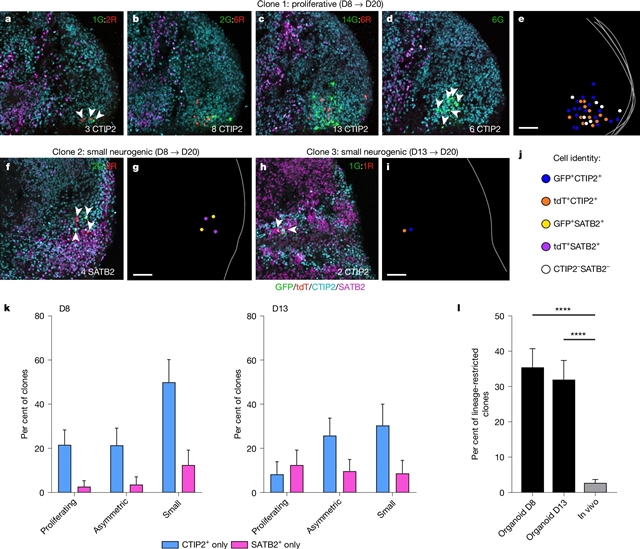
在这里,课题组在小鼠胚胎干细胞中建立了MADM技术,以探索自组织皮质类器官系统中RGP谱系的进展。课题组人员发现RGP在类器官中表现出高度的增殖潜力可塑性,而不是在体内观察到的严格的时间刻板谱系进展。尽管RGP具有统一的单细胞转录特征和单一的谱系轨迹,但类器官中的RGP显示出谱系限制增加,皮质投射神经元克隆中的细胞类型多样性减少。它们是自组织系统和/或真正的干细胞生态位中缺失的关键非细胞自主信号,对于RGP谱系进展的忠实时间控制和克隆皮质细胞类型多样性的产生至关重要。
据了解,放射状胶质祖细胞(RGPs)在发育中的大脑皮层中产生所有兴奋性神经元。基于双标记(MADM)的体内谱系追踪镶嵌分析揭示了RGP谱系进展的定量框架。
附:英文原文
Title: Temporal uncoupling of radial glia lineage progression in cortical organoids
Author: Stouffer, Melissa, Miranda, Osvaldo A., Pauler, Florian M., Pipicelli, Fabrizia, Streicher, Carmen, Cheung, Giselle, Hippenmeyer, Simon
Issue&Volume: 2026-08-12
Abstract: Radial glial progenitors (RGPs) produce all excitatory neurons in the developing cerebral cortex. Mosaic analysis with double markers (MADM)-based lineage tracing in vivo has revealed a quantitative framework of RGP lineage progression1. Here we established MADM technology2,3 in mouse embryonic stem cells to probe RGP lineage progression in a self-organizing cortical organoid system. We found that RGPs exhibit a high level of plasticity in proliferative potential in organoids rather than strict temporally stereotyped lineage progression as observed in vivo. RGPs in organoids showed increased lineage restriction, diminishing cell-type diversity in clones of cortical projection neurons, despite uniform single-cell transcriptional signatures of RGPs and a unitary lineage trajectory. Thus, critical non-cell-autonomous cues that are absent in self-organizing systems and/or the genuine stem cell niche are essential for faithful temporal control of RGP lineage progression and the generation of clonal cortical cell-type diversity.
DOI: 10.1038/s41586-026-10916-7
Source: https://www.nature.com/articles/s41586-026-10916-7
Nature:《自然》,创刊于1869年。隶属于施普林格·自然出版集团,最新IF:69.504
官方网址:http://www.nature.com/
投稿链接:http://www.nature.com/authors/submit_manuscript.html