
大脑导航回路中θ波扫描的自适应调制,这一成果由挪威科技大学
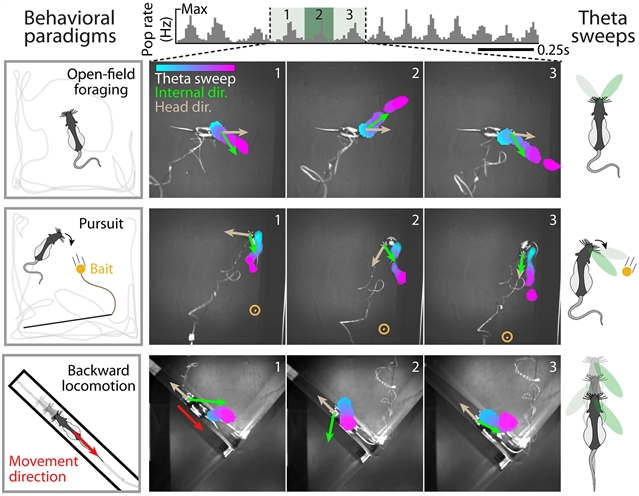
通过对自由行为的大鼠进行大规模神经像素记录,小组发现扫描和方向信号是快速动态调节的:它们在追逐过程中跟踪运动目标,在静止时进行定向反应,在向后运动时进行反向反应——所有这些都没有事先对目标位置的空间学习。类似的调节发生在快速眼动(REM)睡眠期间。总之,这些发现确定了扫描是一种灵活的、类似于注意力的机制,可以选择性地对非中心认知地图进行采样。
据介绍,有效的导航需要优先考虑来自行为相关位置的信息。在大鼠中,这种选择性取样可能来自于对网格和位置细胞群的θ节奏扫描,这种扫描以左右交替的模式扫描附近的空间,由副眼方向信号协调。这种交替在勘探过程中促进了均匀的空间覆盖,但扫描是否可以灵活地调整以适应实时需求仍然未知。
附:英文原文
Title: Adaptive modulation of theta sweeps in the brain’s navigation circuit
Author: Abraham Z. Vollan, Michael F. Schellenberger, Richard J. Gardner, May-Britt Moser, Edvard I. Moser
Issue&Volume: 2026-08-06
Abstract: Efficient navigation requires prioritizing information from behaviorally relevant locations. In rats, such selective sampling may arise from theta-paced sweeps in grid and place cell populations, which scan nearby space in a left-right alternating pattern coordinated by parasubicular direction signals. This alternation promotes uniform spatial coverage during exploration, but whether sweeps can be flexibly tuned to moment-to-moment demands remains unknown. Using large-scale Neuropixels recordings in freely behaving rats, we show that sweeps and direction signals are rapidly and dynamically modulated: They track moving targets during pursuit, precede orienting responses during immobility, and reverse during backward locomotion—all without prior spatial learning of goal locations. Comparable modulation occurs during rapid eye movement (REM) sleep. Together, these findings identify sweeps as a flexible, attention-like mechanism for selectively sampling allocentric cognitive maps.
DOI: aef4184
Source: https://www.science.org/doi/10.1126/science.aef4184