
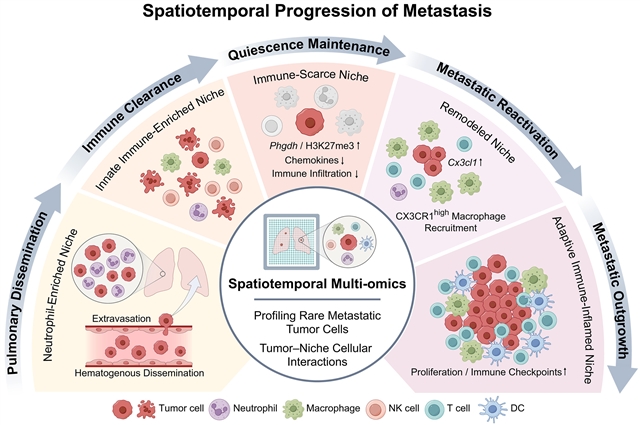
时空多组学揭示肿瘤转移定殖过程中的生态系统动态,这一成果由复旦大学
研究组整合了癌症小鼠模型和人类转移的多模态单细胞和空间分析,以跟踪DTC及其微环境从单细胞接种到明显肺转移的时空动力学。。课题组人员确定了一组静止的高Phgdhhigh DTC,它们在初始的先天免疫清除中存活下来,并在微转移中短暂富集。这些细胞通过PHGDH依赖的H3K27me3介导的趋化因子转录表观遗传沉默形成了一个免疫稀缺的微环境,从而促进了转移性扩张。Cx3cr1高间质巨噬细胞在DTC扩增前也短暂富集,通过招募免疫抑制细胞为转移性生长创造了免疫特权生态位。在DTC中灭活PHGDH-H3K27me3轴或耗尽间质巨噬细胞可恢复免疫监视并抑制转移性定植。这些发现为微转移靶向治疗方案的发展提供了见解。
据了解,在转移性定植过程中,播散性肿瘤细胞(DTC)与其组织微环境之间相互作用的机制目前尚不清楚。
附:英文原文
Title: Spatiotemporal multiomics uncover tumor ecosystem dynamics during metastatic colonization
Author: Miguel A. Esteban
Issue&Volume: 2026-07-30
Abstract: The mechanisms underlying the interactions between disseminated tumor cells (DTCs) and their tissue microenvironment during metastatic colonization are currently poorly understood. We integrated multimodal single-cell and spatial profiling from liver cancer mouse models and human metastases to track the spatiotemporal dynamics of DTCs and their microenvironments from single-cell seeding to overt lung metastasis. We identified a residual population of quiescent Phgdhhigh DTCs that survived initial innate immune clearance and became transiently enriched in micrometastases. These cells shaped an immune-scarce microenvironment through PHGDH-dependent, H3K27me3-mediated epigenetic silencing of chemokine transcription, thereby promoting metastatic expansion. Cx3cr1high interstitial macrophages were also transiently enriched before DTC expansion, creating an immune-privileged niche for metastatic outgrowth by recruiting immunosuppressive cells. Inactivating the PHGDH-H3K27me3 axis in DTCs or depleting interstitial macrophages restored immune surveillance and inhibited metastatic colonization. These findings provide insights into the development of micrometastasis-targeting regimens.
DOI: adz7928
Source: https://www.science.org/doi/10.1126/science.adz7928