
耶鲁医学院Nenad Sestan小组宣布他们的论文发现了竞争性程序塑造皮层感觉运动-联合轴的发育。2026年7月1日出版的《自然》发表了这项成果。
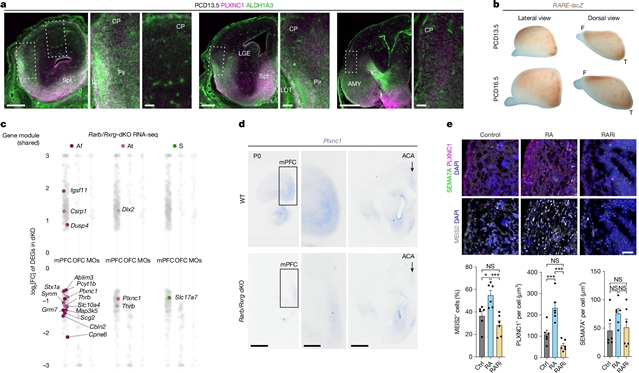
在这里,研究人员提出了支持网络发展多节点诱导-排除(MIND)模型的多物种证据,其中S-A模式是由两个相反的转录组定义程序驱动的诱导和排除的竞争过程控制的。“中央周围”程序在额颞极周围诱导,向内发展到未分化的新皮层的中心区域,并定义高阶关联特征。“中枢”程序通过一级感觉运动丘脑皮质输入集中诱导,建立主要区域并排除中枢周围程序。这些保守程序争夺空间,导致轴突引导、细胞-细胞粘附、视黄酸信号、突触发生、WNT信号和自闭症风险相关基因的区隔化表达。
值得注意的是,PLXNC1和SEMA7A,分别代表中央周围和中央程序的受体配体对,在初级和高阶关联皮质轴突之间表现出排斥相互作用。归纳和排除共同建立了一个S-A组织,在这个组织中,主要区域成为分布式关联网络更广阔海洋中的焦点岛屿。MIND模型为实验、进化和临床现象提供了一个统一的框架,揭示了诱导和排斥是形成S-A轴和加工层次的对立而又互补的原则。
据介绍,大脑皮层沿主导的感觉运动-关联(S-A)轴组织,一端由特定模式的主要感觉运动区域和跨模式关联区域组成分布式网络,在另一端支持抽象认知。形成这条轴的发育机制尚不清楚。
附:英文原文
Title: Competing programs shape cortical sensorimotor–association axis development
Author: Tsyporin, Jeremiah, Zhang, Menglei, Qi, Cai, Segal, Ashlea, Li, Xinyun, Kim, Hyojin, Choi, Sang-Hun, Pavlovic, Ivan, Bandiera, Sara, Finn, Thomas, Kim, Suel-Kee, Shibata, Akemi, Nakamura, Takumi, Onishi, Kohei, Zhang, Ziqin, Hammarlund, Elijah, Su, Graham, Salla, Nikkita, Kachko, Joy, Hawley, Christi, Li, Shuiyu, Doyle, Daniel Z., Peng, Xueyan, Nottoli, Timothy, Ruiz-Reig, Nuria, Tissir, Fadel, Nakagawa, Yasushi, Herzog, Erica, Ma, Shaojie, Gobeske, Kevin, Pattabiraman, Kartik, Shimogori, Tomomi, Duque, Alvaro, Fornito, Alex, Huang, Hao, Shibata, Mikihito, Chen, Bin, Sestan, Nenad
Issue&Volume: 2026-07-01
Abstract: The cerebral cortex is organized along a dominant sensorimotor-to-association (S–A) axis, anchored by modality-specific primary sensorimotor areas at one end and transmodal association areas forming distributed networks that support abstract cognition at the other1,2,3,4,5,6,7,8,9,10,11. The developmental mechanisms shaping this axis remain unclear9,10,11,12,13,14,15,16,17,18,19,20,21,22,23,24. Here we present converging multispecies evidence supporting the multinodal induction–exclusion in network development (MIND) model, in which S–A patterning is governed by competing processes of induction and exclusion driven by two opposing transcriptomically defined programs. ‘Pericentral’ programs are induced around the frontotemporal poles, progress inwards toward the central regions of the undifferentiated neocortex and define higher-order association features. ‘Central’ programs are induced centrally through first-order sensorimotor thalamocortical inputs, establish primary areas and exclude pericentral programs. These conserved programs compete for space, resulting in compartmentalized expression of axon guidance, cell–cell adhesion, retinoic acid signalling, synaptogenesis, WNT signalling and autism-risk-associated genes. Notably, PLXNC1 and SEMA7A, a receptor–ligand pair representing pericentral and central programs, respectively, exhibit repulsive interactions between primary and higher-order association corticocortical axons. Induction and exclusion together establish an S–A organization in which primary areas emerge as focal islands within a broader ocean of distributed association networks. The MIND model provides a unifying framework for experimental, evolutionary and clinical phenomena, revealing induction and exclusion as antagonistic yet complementary principles shaping the S–A axis and processing hierarchies.
DOI: 10.1038/s41586-026-10699-x
Source: https://www.nature.com/articles/s41586-026-10699-x
Nature:《自然》,创刊于1869年。隶属于施普林格·自然出版集团,最新IF:69.504
官方网址:http://www.nature.com/
投稿链接:http://www.nature.com/authors/submit_manuscript.html