
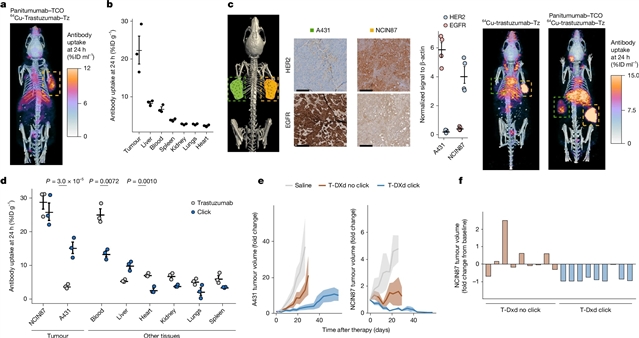
美国华盛顿大学医学院Patrícia M. R. Pereira小组的研究开发出了模块化体内抗体——ADC点击逆转肿瘤耐药性。2026年7月15日出版的《自然》杂志发表了这项成果。
在这里,该课题组人员介绍了一种体内生物正交连接策略,在系统给药后产生功能性抗体-ADC点击构建物。该平台提供了一种模块化和可翻译的方法,用于增强异质肿瘤的靶向药物递送。研究团队将治疗性抗体和ADC与反式环烯和四嗪基团偶联,以顺序给药,从而在全身给药后实现抗体与ADC的体内连接。在HER2和EGFR共表达的临床前模型中,抗体- ADC点击方法相对于标准ADC单药治疗或抗体- ADC联合治疗显示出更高的抗肿瘤活性。这些肿瘤包括HER2低、超低、阴性或异质表达,以及对传统HER2导向ADC耐药或不适合的肿瘤。这种模块化策略利用受体生物学和生物正交化学获得最佳治疗效果,不需要广泛的抗体重组。
此外,抗体-ADC点击方法可以扩展到其他受体对,这使其成为一个灵活的模块化平台,以解决不同肿瘤类型的异质性和对靶向治疗的耐药性。
研究人员表示,抗体-药物偶联物(ADC)通过选择性地向肿瘤细胞递送细胞毒性药物,显著地推进了癌症治疗。然而,ADC的疗效仍然受到其对单一靶抗原的依赖的限制,这限制了肿瘤的靶向性,并促进了抗原表达可变和低的异质肿瘤的耐药性。
附:英文原文
Title: Modular in vivo antibody–ADC click to reverse drug resistance in tumours
Author: Sim, Cristina, Vanover, Alexander C., DOliveira Albanus, Ricardo, Panikar, Sandeep Surendra, Shmuel, Shayla, Benton, Alex, Giraldo-Guzman, Jader, Luna, Jos M., Xu, Yifei, Berry, Na-Keysha, Keltee, Nai, Liu, Jingxia, Dehdashti, Farrokh, Pereira, Patrcia M. R.
Issue&Volume: 2026-07-15
Abstract: Antibody–drug conjugates (ADCs) have significantly advanced cancer therapy by enabling the selective delivery of cytotoxic agents to tumour cells. However, ADC efficacy remains constrained by its dependence on a single target antigen, which limits tumour targeting and promotes resistance in heterogeneous tumours with variable and low antigen expression1,2,3,4,5,6. Here we introduce an in vivo bioorthogonal ligation strategy that generates functional antibody–ADC click constructs following systemic administration. This platform provides a modular and translatable approach for enhanced targeted drug delivery in heterogeneous tumours. We conjugate therapeutic antibodies and ADCs with trans-cyclooctene and tetrazine moieties for sequential administration to enable in vivo ligation of an antibody with an ADC after systemic delivery. The antibody–ADC click approach demonstrated improved antitumour activity relative to standard ADC monotherapy or antibody plus ADC combinations in preclinical models of HER2 and EGFR co-expression. These included tumours with low, ultralow, negative or heterogeneous HER2 expression and resistant or ineligible for conventional HER2-directed ADCs. This modular strategy leverages receptor biology and bioorthogonal chemistry for optimal therapeutic efficacy and does not require extensive antibody re-engineering. Moreover, the antibody–ADC click approach can be extended to other receptor pairs, which makes it a flexible modular platform to address heterogeneity and resistance to targeted therapies across different tumour types.
DOI: 10.1038/s41586-026-10789-w
Source: https://www.nature.com/articles/s41586-026-10789-w
Nature:《自然》,创刊于1869年。隶属于施普林格·自然出版集团,最新IF:69.504
官方网址:http://www.nature.com/
投稿链接:http://www.nature.com/authors/submit_manuscript.html