
近日,谷歌量子人工智能Volodymyr Sivak团队研究了量子纠错的强化学习控制。2026年7月8日,《自然》杂志发表了这一成果。
量子纠错(QEC)是保护量子计算机免受环境干扰的主要策略。QEC的前提是错误必须保持足够罕见,这需要根据不断漂移的环境条件持续调整计算机的控制参数。当前解决这一问题的方案是终止整个量子计算以进行重新校准,但这与未来量子算法的长时间运行不相兼容。
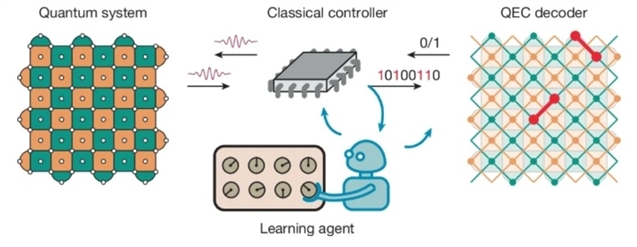
研究组通过将校准与计算统一起来来应对这一挑战。他们赋予QEC过程双重角色:其错误检测事件不仅用于纠正逻辑量子态,还被重新用作学习信号,以训练一个强化学习智能体,使其在计算过程中持续引导控制参数并稳定量子系统。研究组在Willow超导处理器上实验演示了这一框架,将表面码的逻辑稳定性在注入漂移条件下提高了3.5倍。
通过整合全套技术进展,研究组实现了表面码和色码的创纪录性能,其每周期平均逻辑错误率分别为7.72(9)×10-4和8.19(14)×10-3。对具有数万个控制参数的大规模码进行的数值模拟证实了研究组RL框架的可扩展性,揭示了与系统尺寸无关的优化速度。因此,这项工作开启了一种新范式:一台能从自身错误中学习且永不停止计算的量子计算机。
附:英文原文
Title: Reinforcement learning control of quantum error correction
Author: Sivak, Volodymyr, Morvan, Alexis, Broughton, Michael, Cortias, Rodrigo G., Bausch, Johannes, Senior, Andrew W., Neeley, Matthew, Eickbusch, Alec, Shutty, Noah, Beni, Laleh Aghababaie, Spencer, James S., Heras, Francisco J., Edlich, Thomas, Abanin, Dmitry, Abbas, Amira, Acharya, Rajeev, Aigeldinger, Georg, Alcaraz, Ross, Alcaraz, Sayra, Andersen, Trond I., Ansmann, Markus, Arute, Frank, Arya, Kunal, Askew, Walt, Astrakhantsev, Nikita, Atalaya, Juan, Ballard, Brian, Bardin, Joseph C., Bates, Hector, Bengtsson, Andreas, Karimi, Majid Bigdeli, Bilmes, Alexander, Bilodeau, Simon, Borjans, Felix, Bourassa, Alexandre, Bovaird, Jenna, Bowers, Dylan, Brill, Leon, Brooks, Peter, Browne, David A., Buchea, Brett, Buckley, Bob B., Burger, Tim, Burkett, Brian, Bushnell, Nicholas, Busnaina, Jamal, Cabrera, Anthony, Campero, Juan, Chang, Hung-Shen, Chen, Silas, Chiaro, Ben, Chih, Liang-Ying, Cleland, Agnetta Y., Cochrane, Bryan, Cockrell, Matt, Cogan, Josh, Collins, Roberto, Conner, Paul, Cook, Harold, Courtney, William, Crook, Alexander L., Curtin, Ben, Damyanov, Martin, Das, Sayan, Debroy, Dripto M., Demura, Sean, Donohoe, Paul, Drozdov, Ilya, Dunsworth, Andrew, Ehimhen, Valerie, Elbag, Aviv Moshe, Ella, Lior, Elzouka, Mahmoud, Enriquez, David, Erickson, Catherine
Issue&Volume: 2026-07-08
Abstract: Quantum error correction (QEC) is the primary strategy for protecting a quantum computer from the environment1,2. The prerequisite of QEC is that errors must remain sufficiently rare, which requires perpetually adapting the control parameters of the computer to the drifting environmental conditions. The current solution to this problem is to terminate the entire quantum computation for recalibration, but it is incompatible with the long runtimes of future quantum algorithms3,4. Here we address this challenge by unifying calibration with computation. We grant the QEC process5,6,7,8,9,10,11 a dual role: its error-detection events are not only used to correct the logical quantum state but are also repurposed as a learning signal, teaching a reinforcement learning agent12,13,14,15,16 to continuously steer the control parameters and stabilize the quantum system during computation. We experimentally demonstrate this framework on a Willow superconducting processor, improving the logical stability of the surface code 3.5-fold against injected drift. By synthesizing our full suite of technological advances, we achieve record performance of the surface and colour codes, with average logical error per cycle of 7.72(9) × 104 and 8.19(14) × 103, respectively. Numerical simulations of large codes with tens of thousands of control parameters confirm the scalability of our RL framework, revealing an optimization speed that is independent of system size. This work thus enables a new paradigm: a quantum computer that learns from its errors and never stops computing.
DOI: 10.1038/s41586-026-10759-2
Source: https://www.nature.com/articles/s41586-026-10759-2
Nature:《自然》,创刊于1869年。隶属于施普林格·自然出版集团,最新IF:69.504
官方网址:http://www.nature.com/
投稿链接:http://www.nature.com/authors/submit_manuscript.html