
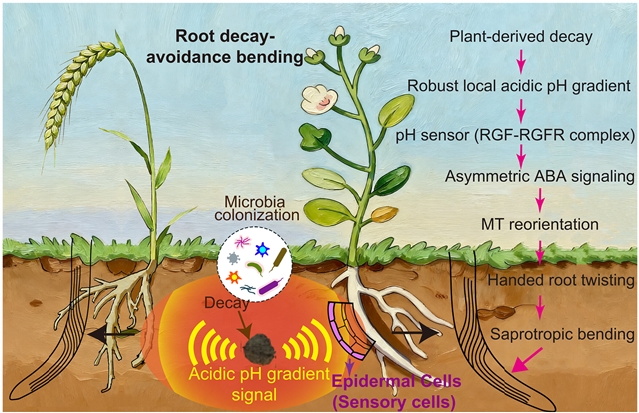
在这项工作中,研究人员确定了“腐性”,这是一种以前未被认识到的生长反应,使根主动弯曲,远离腐烂的植物源物质。真菌驱动的微生物分解释放出有机酸,并在周围土壤中形成稳定的pH梯度,使根在没有直接接触的情况下精确定位腐烂。根表皮细胞通过根分生组织生长因子肽受体模块感知这种酸性梯度,将外部pH的不对称转化为ABA分布的不对称。ABA不对称驱动微管重组,这被解码为避免腐烂的根弯曲。总之,这些发现建立了微生物腐烂产生的化学梯度作为根系导航的指导性信号,并扩展了微生物-土壤-植物交流的框架。
据介绍,植物的向性使根系能够通过响应定向环境线索来导航复杂的土壤。生物腐烂虽然是养分循环的核心,但也会产生微生物活跃和潜在的敌对生态位。
附:英文原文
Title: Roots navigate around decay regions by sensing local pH gradients
Author: Zhulatai Bao, Huihui Wang, Ai Zhang, Ruxi Gao, Wen Gu, Ni Fan, Jií Friml, Yuzhou Zhang
Issue&Volume: 2026-07-09
Abstract: Plant tropisms enable roots to navigate complex soils by responding to directional environmental cues. Biological decay, although central to nutrient cycling, also creates microbially active and potentially hostile niches. In this work, we identified “saprotropism,” a previously unrecognized growth response that enables roots to actively bend away from decaying plant-derived matter. Fungal-driven microbial decomposition released organic acids and formed stable pH gradients in surrounding soil, allowing roots to pinpoint decay without direct contact. Root epidermal cells sensed this acidic gradient through the root meristem growth factor peptide-receptor module, converting external pH asymmetry into asymmetric abscisic acid (ABA) distribution. ABA asymmetry drove microtubule reorganization, which was decoded into decay-avoidant root bending. Together, these findings establish microbial decay–derived chemical gradients as an instructive signal for root navigation and expand the framework of microbe-soil-plant communication.
DOI: adw6568
Source: https://www.science.org/doi/10.1126/science.adw6568