论文标题:Do the Core Concerns of Climate Adaptation Policies and Studies Align?—A Comparative Review of Policy Documents and the Literature
期刊:Landscape Architecture Frontiers
作者:Yunni ZHOU, Guilin PAN, Rui HE, Qianna WANG
发表时间:23 Mar 2026
DOI:10.15302/J-LAF-2026-0015
微信链接:点击此处阅读微信文章


注:本文为删减版,不可直接引用。原中英文全文刊发于《景观设计学(中英文)》(Landscape Architecture Frontiers)2026年第14卷第2期。
导 读
比较评述气候适应政策和研究成果的契合性,有助于认识并缩小二者差距,提升人居环境气候适应行动的成效。全面梳理了政策及研究的发展脉络,揭示二者互动的演进模式,从关注程度、适应对象、行动措施与适应尺度4个维度构建了契合性判断框架,评估了核心关切领域的契合性。结果表明,政策已进入全球协同的新阶段,研究重心则从理论过渡到应用。二者关系经历了研究先行、并行发展到双向互动的转变,但协同效率和深度仍需进一步提升。从核心关切领域来看,整体契合性较好,城市与建成环境、气候风险与灾害管理、水资源管理契合性最高,沿海地区与健康和福祉居中,生态系统与生物多样性偏低;对象和行动契合性良好,但尺度契合性不足,未来情景模拟与区域、社区尺度的研究仍显薄弱。
关键词
气候适应;气候变化;文献综述;政策体系;契合性
气候适应政策与研究的核心关切是否契合?
——政策文件与文献的比较评述
Do the Core Concerns of Climate Adaptation Policies and Studies Align?
—A Comparative Review of Policy Documents and the Literature
周韵妮,潘桂林,何瑞,王倩娜
四川大学建筑与环境学院
本文引用格式 / PLEASE CITE THIS ARTICLE AS
Zhou, Y., Pan, G., He, R. & Wang, Q. (2026). Do the core concerns of climate adaptation policies and studies align?—A comparative review of policy documents and the literature. Landscape Architecture Frontiers, 14(2), 260015. https://doi.org/10.15302/J-LAF-2026-0015
01
研究背景
近年来,全球在气候适应政策制定和理论研究上已取得显著进展。政策层面,从《坎昆协议》到《巴黎协定》,气候适应行动优先级提升并实现制度化。同时,城市与建成环境、气候风险与灾害管理等领域也取得了丰硕研究成果。当前,鲜有分析政策和研究二者在气候适应领域契合度的研究。学术研究一定程度受政策引导,二者的最终目标均指向服务于社会的实际需要。
02
研究框架与方法
气候适应:定义与特征
IPCC的气候评估报告将“气候适应”(climate adaptation)定义为:“在人类系统中,针对实际或预期的气候及其影响进行调整,以减轻危害或利用有利机会;在自然系统中,针对实际气候及其影响进行调整”,即强调主动调整以应对已存在或将要发生的气候变化或极端天气事件。
样本收集
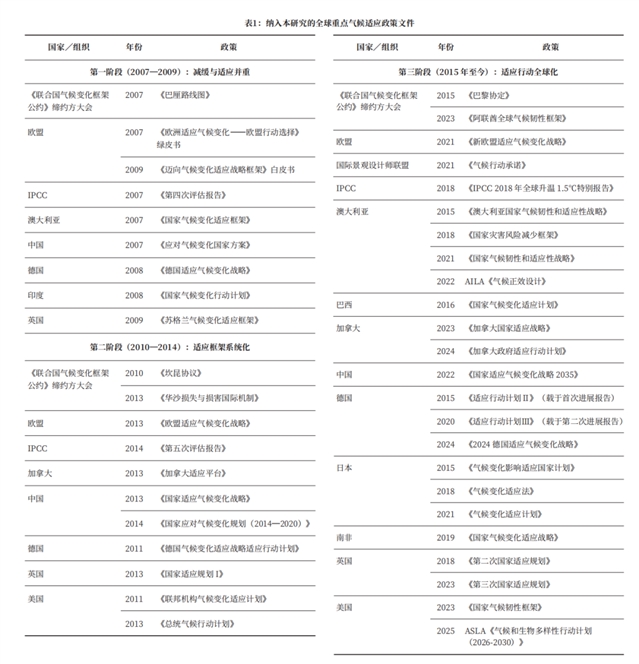
政策样本筛选方面重点关注政策文件中的气候适应相关内容是否符合政策框架的完整定义,即是否包含明确的目标、原则、计划和工具等要素。
文献样本收集方面,以Web of Science核心数据集与中国知网(北大核心、CSSCI和CSCD来源期刊)分别作为中英文文献检索源。以“气候适应”(climate adaptation)等为检索词,学科限定为区域研究(Area Studies)等。经去重处理和最终检查,共收集1967篇文献,英文文献1589篇,中文文献378篇。
在文献内容分析部分,首先基于CiteSpace.6.3.R3,对文献发文量和关键词频次进行统计,使用LLR算法进行关键词聚类和时间线分析,以此划分发展阶段并归纳核心关切领域。
契合性:定义、判断框架与审查指标
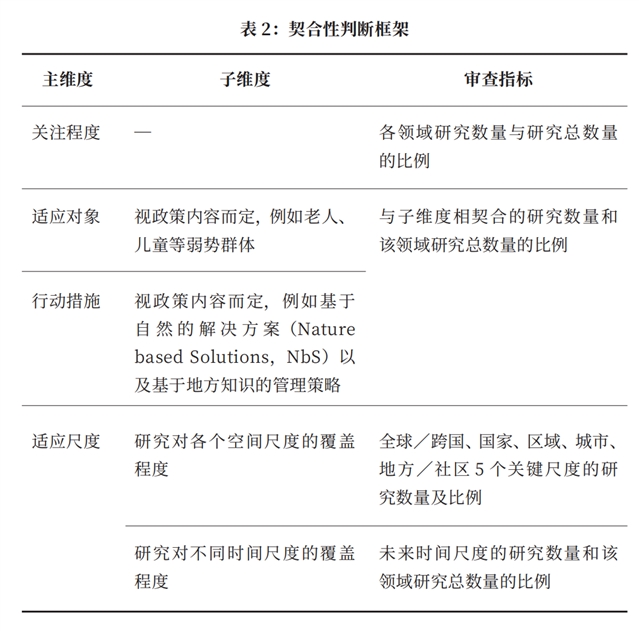
“契合性”(alignment)指两个相关要素或体系在目标与行动安排上相互支持、相互匹配的程度,即一方的使命、目标与计划在多大程度上支持并被另一方的使命、目标与计划所支持。契合性判定采用“子维度-主维度-综合契合性”的审视流程。
03
气候适应政策与研究:进程、核心关切领域
气候适应政策
进程
各政策阶段的发展特征整分析表明,总体而言,目前的气候适应政策呈现多领域覆盖、多层次协作、定期监测、动态调整、国际合作的特点。与发达国家的政策整体特征相比,中国等全球南方国家的适应政策体系在规划约束力和法律法规支持方面相对薄弱,支撑保障机制亦尚未形成制度化的落地路径。
核心关切领域
分析发现,各个领域的适应对象与行动措施具备一定共性特征。首先,生态导向趋势明显增强。越来越多的组织意识到适应不仅是短时应对,更是长期过程,以NbS为核心的无悔方案(no-regret measures)能够更有效地应对这种持续性需求。其次,气候适应与气候风险评价逐步融入空间规划体系,体现出向“主动预防”的转变。此外,政策的人本化导向愈发显著,更加关注热浪等气候风险对人类健康的影响。
气候适应研究
研究进程
英文气候适应研究在2010年首次呈现出主题多元化的发展趋势;至2016年,研究主题和发文量显著增加。据此,将英文气候适应的研究进程划分为3个阶段。近20年来,中文气候适应研究的发展轨迹也可大致划分为3个阶段:自2010年起,研究内容逐步多样化,2018年后研究主题进一步拓展,发文量显著增长。
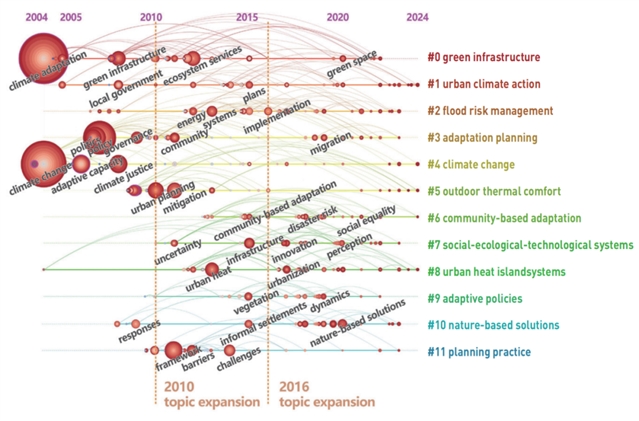
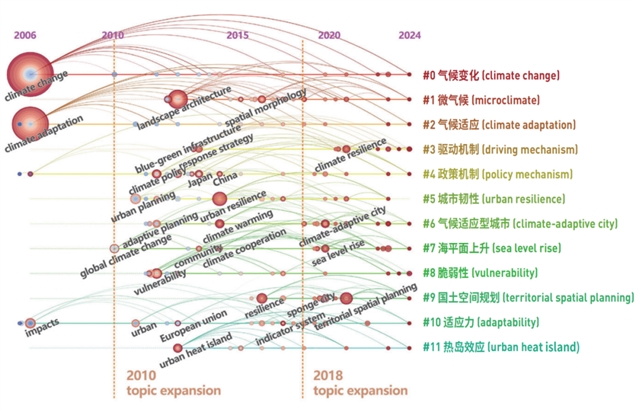
中英文气候适应研究发展时间线 © 周韵妮,潘桂林,何瑞,王倩娜
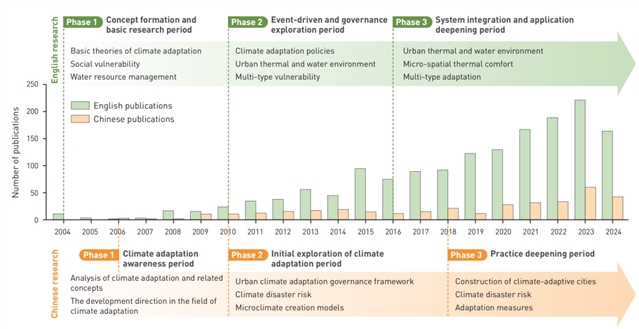
中英文气候适应研究发展阶段 © 周韵妮,潘桂林,何瑞,王倩娜
研究热点
由CiteSpace的高频关键词和聚类词条分析结果可知,全球气候适应研究在核心内容上呈现较高一致性,普遍关注政策与治理体系优化,如“adaptive policies”“政策机制”聚类,以及空间规划设计策略,如“green infrastructure”“国土空间规划”聚类。
整体而言,气候适应研究在对接政策与治理机制、纳入生态措施、嵌入空间规划与设计、回应人本需求,以及日益关注多系统耦合适应等方面不断拓展与深化,推动了气候适应行动的积极发展。
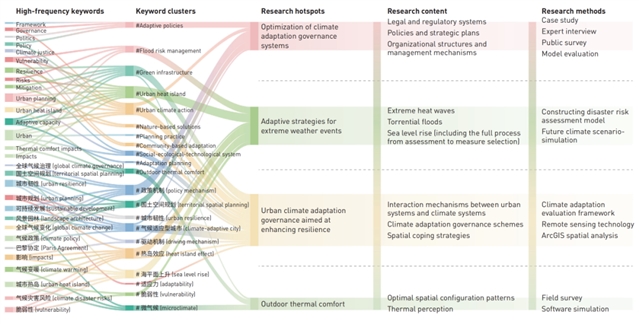
气候适应文献的高频关键词、聚类及研究热点 © 周韵妮,潘桂林,何瑞,王倩娜
04
政策与研究核心关切领域的契合性分析
政策与研究核心关切领域的时序分析
对比分析气候适应政策与研究的发展进程,有助于识别关键时间节点、梳理主题异同及互动模式,进而揭示二者的动态关联。时序对比表明,政策与研究的发展进程呈现出转折同步、主题趋同、互动模式变化等特征。
契合性分析
整体概况
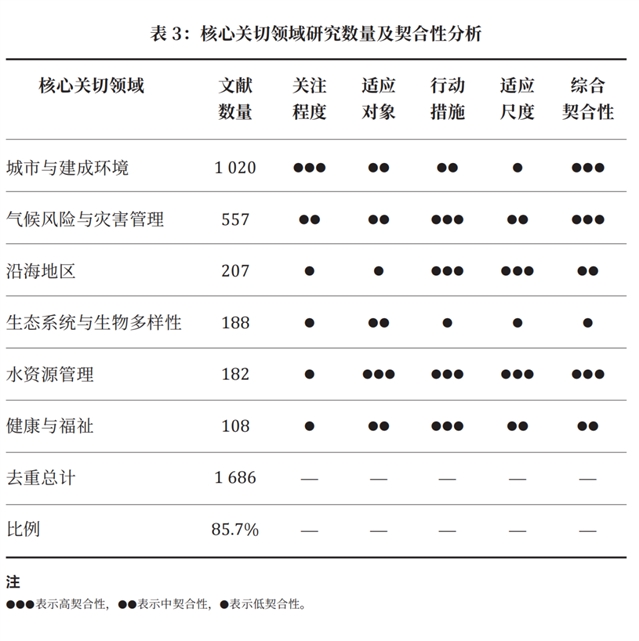
具体而言,适应对象契合性整体较好,行动措施契合性也普遍较高。空间尺度上,各领域均以城市为主,社区和区域次之,全球与国家最少。时间尺度上,对未来情景的模拟较少,反映现有研究对未来气候变化不确定性的应对能力有限。
高契合性领域
(1)城市与建成环境
整体上,该领域的适应对象契合性和行动措施契合性适中,但多集中于治理与制度层面,空间实践案例仍显薄弱。
(2)气候风险与灾害管理
该领域的整体契合性与各维度契合性均较好,但复合灾害风险应对和适应措施评估监测有待进一步探索。
(3)水资源管理
该领域的综合契合性良好,未来可在供水系统方面进一步提升适应对象契合性,加强景观规划与给排水等学科的融合,采用NbS以保障水质与极端天气下的供水安全。
中契合性领域
(1)沿海地区
与水资源管理相比,该领域更注重沿海居民和社会系统的适应性。未来应加强对沿海地区生态系统的探索,构建灰-蓝-绿耦合的防护体系。在空间尺度契合性上,主要集中于城市尺度,尤其是沿海发达城市,较少关注脆弱村庄和社区,有待补充。
(2)健康与福祉
该领域的关注度契合性较弱,文献数量很少。行动措施契合性方面,需进一步探索科学数据在疾病监测与防控预警中的应用。适应尺度契合性方面,宜关注小尺度以惠及个体。
低契合性领域
本研究只识别出生态系统与生物多样性这一个低契合性领域。相较而言,自然生态系统相关研究偏少,尤其是生物多样性研究相对不足。适应尺度契合性方面,关于自然生态系统未来变化趋势的预测与模拟亦不足,难以有效支撑政策对可持续适应的需求。
05
启示
总体而言,契合性分析结果揭示出现有研究格局呈现出研究重心失衡、时空尺度薄弱等特征,难以满足政策对全域覆盖、长期规划和可持续行动的需求。本文分别针对高、中、低不同契合性领域进行讨论,以为未来的适应工作提供反思与启发。
未来,应推动高契合性领域从“整体契合”转向“质量契合”:在适度转移研究资源攻克关键难题的同时,开发实用的决策模型、指标和政策工具,加强成果转化并验证其在经济与工程实践中的可行性。
由于多重因素的叠加影响,中、低契合性领域(沿海地区、健康与福祉和生态系统与生物多样性)存在整体契合性欠佳与子议题发展失衡的问题。首先,其具有的高度跨学科与多系统耦合特性显著提高了研究门槛与整合难度。其次,技术方法的可操作性与数据可获取性是关键瓶颈。最后,有限的研究资源往往优先流向即时可见的风险领域,而中低契合性领域多涉及生态退化、健康潜在威胁等长期隐性风险,导致关注不足与投入不均衡。
分析表明,政策与研究的契合性并非单纯的内容不匹配,而是受到内部与外部机制的共同影响。这意味着未来气候适应工作成效的关键在于从机制层面的根本性提升。强调动态互动与迭代优化的知识共同生产体系已被广泛验证有效,可成为气候适应领域弥合政策-研究差距的核心策略。
参考文献
[1] Horton, H. (2025, May 7). Drought conditions already hitting UK crop production, farmers say. The Guardian.
[2] IPCC. (1992). Climate change: The IPCC 1990 and 1992 assessments.
[3] Ministry of Ecology and Environment of the People’s Republic of China. (2022). National climate change adaptation strategy 2035.
[4] Robinson, W. A. (2021). Climate change and extreme weather: A review focusing on the continental United States. Journal of the Air & Waste Management Association, 71(10), 1186–1209.
[5] Yang, L., Chen, W., Wu, J., Sun, W., & Li, Y. (2020). Spatial planning adapting to climate change: Progress in the content and methodology. International Urban Planning, 35(4), 96–103.
[6] Ferdowsi, A., Piadeh, F., Behzadian, K., Mousavi, S.-F., & Ehteram, M. (2024). Urban water infrastructure: A critical review on climate change impacts and adaptation strategies. Urban Climate, 58, 102132.
[7] Ulibarri, N., Ajibade, I., Galappaththi, E. K., Joe, E. T., Lesnikowski, A., Mach, K. J., Musah-Surugu, J. I., Nagle Alverio, G., Segnon, A. C., Siders, A. R., Sotnik, G., Campbell, D., Chalastani, V. I., Jagannathan, K., Khavhagali, V., Reckien, D., Shang, Y., Singh, C., Zommers, Z., & The Global Adaptation Mapping Initiative Team. (2022). A global assessment of policy tools to support climate adaptation. Climate Policy, 22(1), 77–96.
[8] Li, C., & Chen, Z. (2023). Does academic literature interact with policy texts?—A panel VAR analysis of energy-water nexus based on specific academic terms. Studies in Science of Science, 41(7), 1173–1185.
[9] Wu, B., & Teng, L. (2021). Social sciences research indirectly affects policy changes: An analysis based on policy literature and genealogy. Journal of Jishou University (Social Sciences), 42(2), 35–46.
[10] Tambe, S., Ballal, A., Tomar, R., Wyborn, C., DeFries, R., Ganguly, S., & Scarlett, L. (2023). Bridging science, policy and practice for sustainability: Towards a conceptual framework. Environmental Science & Policy, 145, 208–216.
[11] IPCC. (2023). IPCC sixth assessment report (AR6): The physical science basis.
[12] Lakhno, M. (2023). What is a policy framework? An attempt at conceptualization. Sociální Studia/Social Studies, 20(1), 89–111.
[13] IPCC. (2007, April 6). AR4 climate change 2007: Impacts, adaptation, and vulnerability.
[14] UNFCCC. (n.d.). Bali Road Map intro.
[15] Chen, M. (2019). Progress and outlook of adaptation negotiation under the United Nations Framework Convention on Climate Change. Climate Change Research, 16(1), 105–116.
[16] Jiang, X., Zhou, Z., Lin, Z., Dai, X., & Tan, L. (2021). International cooperation on adaptation in post-Paris times: Thoughts and prospects. Climate Change Research, 17(4), 484–495.
[17] Reich, B. H., & Benbasat, I. (1996). Measuring the linkage between business and information technology objectives. MIS Quarterly, 20(1), 55–81.
[18] Conrad, E., Christie, M., & Fazey, I. (2011). Is research keeping up with changes in landscape policy? A review of the literature. Journal of Environmental Management, 92(9), 2097–2108.
[19] Chen, X., Li, N., Jia, J., & Zhang, M. (2020). Key fields and technology needs for climate change adaptation. China Population, Resources and Environment, 30(8), 13–20.
[20] Zhou, J., Bai, Y., Su, Y., & Wang, C. (2023). Country comparison of governance models for addressing climate change. Chinese Journal of Environmental Management, 15(4), 10–17.
[21] Noble, I. R., Huq, S., Anokhin, Y. A., Carmin, J., Goudou, D., Lansigan, F. P., Osman-Elasha, B., & Villamizar, A. (2014). Adaptation Needs and Options. In: C. B. Field, V. R. Barros, & Intergovernmental Panel on Climate Change. Impact Working Group (Eds.), Climate Change 2014: Impacts, Adaptation, and Vulnerability (pp. 833–868). Cambridge University Press.
[22] Gan, J., Ling, Y., Qian, L., & Fu, Q. (2024). Characteristics and implications of spatial governance tools for climate adaptation in Germany. Urban Planning International, 41(1), 100–110.
[23] Farinós-Dasí, J., Pinazo-Dallenbach, P., Peiró Sánchez-Manjavacas, E., & Rodríguez-Bernal, D. C. (2025). Disaster risk management, climate change adaptation and the role of spatial and urban planning: Evidence from European case studies. Natural Hazards, 121(19), 23479–23512.
[24] Gutin, O., & Ingargiola, B. (2015). Timeline of progress made in President Obama’s Climate Action Plan. Environmental and Energy Study Institute.
[25] Government of Canada. (2023). Canada’s national adaptation strategy: Building resilient communities and a strong economy.
[26] Fall, S., Niyogi, D., Gluhovsky, A., Pielke Sr., R. A., Kalnay, E., & Rochon, G. (2010). Impacts of land use land cover on temperature trends over the continental United States: Assessment using the North American Regional Reanalysis. International Journal of Climatology, 30(13), 1980–1993.
[27] Ma, W., Guo, L., Wang, H., & Chen, B. (2023). Concept and assessment of climate resilience in community ecosystem. Ecological Economy, 39(3), 177–183.
[28] Pei, X., Wu, J., Xue, J., Zhao, J., Liu, C., & Tian, Y. (2022). Assessment on cities’ adaptation to climate change in China. Urban Development Studies, 29(3), 39–46.
[29] Afriyanie, D., Julian, M. M., Riqqi, A., Akbar, R., Suroso, D. S. A., & Kustiwan, I. (2020). Re-framing urban green spaces planning for flood protection through socio-ecological resilience in Bandung City, Indonesia. Cities, 101, 102710.
[30] Chen, Q., Zhai, G., & Shi, Y. (2022). The impacts of sea level rise on coastal cities and measures from the perspective of resilience city: A case study of Xiamen. Modern Urban Research, (2), 106–116.
[31] Yang, L., Yang, H., Fan, Q., Zhao, G., & Yu, B. (2023). Vulnerability assessment and planning response to high-temperature wave in large cities: The case of Chengdu. Planners, 39(2), 38–45.
[32] Chen, K., & Tang, Y. (2019). Identification of urban areas vulnerable to heat waves and coping strategies: A case study of Beijing central city. City Planning Review, 43(12), 37–44.
[33] Sodoudi, S., Zhang, H., Chi, X., Müller, F., & Li, H. (2018). The influence of spatial configuration of green areas on microclimate and thermal comfort. Urban Forestry & Urban Greening, 34, 85–96.
[34] Xiong, Y., Zhang, J., & Yan, Y. (2020). Research on the landscape elements of Lingering Garden based on climate adaptability. Journal of Nanjing Forestry University (Natural Sciences Edition), 44(1), 145–153.
[35] Li, X., Ma, Y., Cui, H., & Zhang, X. (2021). Research on climate adaptation of Bayu traditional settlements. Urban Development Studies, 28(5), 12–17.
[36] Pour, S. H., Wahab, A. K. A., Shahid, S., Asaduzzaman, M., & Dewan, A. (2020). Low impact development techniques to mitigate the impacts of climate-change-induced urban floods: Current trends, issues and challenges. Sustainable Cities and Society, 62, 102373.
[37] La Rosa, D., & Pappalardo, V. (2020). Planning for spatial equity—A performance based approach for sustainable urban drainage systems. Sustainable Cities and Society, 53, 101885.
[38] Veraart, J. A., van Ierland, E. C., Werners, S. E., Verhagen, A., de Groot, R. S., Kuikman, P. J., & Kabat, P. (2010). Climate change impacts on water management and adaptation strategies in the Netherlands: Stakeholder and scientific expert judgements. Journal of Environmental Policy & Planning, 12(2), 179–200.
[39] Chelleri, L., Schuetze, T., & Salvati, L. (2015). Integrating resilience with urban sustainability in neglected neighborhoods: Challenges and opportunities of transitioning to decentralized water management in Mexico City. Habitat International, 48, 122–130.
[40] Xia, J., Peng, S., Wang, C., Hong, S., Chen, J., & Luo, X. (2014). Impact of climate change on water resources and adaptive management in the Yellow River Basin. Yellow River, 36(10), 1–4.
[41] Gerlak, A. K., & Schmeier, S. (2014). Climate change and transboundary waters: A study of discourse in the Mekong River Commission. The Journal of Environment & Development, 23(3), 358–386.
[42] Han, Y., Ye, X., Atoba, K., Mozumder, P., Chen, C., van den Bout, B., & van Westen, C. (2024). Retreat from flood zones: Simulating land use changes in response to compound flood risk in coastal communities. Cities, 149, 104953.
[43] Haasnoot, M., Kwakkel, J. H., Walker, W. E., & ter Maat, J. (2013). Dynamic adaptive policy pathways: A method for crafting robust decisions for a deeply uncertain world. Global Environmental Change, 23(2), 485–498.
[44] van der Voorn, T., Pahl-Wostl, C., & Quist, J. (2012). Combining backcasting and adaptive management for climate adaptation in coastal regions: A methodology and a South African case study. Futures, 44(4), 346–364.
[45] Ellen, I. G., Yager, J., Hanson, M., & Bosher, L. (2016). Planning for an uncertain future: Can multi-criteria analysis support better decision-making in climate planning?. Journal of Planning Education and Research, 36(3), 349–362.
[46] Glaas, E., Ballantyne, A. G., Neset, T.-S., & Linnér, B.-O. (2017). Visualization for supporting individual climate change adaptation planning: Assessment of a web-based tool. Landscape and Urban Planning, 158, 1–11.
[47] Dong, J., Peng, J., He, X., Corcoran, J., Qiu, S., & Wang, X. (2020). Heatwave-induced human health risk assessment in megacities based on heat stress-social vulnerability-human exposure framework. Landscape and Urban Planning, 203, 103907.
[48] Matthew, R., Chiotha, S., Orbinski, J., & Talukder, B. (2022). Research note: Climate change, peri-urban space and emerging infectious disease. Landscape and Urban Planning, 218, 104298.
[49] American Society of Landscape Architecture. (n.d.). Climate & biodiversity action plan (2026-2030).
[50] Government of Canada. (2024). Canada’s 2030 nature strategy: Halting and reversing biodiversity loss in Canada.
[51] Esraz-Ul-Zannat, M., Dedekorkut-Howes, A., & Morgan, E. A. (2024). A review of nature-based infrastructures and their effectiveness for urban flood risk mitigation. WIREs Climate Change, 15(5), e889.
[52] Fan, W., & Luo, Y. (2025). Conservation methods for Trollius mountain flowers in Xinjiang, China under climate change: Habitat networks construction based on habitat suitability and protected areas optimization response. Journal of Environmental Management, 376, 124519.
[53] McGuire, J. L., Lawler, J. J., McRae, B. H., Nuñez, T. A., & Theobald, D. M. (2016). Achieving climate connectivity in a fragmented landscape. Proceedings of the National Academy of Sciences, 113(26), 7195–7200.
[54] Arroyave, F. J., Jenkins, J., Shackelton, S., Jackson, B., & Petersen, A. M. (2024). Research alignment in the U.S. national park system: Impact of transformative science policy on the supply and demand for scientific knowledge for protected area management. Journal of Environmental Management, 357, 120699.
[55] Kourtit, K., & Nijkamp, P. (2016). Towards a regional science academy: A manifesto. REGION, 3(1), R1–R16.
[56] Dalton, A., Wolff, K., & Bekker, B. (2022). Interdisciplinary research as a complicated system. International Journal of Qualitative Methods, 21(6), 1–13.
[57] Anom, B. Y. (2020). Ethics of big data and artificial intelligence in medicine. Ethics, Medicine and Public Health, 15, 100568.
[58] Caughlan, L., & Oakley, K. L. (2001). Cost considerations for long-term ecological monitoring. Ecological Indicators, 1(2), 123–134.
[59] Grant, K., White, J., Martin, J., & Haines, T. (2019). The costs of risk and fear: A qualitative study of risk conceptualisations in allied health resource allocation decision-making. Health, Risk & Society, 21(7–8), 373–389.
[60] UNFCCC. (2022, November 3). Fourth review of the Adaptation Fund.
[61] Howarth, C., Lane, M., Morse-Jones, S., Brooks, K., & Viner, D. (2022). The ‘co’ in co-production of climate action: Challenging boundaries within and between science, policy and practice. Global Environmental Change, 72, 102445.
[62] Halliday, A., Fountain, J., Wreford, A., & Cradock-Henry, N. A. (2025). Four propositions to narrow the gap between science and policy for climate change adaptation: Insights and evidence from Aotearoa New Zealand. Environmental Science & Policy, 173, 104239.
[63] Wang, Z., Tan, P. Y., Zhang, T., & Nassauer, J. I. (2014). Perspectives on narrowing the action gap between landscape science and metropolitan governance: Practice in the US and China. Landscape and Urban Planning, 125, 329–334.
特别声明:本文转载仅仅是出于传播信息的需要,并不意味着代表本网站观点或证实其内容的真实性;如其他媒体、网站或个人从本网站转载使用,须保留本网站注明的“来源”,并自负版权等法律责任;作者如果不希望被转载或者联系转载稿费等事宜,请与我们接洽。