
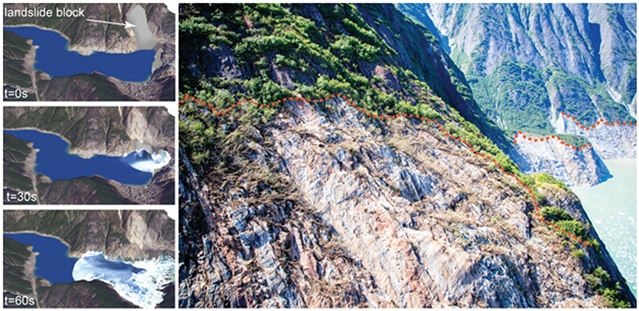
近日,加拿大卡尔加里大学Dan H. Shugar团队报道了游轮频繁往来的阿拉斯加峡湾中一场481米高的滑坡海啸。该研究于2026年6月11日发表在《科学》杂志上。
2025年8月10日凌晨,一场体积超过6400万立方米的滑坡袭击了阿拉斯加的特蕾西·阿姆峡湾。 该滑坡由气候变化导致的冰川退缩所促成。随后产生了高达481米的涌浪式巨海啸,初始阶段有一道100米高的碎浪以超过70米/秒的速度传播。滑坡发生前数日即出现微震活动,其发生率和震级在失稳前约1小时持续增加。该滑坡产生了全球可观测到的长周期地震波,其规模相当于矩震级5.4级的地震。
由滑坡引起并在峡湾内受限捕获的一个长周期(约66秒)全球地震信号持续了长达36小时,这是第二次观测到持续数日的这种湖震/峡湾震荡现象。随着峡湾地区游轮访问日益频繁,而气候变化使类似事件更易发生,这一险些酿成灾难的意外事件凸显了沿海环境中滑坡和海啸所带来的日益增长的风险。
附:英文原文
Title: A 481-meter-high landslide-tsunami in a cruise ship–frequented Alaska fjord
Author: Dan H. Shugar, Katherine R. Barnhart, Mira Berdahl, Jacqueline Caplan-Auerbach, Gran Ekstrm, Aram Fathian, Marten Geertsema, Stephen P. Hicks, Bretwood Higman, Erin K. Jensen, Ezgi Karaszen, Patrick Lynett, John Lyons, Thomas Monahan, Gerard Roe, Kristian Svennevig, Liam Toney, Maximillian Van Wyk de Vries, Michael E. West
Issue&Volume: 2026-06-11
Abstract: Early in the morning of 10 August 2025, a >64 × 106–cubic meter landslide struck Tracy Arm fjord in Alaska. The landslide was preconditioned by glacial retreat caused by climate change. The resulting 481-meter runup megatsunami followed an initial 100-meter-high breaking wave traveling at >70 meters per second. The landslide was preceded by several days of microseismicity, which increased in rate and magnitude until ~1 hour before failure. The landslide produced globally observed long-period seismic waves equivalent in size to a moment magnitude 5.4 earthquake. A long-period (~66 second) global seismic signal, produced by a landslide-induced seiche trapped within the fjord, persisted for up to 36 hours, the second time a days-long seiche had thus been observed. With fjord regions increasingly visited by cruise ships, and climate change making similar events more likely, this unanticipated, near-miss event highlights the growing risk from landslides and tsunamis in coastal environments.
DOI: aec3187
Source: https://www.science.org/doi/10.1126/science.aec3187