
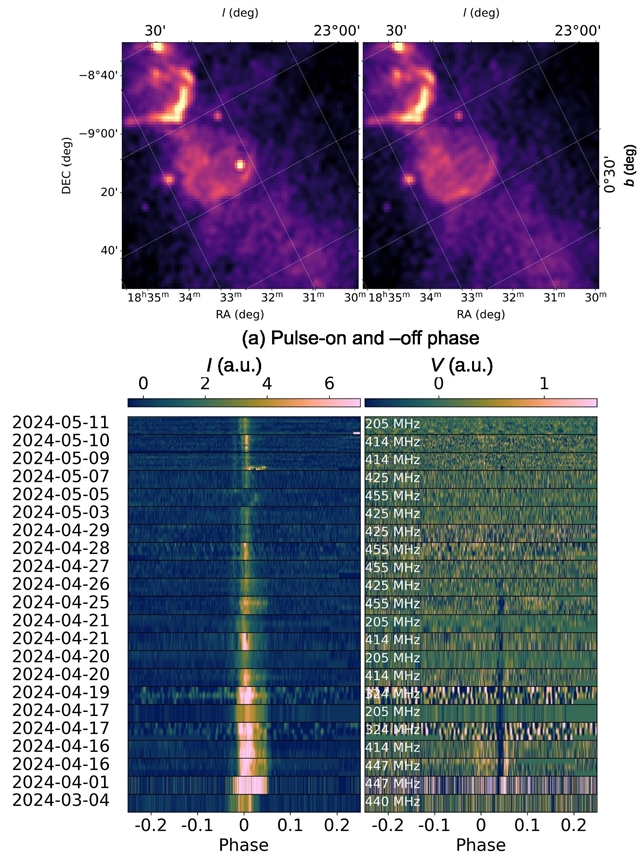
近日,中国科学院国家空间科学中心阎敬业团队报道了超新星遗迹中44分钟的周期性无线电瞬变。这一研究成果发表在2026年6月10日出版的《科学通报》杂志上。
长周期射电暂现源(LPT) 是一类新发现的射电辐射体,其周期范围从数分钟到数小时。其天体物理本质尚未确定,尤其是那些没有可探测到伴星的LPT。
研究组首次报告了一个LPT(DART J1832-0911,周期为 2656.23±0.15 秒)与一个可能的超新星遗迹(SNR)之间存在关联的证据,这支持了此类天体具有中子星起源的观点。该LPT的色散度量、SNR 的一氧化碳(CO)发射和中性氢(H I)吸收,以及与已知脉冲星方向偶然重合的低概率,均与这一关联相符。
该源表现出锁相圆偏振或接近100%的线偏振,表明其磁场强且几何结构稳定。即使使用10米级望远镜也未发现可探测的光学对应体。该SNR关联以及稳定的偏振特性表明,DART J1832-0911极有可能源自一颗年轻的中子星,其自转可能受到超新星回落物质的制动。这一发现为理解超长周期暂现源的本质及其与恒星遗迹之间的联系提供了关键见解。
附:英文原文
Title: A 44-minute periodic radio transient in a supernova remnant
Author: anonymous
Issue&Volume: 2026/06/10
Abstract: Long-period radio transients (LPTs) are a newly discovered class of radio emitters with periods ranging from minutes to hours. The astrophysical nature remains undetermined, particularly of LPTs with no detectable companions. We report the first evidence for a plausible supernova remnant (SNR) association with an LPT (DART J1832-0911, 2656.23±0.15 s period), which supports a neutron star origin of such objects. The dispersion measure of this LPT, SNR’s CO emission and neutral hydrogen (H I) absorption, and low probability of chance of alignment with field pulsars are all consistent with such an association. The source displays either phase-locked circular or nearly 100% linear polarization, indicating its strong and geometrically stable magnetic field. No detectable optical counterpart was found, even with a 10m-class telescope. The SNR association and the stable polarization suggest that DART J1832-0911 most likely originates from a young neutron star, whose spin could have been braked by supernova’s fallback materials. This discovery provides critical insights into the nature of ultra-long period transients and their link to stellar remnants.
DOI: 10.1016/j.scib.2026.06.015
Source: https://www.sciencedirect.com/science/article/pii/S2095927326006225
Science Bulletin:《科学通报》,创刊于1950年。隶属于SciEngine出版平台,最新IF:18.9
官方网址:https://www.sciengine.com/SB/home
投稿链接:https://mc03.manuscriptcentral.com/csb