
近日,德国波鸿鲁尔大学Sebastian Kruss团队研究了碳纳米管在水中的光致量子摩擦。该项研究成果发表在2026年6月10日出版的《自然》杂志上。
摩擦在宏观和微观尺度上都会减慢运动物体的速度。 在电子层面,量子摩擦描述的是液体与固体电子之间直接的动量传递。由于该现象具有微观本质,实验上仍难以捕捉。
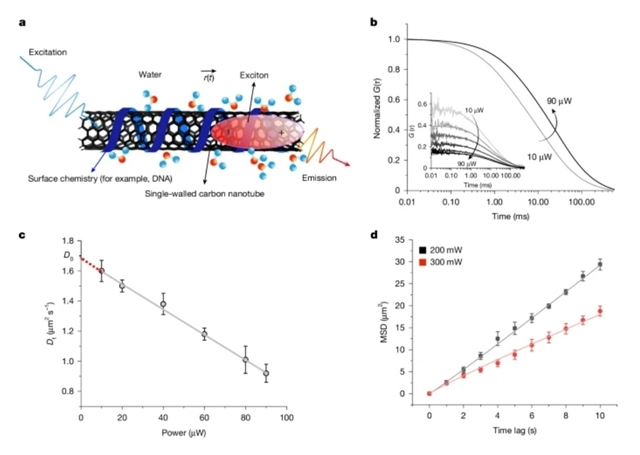
研究组展示了近红外荧光单壁碳纳米管(SWCNT)在水中表现出光诱导的量子摩擦。通过观察功能化SWCNT在水溶液中的扩散常数随激发功率增加而线性下降约50%这一现象,对此进行了测量。当激子被局域化时(例如带有量子缺陷的SWCNT),该效应消失。研究组进一步表明,通过分子化学调控激子浓度(增强或减弱SWCNT荧光)可以改变扩散常数,变化幅度可达2倍。光学泵浦-太赫兹探测光谱显示存在一个瞬时响应(约 30 cm-1),研究组将其归因于激子与水在水的德拜模式范围内的直接耦合。
随后,在水的氢键网络分子间平移模式范围(>100 cm-1)内出现一个增加(>100 ps)的响应,类似于热效应。经典分子动力学模拟进一步支持了以下机制:激子的波动偶极矩产生摩擦力。这些发现确立了 SWCNT中激子与水之间存在光诱导量子摩擦,并表明电子激发可用于控制纳米尺度运动和流体性质。
附:英文原文
Title: Light-induced quantum friction of carbon nanotubes in water
Author: Kistwal, Tanuja, Kanhaiya, Krishan, Buchmann, Adrian, Ma, Chen, Nikoli, Jana, Ackermann, Julia, Galonska, Phillip, Nalige, Sanjana S., Sardari, Vahideh, Sudarsan, Aishwarya, Havenith, Martina, Sulpizi, Marialore, Kruss, Sebastian
Issue&Volume: 2026-06-10
Abstract: Friction slows down moving objects at both macroscopic and microscopic scales1. At the electronic level, quantum friction describes direct transfer of momentum between a liquid and the electrons of a solid2. Owing to its microscopic nature, this phenomenon remains experimentally challenging to capture3. Here we show that near-infrared fluorescent single-walled carbon nanotubes (SWCNTs) exhibit light-induced quantum friction in water. It is measured by observing an excitation-power-dependent linear decrease of around 50% in the diffusion constants of functionalized SWCNTs in aqueous solution. This effect disappears when excitons are localized, as in the case of SWCNTs with quantum defects. We further show that the chemical manipulation of exciton concentration by molecules that increase or decrease SWCNT fluorescence also modulates the diffusion constant by up to a factor of 2. Optical pump terahertz (THz) probe spectroscopy shows an instantaneous response (around 30cm1) that we assign to direct exciton–water coupling in the range of water Debye modes. It is followed by an increasing (>100ps) response in the range of intermolecular translational modes of the hydrogen bond network of water (>100cm1), resembling heating. Classical molecular dynamics simulations further support a mechanism in which the fluctuating dipole moments of excitons create frictional forces. These findings establish light-induced quantum friction between excitons in SWCNTs and water and show that electronic excitations can be used to control nanoscale motion and fluid properties.
DOI: 10.1038/s41586-026-10632-2
Source: https://www.nature.com/articles/s41586-026-10632-2
Nature:《自然》,创刊于1869年。隶属于施普林格·自然出版集团,最新IF:69.504
官方网址:http://www.nature.com/
投稿链接:http://www.nature.com/authors/submit_manuscript.html