
近日,美国华盛顿大学教授Garret D. Stuber及其课题组探明了前额到腹侧被盖区动态驱动偶然性退化。这一研究成果于2026年5月6日发表在国际顶尖学术期刊《自然》上。
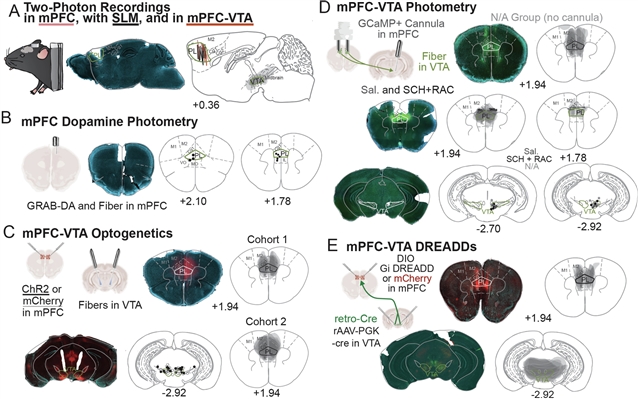
该团队开发了一个认知灵活性的定量模型,该模型将元学习参数纳入已建立的奖励预测误差学习模型。他们的元奖励预测误差模型显著提高了小鼠线索诱发的舔舐行为在线索奖励关联减弱或增强时的准确表征。利用纵向双光子钙成像和单细胞全息光遗传学,研究团队发现mPFC中的一个神经元子集以一种显著的和诱导的方式特异性地编码偶然性降解。
认识到行为灵活性可能需要mPFC和典型奖励学习回路之间的相互作用,小组随后研究了mPFC神经信号在偶发退化过程中如何与腹侧被盖区(VTA)相互作用,VTA是奖励处理的关键枢纽。他们的成像和光遗传学数据表明,mPFC将该信号发送到VTA,大多数mPFC→VTA神经元反映了这种传递,并且这些集合的选择性光遗传学刺激加速了偶然性降解。这些发现揭示了前额回路如何促进灵活性,通过与皮层下奖励网络的连接,选择性地停止学习行为。
据介绍,认知灵活性是指随着环境变化而调整学习行为的适应性神经过程,支持最佳决策和行为控制。这包括当提示和奖励之间的偶然性降低时修改特定行为的能力。在物种中,内侧前额叶皮层(mPFC)在控制偶然性退化中起着明确的作用;然而,这种认知过程背后的精确神经回路机制尚不清楚。
附:英文原文
Title: Prefrontal to ventral tegmental area dynamics drive contingency degradation
Author: Hjort, Madelyn M., Garrett, Zoe Q., Gordon, Adam G., Ancell, Ethan, Trzeciak, Marta, Lu, Pei-Yun, Bruchas, Michael R., Witten, Daniela M., Steinmetz, Nicholas A., Stuber, Garret D.
Issue&Volume: 2026-05-06
Abstract: Cognitive flexibility refers to the adaptive neural processes that adjust learned behaviours as circumstances shift, supporting optimal decision-making and behavioural control. This includes the capacity to modify specific behaviours as the contingency between cues and rewards degrades. Across species1,2,3,4, the medial prefrontal cortex (mPFC) has a well-established role in controlling contingency degradation5; however, the precise neural circuit mechanisms underlying this cognitive process remain unclear. To address this gap, we developed a quantitative model of cognitive flexibility that incorporates a meta-learning parameter into an established reward prediction error learning model6,7. Our meta-reward prediction error model significantly improves accurate representation of mouse cue-evoked licking behaviour in response to degraded or enhanced cue–reward associations. Using longitudinal two-photon calcium imaging and single-cell holographic optogenetics, we found that a subset of neurons in the mPFC specifically encode the contingency degradation in a significant and causal manner. Recognizing that behavioural flexibility probably requires interactions between the mPFC and canonical reward learning circuitry, we then examined how mPFC neural signalling during contingency degradation interacts with the ventral tegmental area (VTA)—a critical hub for reward processing8. Our imaging and optogenetics data show that mPFC sends this signal to VTA, with most mPFC→VTA neurons reflecting this transmission, and that selective optogenetic stimulation of these ensembles accelerates contingency degradation. These findings reveal how prefrontal circuits facilitate flexibility, selectively halting learned behaviours through connections with subcortical reward networks.
DOI: 10.1038/s41586-026-10443-5
Source: https://www.nature.com/articles/s41586-026-10443-5
Nature:《自然》,创刊于1869年。隶属于施普林格·自然出版集团,最新IF:69.504
官方网址:http://www.nature.com/
投稿链接:http://www.nature.com/authors/submit_manuscript.html