
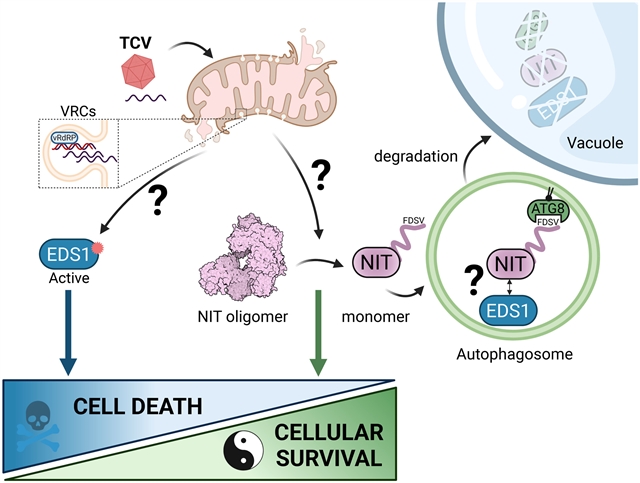
研究小组发现拟南芥激活选择性自噬,以响应针对线粒体、叶绿体和内质网的病毒主题。而不是降解病毒成分,自噬选择性地去除免疫调节剂增强疾病敏感性1 (EDS1),以防止细胞死亡。这种靶向机制是由寡聚代谢酶介导的,寡聚代谢酶作为选择性自噬受体,将细胞器应激与免疫稳态联系起来。他们的发现确立了选择性自噬作为一种重要的免疫变阻器,在病毒感染期间微调防御反应和保护细胞完整性以促进宿主生存。
据介绍,RNA病毒主题可以通过宿主膜形成复制复合体,从而引发细胞应激和免疫反应。
附:英文原文
Title: Selective autophagy fine-tunes plant immunity to promote cell survival during viral infection
Author: Marion Clavel, Anita Bianchi, Roksolana Kobylinska, Roan Groh, Xi Zhang, Juncai Ma, Ranjith K. Papareddy, Nenad Grujic, Lorenzo Picchianti, Ethan Stewart, Michael Schutzbier, Karel Stejskal, Juan Carlos de la Concepcion, Victor Sanchez de Medina Hernandez, Yoav Voichek, Pieter Clauw, Joanna Gunis, Gerhard Durnberger, Jens Christian Muelders, Annett Grimm, Arthur Sedivy, Mathieu Erhardt, Victoria Vyboishchikov, Peng Gao, Esther Lechner, Emilie Vantard, Thomas Potuschak, Jakub Jez, Elisabeth Roitinger, Pascal Genschik, Byung-Ho Kang, Yasin Dagdas
Issue&Volume: 2026-05-28
Abstract: RNA viruses co-opt host endomembranes to form replication complexes, often triggering cellular stress and immune responses. Here, we show that Arabidopsis thaliana activates selective autophagy to respond to viruses targeting mitochondria, chloroplasts, and the endoplasmic reticulum. Rather than degrading viral components, autophagy selectively removes the immune regulator Enhanced Disease Susceptibility 1 (EDS1) to prevent cell death. This targeted mechanism is mediated by oligomeric metabolic enzymes that moonlight as selective autophagy receptors, linking organelle stress to immune homeostasis. Our findings establish selective autophagy as an essential immune rheostat that fine-tunes defense responses and safeguards cellular integrity to promote host survival during viral infections.
DOI: adu9554
Source: https://www.science.org/doi/10.1126/science.adu9554