
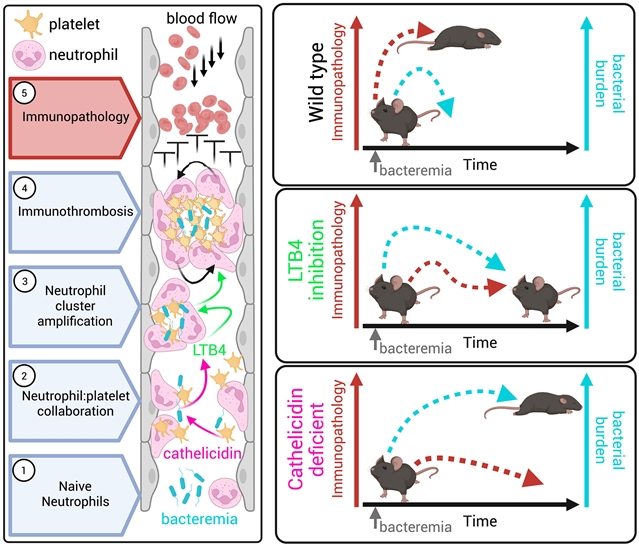
小鼠败血症期间肺中性粒细胞-血小板免疫血栓级联的可视化,这一成果由加拿大卡尔加里大学
小组在大肠杆菌-脓毒杆菌小鼠的肺微循环中定义了中性粒细胞和血小板的免疫血栓级联。抗菌肽Cathelicidin通过甲酰基肽受体将中性粒细胞定位到大肠杆菌并引发免疫血栓。免疫血栓捕获细菌和抗菌肽使血小板具有抗菌活性。阻断抗菌肽可预防免疫血栓形成和减轻早期败血症死亡,但导致感染不受控制的延迟死亡。白三烯B4是一种重要的中性粒细胞与中性粒细胞之间的通讯分子,可放大免疫血栓,抑制免疫血栓可改善血管妥协,同时保持宿主防御,它们是脓毒症疾病进展的一个离散转折点。因此,在脓毒症期间,靶向免疫血栓级联可以在不抑制宿主防御的情况下减轻免疫病理。
据介绍,败血症是一种免疫悖论,宿主防御是生存所必需的,但也会导致器官损伤和死亡。
附:英文原文
Title: Visualizing a lung neutrophil-platelet immunothrombosis cascade during sepsis in mice
Author: Luke Brown, Jared Schlechte, Mahum Rashid, Yuefei Lou, Angela P. Nguyen, Mortaza F. Hassanabad, Carlos H. Hiroki, Eduardo Cobo, Morley D. Hollenberg, Braeden McDonald, Bryan G. Yipp
Issue&Volume: 2026-05-28
Abstract: Sepsis is an immune paradox in which host defense is necessary for survival but also contributes to organ damage and death. We defined an immunothrombosis cascade of neutrophil and platelets in the lung microcirculation of Escherichia coli–septic mice. Cathelicidin, an antimicrobial peptide, localized neutrophils to E. coli and initiated immunothrombi through formyl-peptide receptors. Immunothrombi captured bacteria, and cathelicidin enabled antimicrobial activities in platelets. Blocking cathelicidin prevented immunothrombosis and attenuated early sepsis death but resulted in delayed death with uncontrolled infection. Leukotriene B4, an important neutrophil-to-neutrophil communication molecule, amplified immunothrombi, and inhibiting it improved vascular compromise while preserving host defense, thus representing a discrete inflection point of sepsis disease progression. Therefore, targeting the immunothrombi cascade can mitigate immunopathology without suppressing host defense during sepsis.
DOI: adv0377
Source: https://www.science.org/doi/10.1126/science.adv0377