
德国慕尼黑亥姆霍兹研究所Ali Ertürk小组的一项最新研究发现深度学习框架揭示了细胞水平的全身扰动。相关论文于2026年5月20日发表在《自然》杂志上。
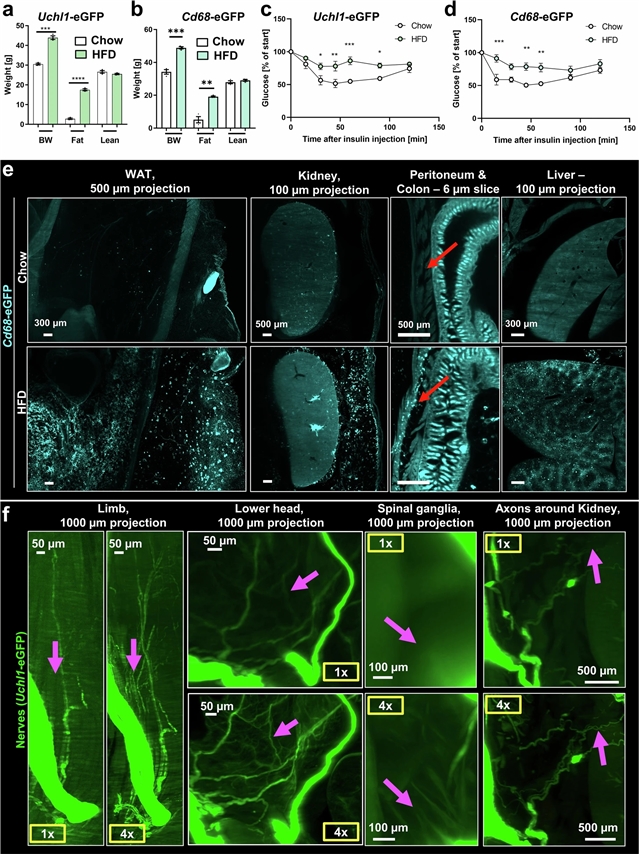
在这里,研究小组开发了MouseMapper,这是一套基于基础模型的深度学习算法,可以对整个母体的疾病进行多系统分析。MouseMapper能够对神经和免疫细胞进行全身定量分析,解析精细的轴突分支和免疫细胞细胞,同时自动分割31个器官和组织。课题组研究人员以MouseMapper为主题研究饮食性肥胖,并确定了三叉神经节眶下分支的结构改变。眶下神经的这种结构损伤与须感测的功能性感觉缺陷有关。
此外,该课题组在小鼠和人类中发现了影响轴突重塑和补体通路的三叉神经节蛋白质组学变化。MouseMapper还通过表征组织中免疫细胞的组成来生成详细的三维炎症图。MouseMapper框架展示了不同成像分辨率和数据集的通用性。他们的研究为识别和量化系统性病理提供了一种强大的、可扩展的方法,将动物模型的分子见解与人类条件联系起来。
研究人员表示,许多疾病,包括肥胖,具有全身影响,扰乱全身多个器官系统。然而,在全身范围内对疾病相关变化进行全面、高分辨率分析的工具一直缺乏。
附:英文原文
Title: A deep-learning framework reveals whole-body perturbations at cell level
Author: Kaltenecker, Doris, Horvath, Izabela, Al-Maskari, Rami, Chen, Ying, Kolabas, Zeynep Ilgin, Hoeher, Luciano, Todorov, Mihail, Minde, David-Paul, Kapoor, Saketh, Turhan, Sena Gl, Kuemmerle, Louis B., Steinke, Hanno, Wohlgemuth, Tim, Ali, Mayar, Kofler, Florian, Morigny, Pauline, Geppert, Julia, Jeridi, Denise, Wittmann, Bastian, Luo, Jie, Shit, Suprosanna, Cigankova, Carolina, Kolenic, Victor Miro, Gr, Nilsu, Aydeniz, Eren, Ycecan, Alara, Ertrk, Melissa, Simons, Laurent H. A., Pan, Chenchen, Piraud, Marie, Rueckert, Daniel, Rohm, Maria, Hellal, Farida, Elsner, Markus, Bhatia, Harsharan Singh, Bechmann, Ingo, Menze, Bjoern H., Herzig, Stephan, Paetzold, Johannes Christian, Diaz, Mauricio Berriel, Ertrk, Ali
Issue&Volume: 2026-05-20
Abstract: Many diseases, including obesity, have systemic effects that perturb multiple organ systems throughout the body1,2. However, tools for comprehensive, high-resolution analysis of disease-associated changes at the whole-body scale have been lacking. Here we developed MouseMapper, a suite of foundation-model-based deep-learning algorithms enabling multi-system analysis of disease across the entire mouse body. MouseMapper enables whole-body quantitative analysis of nerves and immune cells, resolving fine axonal branches and immune-cell clusters while automatically segmenting 31 organs and tissues. We used MouseMapper to study diet-induced obesity, and identified structural alterations of the infraorbital branch of the trigeminal ganglia. This structural impairment in infraorbital nerves was associated with functional sensory deficits in whisker sensing. Furthermore, we identified proteomic changes in the trigeminal ganglion affecting axon remodelling and complement pathways both in mice and humans. MouseMapper also generated detailed three-dimensional inflammation maps by characterizing immune cell cluster compositions across tissues. The MouseMapper framework demonstrates robust generalizability across different imaging resolutions and datasets. Our study provides a powerful, scalable approach for identifying and quantifying systemic pathologies, bridging molecular insights from animal models to human conditions.
DOI: 10.1038/s41586-026-10535-2
Source: https://www.nature.com/articles/s41586-026-10535-2
Nature:《自然》,创刊于1869年。隶属于施普林格·自然出版集团,最新IF:69.504
官方网址:http://www.nature.com/
投稿链接:http://www.nature.com/authors/submit_manuscript.html