
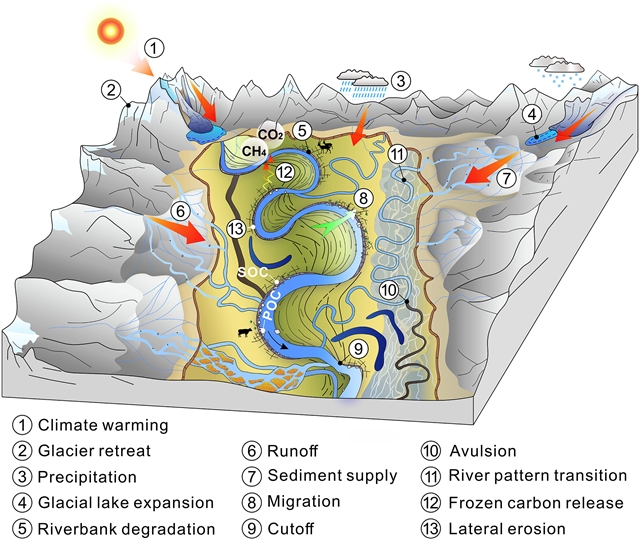
近日,中国地质大学(北京)王成善团队报道了气候变化导致喜马拉雅区域河流曲流及动力学加速。相关论文于2026年5月14日发表在《科学》杂志上。
河流曲流与迁移是全球范围内的基本过程,而喜马拉雅山脉的高海拔为检验河流形态动力学是否会随着快速变化的气候而变化提供了契机。
研究组利用遥感影像和现场观测,对三大流域四十余年间的河流曲流及相关动力学进行了量化。在1980-2000年至2000-2020年间,单河道与多河道模式之间的自由迁移、截断、改道以及转换率大约翻了一番。研究组将河道形态动力学的这种加速归因于气候变暖下的冰冻圈退化,后者增加了融水和泥沙通量,并致使冰冻河岸失稳。该研究结果表明,喜马拉雅高海拔地区是探测河流系统中气候信号的前哨区域,为理解气候驱动的地貌和生物地球化学响应提供了关键见解,并为河流生态系统和下游社区的适应策略提供了科学依据。
附:英文原文
Title: Accelerated Himalayan river meandering and dynamics due to climate change
Author: Zhipeng Lin, Zhongpeng Han, David R. Montgomery, Waqas Ul Hussan, Lars Lnsmann Iversen, Mette Bendixen, Xu Xu, Ling Yao, Yalige Bai, Xinhang Wang, Er Huang, Xingnian Liu, Chengshan Wang
Issue&Volume: 2026-05-14
Abstract: River meandering and migration are fundamental processes worldwide, and the high Himalayas offer an opportunity to test whether river morphodynamics are shifting in response to a rapidly changing climate. We used remote-sensing imagery and field observations to quantify river meandering and associated dynamics for three major river basins over four decades. Between 19802000 and 20002020, rates of unconfined migration, cutoff, avulsion, and transitions between single- and multithread channel patterns roughly doubled. We ascribe this acceleration in channel morphodynamics to cryosphere degradation under climate warming, which amplifies meltwater and sediment fluxes and destabilizes frozen riverbanks. Our findings highlight the Himalayan uplands as a sentinel region for detecting climatic signals in fluvial systems, providing critical insights into climate-driven geomorphological and biogeochemical responses and informing adaptation strategies for riverine ecosystems and downstream communities.
DOI: adg8401
Source: https://www.science.org/doi/10.1126/science.adg8401