
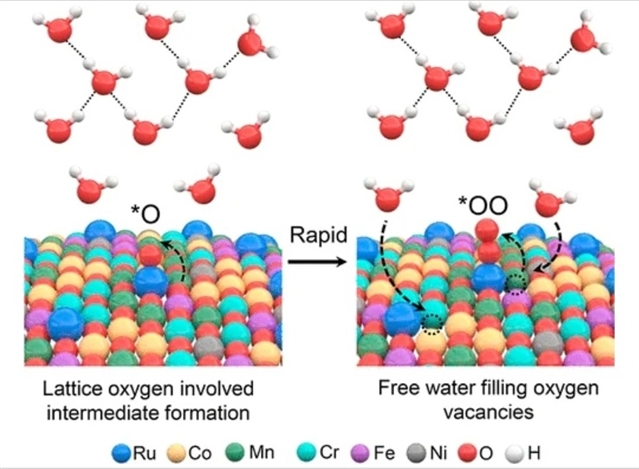
近日,东南大学彭生杰团队研究了基于高熵支持的Ru单原子稳定晶格氧机制。相关论文于2026年5月12日发表在《美国化学会志》上。
晶格氧机制(LOM)已成为增强酸性析氧反应(OER)活性的有效途径。然而,晶格氧的广泛参与往往会导致缺陷积累和骨架失稳,严重限制了催化剂的耐久性。
研究组提出,将Ru单原子锚定在高熵氧化物(Ru-(FeCoNiCrMn)3O4)上,可以在Ru位点建立一条稳定的LOM路径,同时实现高活性和长期结构完整性。高熵效应增强了Ru 4d-O 2p杂化,降低了晶格氧氧化的能垒,并促进了Ru位点附近的晶格氧与吸附氧物种之间直接的Olat–Oad耦合。与此同时,界面氢键网络的破坏富集了具有高反应活性的弱氢键自由水,使得水来源的氧能够快速填充晶格氧缺陷。
这种动态的缺陷修复过程保护了Ru位点的局域配位环境,防止了不可逆的结构退化。因此,Ru-(FeCoNiCrMn)3O4催化剂在0.5 M H2SO4中达到10 mA cm-2仅需204 mV过电位,并在相对于RHE为1.50 V时表现出5235.42 A gRu-1的高质量活性。采用Ru-(FeCoNiCrMn)3O4阳极的质子交换膜电解槽可以在500 mA cm-2下稳定运行超过320小时。这项工作提出了一种同时增强催化剂活性和稳定性的新策略。
附:英文原文
Title: Stabilizing Lattice Oxygen Mechanism on Ru Single Atoms via a High-Entropy Support for Acidic Oxygen Evolution
Author: Luqi Wang, Yixin Hao, Suwan Bi, Sung-Fu Hung, Kang-Shun Peng, Han-Yi Chen, Tsung-Yi Chen, Ying Zhang, Gengyu Xing, Linlin Li, Feng Hu, Yuping Wu, Shengjie Peng
Issue&Volume: May 12, 2026
Abstract: The lattice oxygen mechanism (LOM) has emerged as an effective route to enhance acidic oxygen evolution reaction (OER) activity. However, extensive lattice-oxygen participation often leads to defect accumulation and framework destabilization, severely limiting catalyst durability. Herein, we propose that anchoring Ru single atoms on a high-entropy oxide (Ru-(FeCoNiCrMn)3O4) establishes a stabilized LOM pathway at the Ru sites, combining high activity with long-term structural integrity. The high-entropy effect strengthens Ru 4d-O 2p hybridization, lowering the energetic barrier for lattice-oxygen oxidation and facilitating direct Olat–Oad coupling between lattice oxygen near the Ru sites and adsorbed oxygen species. In parallel, disruption of the interfacial hydrogen-bond network enriches weakly hydrogen-bonded free water with high reactivity, enabling rapid incorporation of water-derived oxygen into lattice-oxygen defects. This dynamic defect-refilling process preserves the local coordination environment of Ru sites and prevents irreversible structural degradation. Consequently, the Ru-(FeCoNiCrMn)3O4 catalyst only needs an overpotential of 204 mV to reach 10 mA cm–2 in 0.5 M H2SO4 and delivers a high mass activity of 5235.42 A gRu–1 at 1.50 V vs RHE. The proton exchange membrane electrolyzer with a Ru-(FeCoNiCrMn)3O4 anode can operate stably for over 320 h at 500 mA cm–2. This work presents a novel strategy for simultaneously enhancing catalyst activity and stability.
DOI: 10.1021/jacs.6c02539
Source: https://pubs.acs.org/doi/abs/10.1021/jacs.6c02539
JACS:《美国化学会志》,创刊于1879年。隶属于美国化学会,最新IF:16.383
官方网址:https://pubs.acs.org/journal/jacsat
投稿链接:https://acsparagonplus.acs.org/psweb/loginForm?code=1000