
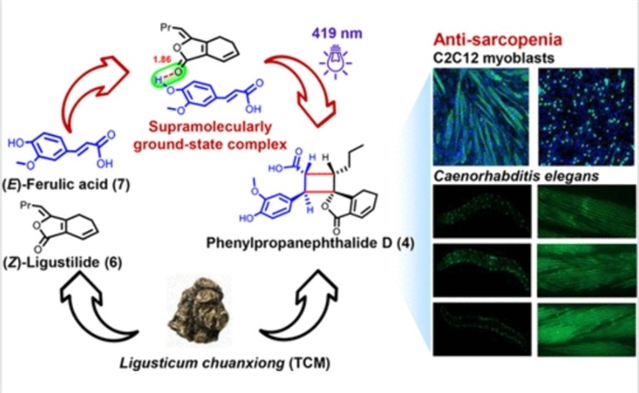
近日,暨南大学高昊团队报道了川芎强效抗肌少症药物分子支架的发现及其光化学合成。相关论文于2026年5月11日发表在《美国化学会志》上。
肌少症是一个日益严峻的公共卫生危机,目前仍缺乏有效的药物治疗方案。川芎是一种在中医中广泛用于治疗肌肉萎缩和肌无力相关病症的药用植物。
研究组报道了从川芎中发现的一类新型抗肌少症分子骨架,命名为苯丙苯酞类(phenylpropanephthalide),其结构上整合了(Z)-藁本内酯(6)和(E)-阿魏酸(7)。苯丙苯酞A–E(1–5)代表了一类自然界中全新的苯酞类化合物,构成了川芎化学成分的一个新亚类。通过综合核磁共振波谱、X射线晶体学和电子圆二色谱计算,阐明了它们的结构及绝对构型。通过光环加成实验实现了1–4的高效合成,结合密度泛函理论计算的机理研究表明,其形成过程经由一个区域发散性的[2+2]光环化反应,该反应的关键在于6和7之间通过超分子预组织形成的基态复合物。
系统的活性评价发现,化合物4是最具潜力的候选分子,在C2C12成肌细胞的体外实验和秀丽隐杆线虫模型的体内实验中均表现出显著的抗肌少症活性。苯丙苯酞D(4)的发现为治疗肌少症提供了一个极具吸引力的先导化合物和全新的分子骨架。
附:英文原文
Title: Discovery of a Potent Antisarcopenia Drug Molecular Scaffold Derived from Ligusticum chuanxiong and Its Photochemical Synthesis
Author: Shuai Zhang, Lei Wang, Chen-Yang He, Yong-Bin Chen, Yong-Heng Wang, Yi-Fang Li, Rong-Rong He, Yi Ding, Xin-Luan Wang, Qing-Hua Zhou, Xin-Sheng Yao, Huan Zhao, Qin-Li Wan, Jian Zou, Hao Gao
Issue&Volume: May 11, 2026
Abstract: Sarcopenia is a growing public health crisis with an unmet need for effective pharmacotherapies. Ligusticum chuanxiong (L. chuanxiong), commonly known as Chuanxiong in China, is a medicinal plant widely utilized for conditions involving muscle wasting and weakness. Herein, we report the discovery of a novel antisarcopenia molecular scaffold from L. chuanxiong, designated as phenylpropanephthalide, which structurally integrates (Z)-ligustilide (6) and (E)-ferulic acid (7). Phenylpropanephthalides A–E (1–5) represent a new category of phthalides in nature, constituting a new chemical subclass of L. chuanxiong constituents. Their structures and absolute configurations were elucidated through comprehensive NMR spectroscopy, X-ray crystallography, and ECD calculations. Photocycloaddition experiments enabled the efficient synthesis of 1–4, and mechanistic studies, supported by DFT calculations, revealed that their formation proceeds via a regio-divergent [2 + 2] photocyclization, which is critically dependent on a supramolecularly preorganized ground-state complex between 6 and 7. Systematic evaluation identified compound 4 as the most promising candidate, exhibiting potent antisarcopenia activity both in vitro using C2C12 myoblasts and in vivo in a Caenorhabditis elegans model. The discovery of phenylpropanephthalide D (4) provides a compelling lead compound and a novel molecular scaffold for the treatment of sarcopenia.
DOI: 10.1021/jacs.6c01000
Source: https://pubs.acs.org/doi/abs/10.1021/jacs.6c01000
JACS:《美国化学会志》,创刊于1879年。隶属于美国化学会,最新IF:16.383
官方网址:https://pubs.acs.org/journal/jacsat
投稿链接:https://acsparagonplus.acs.org/psweb/loginForm?code=1000