
近日,西南科技大学宋英泽团队报道了桥键定制双核Cu空间接近控制Li-S电池的均相催化。这一研究成果发表在2026年5月12日出版的《科学通报》杂志上。
金属有机小分子近期作为均相催化剂出现,为锂硫电池中的催化作用提供了新的范式。精确调控分子构型对于提升其在锂硫化学中促进氧化还原反应的催化活性至关重要。
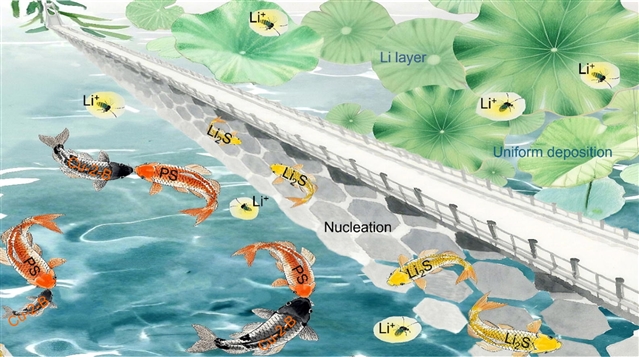
研究组表明,将氧桥键和氯桥键精确地引入双核铜配合物(Cu-2-B)中,可在电解液中原位生成均相催化剂。这种多功能的分子工程调控有效地将配合物分子中相邻铜原子之间的近端距离从4.7 Å缩短至3.2 Å,实现了催化剂构型的优化。利用同步辐射X射线三维纳米计算机断层扫描技术,研究组以高分辨率和空间分布水平可视化了Li2S的成核与生长过程。结果发现,在Cu-2-B中引入氧桥键,使得Li2S沉积具有质量高、尺寸小且分布均匀的特点。
通过结合中子成像和小角中子散射技术,定性与定量地解析了表面及内部的沉积锂形态。研究证实,Cu-2-B能够引导锂的剥离/沉积行为,从而形成坚固的锂工作表面及内部结构。得益于饱和Cu-2-B增强的均相催化效应,锂硫电池在273–328 K的宽温度范围内实现了稳定循环。令人瞩目的是,Cu-2-B使得1.1克硫的软包电池获得了345.3 Wh kg-1的质量能量密度,表明其在未来电源应用中具有巨大潜力。
附:英文原文
Title: Bridge-bond tailored binuclear Cu spatial proximity steers homogeneous catalysis in Li–S batteries
Author: anonymous
Issue&Volume: 2026/05/12
Abstract: Metal-organic small molecules have recently emerged as homogeneous catalysts, presenting a new paradigm for catalysis in lithium-sulfur (Li–S) batteries. Precise tailoring of molecular configurations is crucial for elevating their catalytic activity in facilitating the redox reactions in Li–S chemistry. In this study, paired oxygen-bridge and chlorine-bridge bonds are precisely incorporated into a binuclear copper complex (Cu-2-B) to generate a homogeneous catalyst in situ in the electrolyte. This versatile molecular engineering modulation effectively reduces the proximal distance between adjacent copper atoms in the complex molecule from 4.7 to 3.2 , leading to an optimized catalyst configuration. Using synchrotron radiation X-ray three-dimensional nano-computed tomography, the Li2S nucleation and growth at a high-resolution and spatial-distribution level were visualized. It is found that the introduction of an oxygen bridge into Cu-2-B enables the Li2S deposition that is high in mass, small in size, and uniform in distribution. By combining neutron imaging and small-angle neutron scattering techniques, surface and internal deposited lithium are qualitatively and quantitatively deciphered. It is confirmed that Cu-2-B can guide the lithium stripping/plating behaviors, resulting in a robust lithium working surface and inner architecture. Benefiting from the enhanced homogeneous catalytic effect of the saturated Cu-2-B, the Li–S cell achieves stable cycling over a wide temperature range of 273–328 K. Impressively, the Cu-2-B endows a 1.1-g-sulfur pouch cell with a gravimetric energy density of 345.3 Wh kg1, indicating its great potential for future power supply implementations.
DOI: 10.1016/j.scib.2026.05.013
Source: https://www.sciencedirect.com/science/article/abs/pii/S2095927326005116
Science Bulletin:《科学通报》,创刊于1950年。隶属于SciEngine出版平台,最新IF:18.9
官方网址:https://www.sciengine.com/SB/home
投稿链接:https://mc03.manuscriptcentral.com/csb