
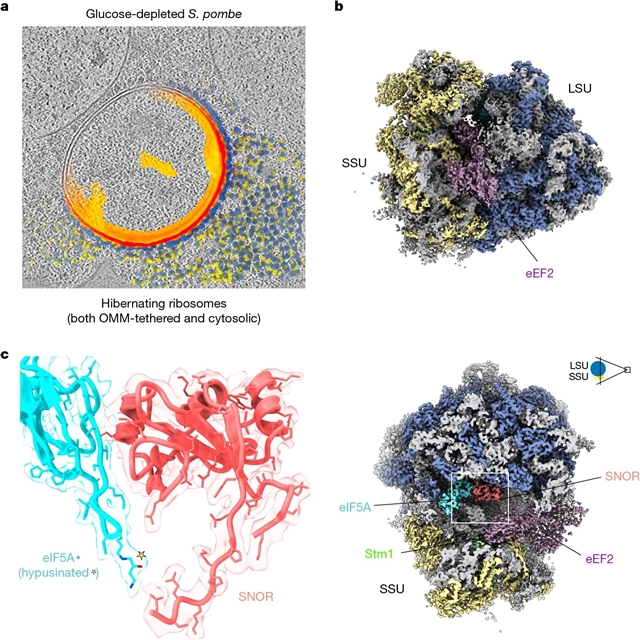
弗吉尼亚大学Ahmad Jomaa课题组在研究中取得进展。他们的论文发现了SNOR促进休眠后的翻译重启。2026年5月13日出版的《自然》杂志发表了这项成果。
通过高分辨率原位冷冻电子断层扫描,该课题组研究人员鉴定出SNOR,这是一种含有SBDS结构域的核糖体相关因子,它在葡萄糖消耗诱导的休眠期间结合在肽基转移酶中心并与eIF5A的次黄嘌呤化环接触。SNOR不是作为典型的休眠因子,而是允许休眠核糖体快速重新启动翻译。当葡萄糖补充时,SNOR和eIF5A共同作用,促进多聚体的有效恢复和退出休眠。这些发现定义了一种应激性核糖体重启模块,该模块将碳强度限制与监视核糖体活性位点和蛋白质合成的再激活结合起来。
据悉,细胞休眠通过可逆地抑制蛋白质合成,使细胞能够在长时间的营养限制下存活。当营养物质返回时,失活的真核核糖体如何被重新激活尚不清楚。
附:英文原文
Title: SNOR promotes translation restart after dormancy
Author: Gluc, Maciej, Rosa, Higor, Bozko, Maria, Turner, Lesley A., Prince, Cassidy R., Peskova, Yelena, Feaga, Heather A., Gould, Kathleen L., Mattei, Simone, Jomaa, Ahmad
Issue&Volume: 2026-05-13
Abstract: Cellular dormancy enables survival during prolonged nutrient limitation by reversibly suppressing protein synthesis1,2,3,4. How inactive eukaryotic ribosomes are reactivated when nutrients return remains unclear. Here, using high-resolution in situ cryo-electron tomography in Schizosaccharomyces pombe, we identify SNOR, an SBDS domain-containing ribosome-associated factor that binds at the peptidyl transferase centre and contacts the hypusinated loop of eIF5A during glucose depletion-induced dormancy. Rather than acting as a canonical hibernation factor, SNOR licenses dormant ribosomes for rapid translational restart. Upon glucose repletion, SNOR and eIF5A act together to promote efficient recovery of polysomes and exit from dormancy. These findings define a stress-responsive ribosome restart module that couples carbon-source limitation to surveillance of the ribosomal active site and reactivation of protein synthesis.
DOI: 10.1038/s41586-026-10530-7
Source: https://www.nature.com/articles/s41586-026-10530-7
Nature:《自然》,创刊于1869年。隶属于施普林格·自然出版集团,最新IF:69.504
官方网址:http://www.nature.com/
投稿链接:http://www.nature.com/authors/submit_manuscript.html