
耶鲁大学医学院Rui B. Chang课题组的一项最新研究探明了谱系和器官信号依次构建器官内在神经系统。2026年5月13日出版的《自然》发表了这项成果。
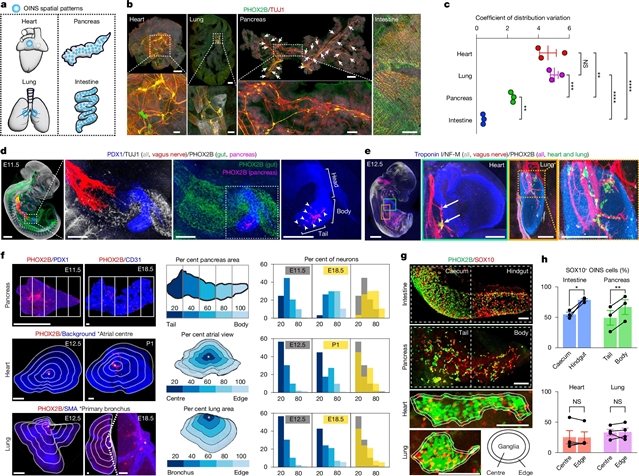
通过对心脏、胰腺、肠道和肺部的谱系追踪、三维成像、单细胞转录组学和遗传扰动,对OINSs的发育进行了系统层面的跨器官分析。课题组研究人员发现,神经嵴细胞迁移轨迹的差异预示着OINS的空间结构,为器官特异性模式奠定了基础。相比之下,分子身份主要是对局部环境的反应,表明外部线索具有重要的指导作用。通过体外共培养,课题组研究人员证明了器官来源的线索将内在神经元重新编程为器官特异性转录谱和直接神经元分化,细胞外基质(ECM)接触作为中心介质。在体内,ECM -整合素信号支持内在心脏神经元的神经发生,并且ECM交联稳定其刻板的神经节组织。
总之,这些发现揭示了OINS多样性通过双重逻辑产生:谱系程序预示空间框架,而器官特异性线索指导最终的分子身份和结构精度。这项工作为器官如何积极地建立它们的神经系统建立了一个概念范例,阐明了身体-大脑整合的基本原则。
研究人员表示,器官内在神经系统(OINSs)是体脑轴的重要组成部分,协调内脏器官功能与全身生理控制。尽管它们很重要,但这些不同的神经结构是如何从一个共同的神经嵴细胞起源产生的仍不清楚。
附:英文原文
Title: Lineage and organ signals sequentially build organ intrinsic nervous systems
Author: Hsu, I-Uen Yvonne, Zhao, Jia, Lin, Yingxin, Guo, Yunshan, Xu, Qian J., Shao, Yuancheng, Wang, Ruiqi L., Yin, Dominic, Ghoshal, Kakali, Mourad, Rida, Pozzi, Ambra, Halabi, Carmen M., Young, Lawrence H., Zhao, Hongyu, Zhang, Le, Chang, Rui B.
Issue&Volume: 2026-05-13
Abstract: Organ intrinsic nervous systems (OINSs) are critical components of the body–brain axis and coordinate visceral organ function with systemic physiological control1,2,3,4,5,6,7. Despite their importance, how these distinct neural architectures arise from a common neural crest cell origin has remained unclear. Here we present a systems-level, cross-organ analysis of OINS development, integrating lineage tracing, 3D imaging, single-cell transcriptomics and genetic perturbations across the heart, pancreas, intestine and lungs. We show that differences in neural crest cell migratory trajectories prefigure the spatial architecture of OINSs, laying the foundation for organ-specific patterning. By contrast, molecular identity emerges largely in response to local environments, indicating that extrinsic cues have a major instructive role. Using in vitro co-cultures, we demonstrate that organ-derived cues reprogramme intrinsic neurons towards organ-specific transcriptional profiles and direct neuronal differentiation, with extracellular matrix (ECM) contact as a central mediator. In vivo, ECM–integrin signalling supports neurogenesis of intrinsic cardiac neurons, and ECM crosslinking stabilizes their stereotyped ganglionic organization. Together, these findings reveal that OINS diversity arises through a dual logic: lineage programmes prefigure spatial frameworks, whereas organ-specific cues instruct final molecular identities and architectural precision. This work establishes a conceptual paradigm for how organs actively build their nervous systems, illuminating principles that underlie body–brain integration.
DOI: 10.1038/s41586-026-10490-y
Source: https://www.nature.com/articles/s41586-026-10490-y
Nature:《自然》,创刊于1869年。隶属于施普林格·自然出版集团,最新IF:69.504
官方网址:http://www.nature.com/
投稿链接:http://www.nature.com/authors/submit_manuscript.html