
近日,瑞典农业科学大学Ludovic Henneron团队报道了树木群落资源经济调控土壤食物网的多功能性。2026年5月6日出版的《自然》杂志发表了这一最新研究成果。
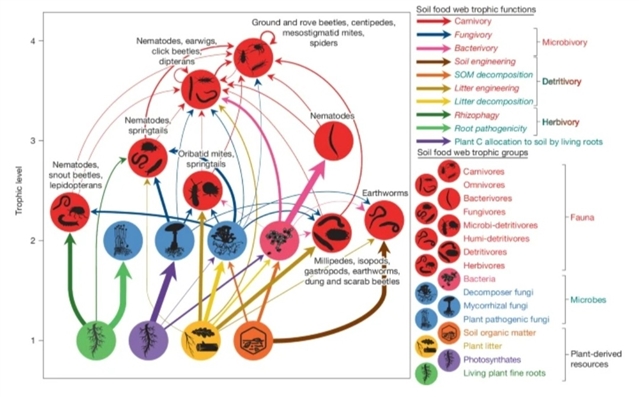
植物通过塑造微环境以及提供驱动食物网能量流动的初级生产,影响着陆地生态系统的功能。然而,植物群落属性如何通过食物网中的能量通量影响生态系统功能,尤其是在传导大部分植物源能量的土壤食物网中,相关研究仍然很少。
研究组采用食物网能量学方法,揭示了在欧洲森林中,优势树种的资源经济策略控制着土壤食物网的多功能性。与资源保守型树种为主的群落相比,资源获取型树种为主的群落促进了多种土壤营养功能更快的速率。这些效应主要源于更高质量的凋落物和更温暖的森林微气候,从而导致土壤生物代谢活性增强。因此,树种组成解释了土壤食物网多功能性的很大一部分变异,其解释程度与不同地点间生物地理差异相当。
相比之下,三个树种的混交林相对于纯林表现出微弱的负效应,这主要是由于能量通道从活细根向凋落物转移以及对森林微气候的降温效应。尽管地上部树木生物量生产存在超产效应,但上述现象仍然发生,这表明地上与地下的多样性效应存在差异。我们的发现强调了与资源经济相关的植物功能性状作为土壤食物网功能驱动因素的重要性,并展示了气候变化驱动的树种组成变化如何可能改变森林土壤的功能。
附:英文原文
Title: Tree community resource economics control soil food web multifunctionality
Author: Henneron, Ludovic, Wardle, David A., Berg, Matty P., Httenschwiler, Stephan, Bauhus, Jrgen, Buscot, Franois, Coq, Sylvain, Decans, Thibaud, Fromin, Nathalie, Ganault, Pierre, Gillespie, Lauren M., Goldmann, Kezia, Matula, Radim, Milcu, Alexandru, Muys, Bart, Nahmani, Johanne, Prada-Salcedo, Luis Daniel, Scherer-Lorenzen, Michael, Verheyen, Kris, Wambsganss, Janna, Kardol, Paul
Issue&Volume: 2026-05-06
Abstract: Plants affect terrestrial ecosystem functioning by shaping microenvironments1 and by providing the primary production that fuels energy flow into food webs2. However, how plant community properties affect ecosystem functioning via energy fluxes in food webs has been little studied3,4, especially for the soil food webs that channel most plant-derived energy2,5. Applying a food web energetics approach6,7, we show that the resource economics of dominant tree species control soil food web multifunctionality across European forests. Tree communities dominated by resource-acquisitive species promoted faster rates of multiple soil trophic functions than did communities dominated by resource-conservative species. These effects were primarily driven by higher-quality litter and warmer forest microclimates, leading to increased metabolic activity of soil organisms8. Accordingly, tree species composition explained a large portion of variation in soil food web multifunctionality, comparable to that explained by biogeographic differences among locations. By contrast, mixtures of three tree species had weakly negative effects relative to single-species stands, mostly due to shifts in energy channelling from living fine roots to litter and a cooling effect on forest microclimate. This occurred despite an overyielding effect in aboveground tree biomass production, suggesting contrasting diversity effects above- and belowground. Our findings emphasize the importance of plant functional traits related to resource economics as drivers of soil food web functioning5,9 and demonstrate how climate-driven shifts in tree community composition may alter forest soil functioning.
DOI: 10.1038/s41586-026-10455-1
Source: https://www.nature.com/articles/s41586-026-10455-1
Nature:《自然》,创刊于1869年。隶属于施普林格·自然出版集团,最新IF:69.504
官方网址:http://www.nature.com/
投稿链接:http://www.nature.com/authors/submit_manuscript.html