
近日,美国普渡大学Jianguo Mei团队报道了血液催化n型掺杂聚合物用于可逆光学神经调控。相关论文于2026年4月2日发表在《科学》杂志上。
将合成材料与活体组织实现生物相容性的融合,仍是生物电子学领域面临的一大难题。在这种情况下,无基底导电聚合物(CP)界面或有助于弥合这一差距。
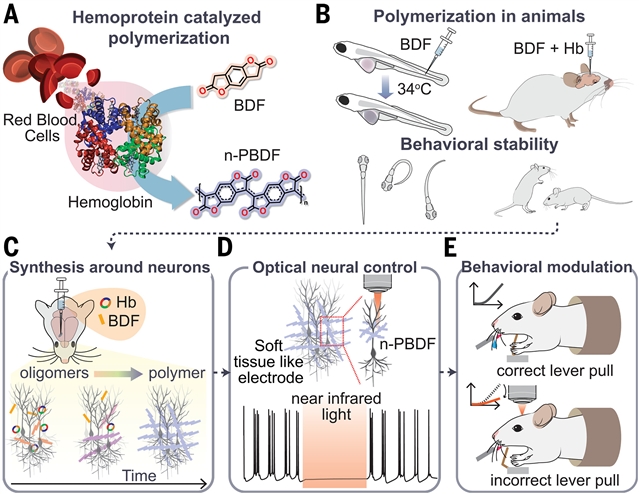
研究组报道了在清醒的斑马鱼和小鼠体内利用全血催化聚合的方式对n型掺杂的聚(苯并二呋喃二酮)(n-PBDF)进行的体内自组装过程。这种方法利用内源性催化剂(特别是血红蛋白),来形成稳定且对热和离子敏感的CP网络,确保其在整个生命周期内都具有长期相容性。
研究组通过使用近红外(NIR)光进行可逆、细胞和亚细胞水平的神经调节(包括在体内聚合n-PBDF)来展示这种界面的效果。电生理学研究证实,n-PBDF可改变原生钠离子通道的兴奋性,并且近红外光刺激通过热离子诱导的分流作用放大了这种调节作用,从而实现了按需、毫秒级可逆的兴奋性抑制控制,这一特性在行为活跃小鼠中也得到了验证。
附:英文原文
Title: Blood-catalyzed n-doped polymers for reversible optical neural control
Author: Sanket Samal, Shulan Xiao, Samantha Nelson, Om Kolhe, Hammad F. Khan, Meisam Habibi Matin, Won-June Lee, Mustafa Ahmed, Decheng Wang, Tianqi Wang, Tyler Pikes, Alicia N. Scott, J. Alejandra Rodriguez, Matthew R. Olson, Qing Deng, Elizabeth I. Parkinson, Jean-Christophe Rochet, Krishna Jayant, Jianguo Mei
Issue&Volume: 2026-04-02
Abstract: Biocompatible integration of synthetic materials with living tissue remains a major challenge for bioelectronics. In this case, substrate-free conducting polymer (CP) interfaces could help bridge this gap. We report in vivo assembly of n-doped poly(benzodifurandione) (n-PBDF) using whole blood–catalyzed polymerization in awake zebrafish and mice. This approach leverages endogenous catalysts, specifically hemoproteins, to form stable, thermally and ionically sensitive CP networks, ensuring long-term compatibility throughout the lifespan. We showcase the impact of this interface through reversible, cellular, and subcellular neuromodulation using near-infrared (NIR) light, including in vivo polymerized n-PBDF. Electrophysiological studies confirmed that n-PBDF alters intrinsic sodium ion channel excitability, and NIR light stimulation amplifies this modulation through thermoionic-induced shunting, providing on-demand, millisecond-scale reversible inhibitory control of excitability, a feature recapitulated in actively behaving mice.
DOI: adu5500
Source: https://www.science.org/doi/10.1126/science.adu5500
Science:《科学》,创刊于1880年。隶属于美国科学促进会,最新IF:63.714
官方网址:https://www.sciencemag.org/
投稿链接:https://cts.sciencemag.org/scc/#/login