
剑桥大学Joo-Hyeon Lee课题组近日取得一项新成果。经过不懈努力,他们揭示了早期纤维化生态位构建肿瘤许可性微环境。这一研究成果发表在2026年4月22日出版的国际学术期刊《自然》上。
在本研究中,该研究组对单细胞、空间和功能进行了综合分析,定义了肺中致癌激活后这种转变的最早的多细胞事件。KrasG12D突变型肺泡II型细胞迅速进入再生样状态,充当信号中枢,协调基质和免疫重编程,同时增强上皮可塑性。通过分泌双调节蛋白,突变上皮细胞激活相邻成纤维细胞中的EGFR信号,诱导纤维化,损伤样程序。重新编程的成纤维细胞反过来扩大并重新编程肺泡巨噬细胞,放大炎症信号并增强上皮可塑性。
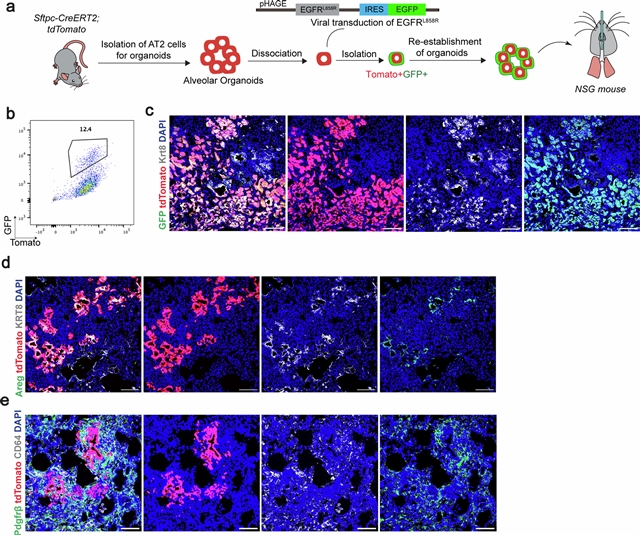
这些相互作用建立了一个自我维持的上皮-基质-免疫回路,在恶性生长之前产生肿瘤容许的生态位。双调节蛋白-EGFR轴的破坏阻止了早期生态位的形成,并取消了肿瘤的启动。在KrasG12D诱导的人类肺泡类器官和早期肺腺癌组织中,这一程序的保存表明,上皮-微环境通讯是一种治疗上可行的易感性,并表明阻断生态位形成可能阻止疾病发展为耐药疾病。
据介绍,病理转化是一个关键但定义不清的窗口期,在此期间,突变的上皮干细胞主动构建微环境,使肿瘤发生。
附:英文原文
Title: Early fibrotic niches establish tumour-permissive microenvironments
Author: Cardoso, Erik C., Lee, Hyeyoung, England, Frances J., Cho, Hyunjin, Lu, Robin, Varankar, Sagar S., Park, Moo Suk, Rekhtman, Natasha, Koo, Bon-Kyoung, Simons, Benjamin D., Choi, Jinwook, Lee, Joo-Hyeon
Issue&Volume: 2026-04-22
Abstract: Pathologic transformation represents a critical yet poorly defined window during which mutant epithelial stem cells actively construct the microenvironment that enables tumour initiation1,2. Here using integrated single-cell, spatial and functional analyses, we define the earliest multicellular events that licence this transition following oncogenic activation in the lung. KrasG12D-mutant alveolar type II cells rapidly adopt regenerative-like states that act as signalling hubs, orchestrating coordinated stromal and immune reprogramming while enhancing epithelial plasticity. Through secretion of amphiregulin, mutant epithelial cells activate EGFR signalling in adjacent fibroblasts, inducing a fibrotic, injury-like programme. Reprogrammed fibroblasts, in turn, expand and reprogramme alveolar macrophages, amplifying inflammatory signalling and reinforcing epithelial plasticity. These reciprocal interactions establish a self-sustaining epithelial–stromal–immune circuit that generates a tumour-permissive niche before malignant outgrowth. Disruption of the amphiregulin–EGFR axis prevents early niche formation and abrogates tumour initiation. Conservation of this programme in KRASG12D-inducible human alveolar organoids and early-stage lung adenocarcinoma tissues identifies epithelial–microenvironment communication as a therapeutically actionable vulnerability and suggests that intercepting niche formation may prevent progression to treatment-resistant disease.
DOI: 10.1038/s41586-026-10399-6
Source: https://www.nature.com/articles/s41586-026-10399-6
Nature:《自然》,创刊于1869年。隶属于施普林格·自然出版集团,最新IF:69.504
官方网址:http://www.nature.com/
投稿链接:http://www.nature.com/authors/submit_manuscript.html