
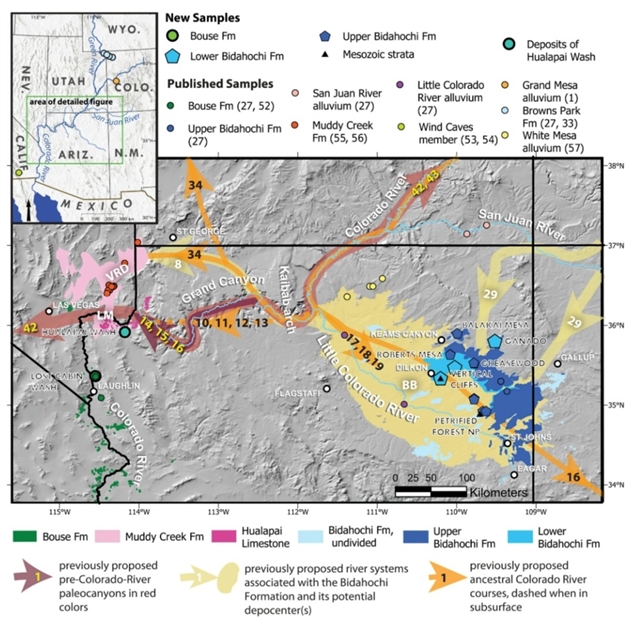
近日,美国地质调查局Ryan S. Crow团队报道了晚中新世科罗拉多河进入比达霍奇盆地支持大峡谷的溢出起源。2026年4月16日出版的《科学》杂志发表了
科罗拉多河贯通与大峡谷下切的时间与机制,仍是地质学领域长期存在的争议之一。一个关键问题是距今1100万到600万年间科罗拉多河上游流域的格局。
研究组利用锆石铀-铅年代学提供了新的证据,表明源自布朗斯帕克组的独特科罗拉多河-格林河沉积物,在660万年前就已到达比达霍奇盆地。与此同时,沉积速率出现了一个数量级的增加,碳酸盐锶同位素(87Sr/86Sr)比值升高,出现了快速水流环境特有的大型鱼类物种,并伴随有其他沉积学变化。这些证据与科罗拉多河在通过大峡谷贯通整合之前就已经向比达霍奇盆地供水并输送沉积物的推论相一致。
附:英文原文
Title: Late Miocene Colorado River arrival in the Bidahochi basin supports spillover origin of Grand Canyon
Author: John J. Y. He, Ryan S. Crow, John Douglass, Christopher S. Holm-Denoma, Jorge A. Vazquez, Brian F. Gootee, Marsha I. Lidzbarski, Laura S. Pianowski, Harrison Gray, Emma Heitmann, Phil A. Pearthree, P. Kyle House, Shannon Dulin
Issue&Volume: 2026-04-16
Abstract: The timing and mechanism of the integration of the Colorado River and incision of the Grand Canyon remain among geology’s enduring controversies. A key question is the configuration of the upper Colorado River watershed between 11 and 6 million years ago. In this study, we present new evidence from zircon uranium-lead geochronology for the arrival of distinctive Colorado–Green River sediment in the Bidahochi basin by 6.6 million years ago derived from the Browns Park Formation. This is coeval with an order-of-magnitude increase in depositional rate, an increase in carbonate strontium isotope (87Sr/86Sr) ratios, the appearance of large fish species characteristic of fast-flowing waters, and other sedimentological changes. This evidence is consistent with the Colorado River supplying water and sediment to the Bidahochi basin before spillover integration of the river through the Grand Canyon.
DOI: adz6826
Source: https://www.science.org/doi/10.1126/science.adz6826