
近日,印度曼尼普尔大学Avinash Kumar Chouhan团队报道了地壳结构在印度-恒河东部前陆盆地和喜马拉雅碰撞带地球动力学演化和地震成因中的作用。2026年4月14日出版的《大地测量与地球动力学》杂志发表了这项成果。
印度板块与欧亚板块之间持续不断的汇聚,自它们碰撞以来已显著改变了印度次大陆的地壳厚度,并在印度次大陆北部形成了一个地质活动最活跃的区域之一,即印度河-恒河前陆盆地(IGFB)。由于该地区破坏性地震频繁发生,印度板块这一区段的地壳几何形态长期以来一直是主要的研究焦点。
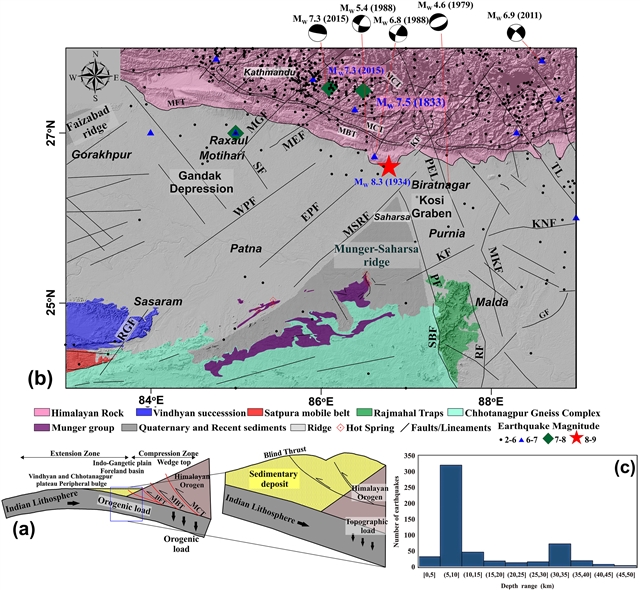
在此背景下,研究组旨在绘制IGFB东段的地壳层结构图,以建立一个真实且广泛接受的框架,用于理解其构造成因。研究组利用布格异常的导数分析,圈定了东西走向、受基底控制的、形成于中新世和更新世的地下地质构造。前寒武纪基底和莫霍面的深度范围分别为1–6.8 km和39–60 km。布格异常的正演模拟表明,IGFB东段下方的地壳界面向北陡倾,这主要与始新世和更新世期间的喜马拉雅造山运动有关。
研究结果表明,蒙格尔-萨哈尔萨脊(MSR)从中新世至今一直控制着IGFB东段的沉降。此外,研究组在甘达克凹陷发现了一条隐伏断层,其断层活动可能由喜马拉雅楔体向南传播或下地壳的挤压弯曲所驱动。研究组还提出,蒙格尔-萨哈尔萨脊与地壳弯曲共同作用,在调节IGFB东段的地震活动性方面发挥着重要作用。
附:英文原文
Title: Role of crustal structure in geodynamic evolution and seismogenesis in the eastern Indo-Gangetic Foreland Basin and Himalayan Collision Zone
Author: Avinash Kumar Chouhan
Issue&Volume: 2026/04/14
Abstract: The incessant convergence between the Indian and Eurasian plates has significantly altered the crustal thicknesses of the Indian subcontinent since their collision and formed one of the most dynamically active geological provinces in the northern Indian subcontinent, namely the Indo-Gangetic Foreland Basin (IGFB). The crustal geometry of this segment of the Indian Plate has long been a primary research focus due to the frequent occurrence of devastating earthquakes in the region. In this context, we aim to map the crustal layers of the eastern IGFB to establish a realistic and widely accepted framework for understanding its tectonogenesis. In this study, derivative analysis of the Bouguer Anomaly (BA) was used to delineate the E-W trending basement-controlled subsurface geological structures formed during the Miocene and Pleistocene epochs. The depths of the Precambrian basement and the Moho discontinuity range from 1 to 6.8 km and 39 to 60 km, respectively. Forward modelling of the BA reveals that the crustal interfaces beneath the eastern IGFB dip steeply northward, which is primarily associated with the Himalayan orogeny during the Eocene and Pleistocene epochs. The findings of this study indicate that the Munger-Saharsa Ridge (MSR) has controlled subsidence in the eastern IGFB from the Miocene to the present day. Furthermore, this study has identified a blind fault in the Gandak depression, where fault activity may be driven by either the southward propagation of the Himalayan wedge or by compressional bending of the lower crust. We also propose that the Munger-Saharsa Ridge, in conjunction with crustal bending, plays a significant role in modulating seismicity in the eastern segment of the IGFB.
DOI: 10.1016/j.geog.2026.01.011
Source: https://www.sciencedirect.com/science/article/pii/S1674984726000492
Geodesy and Geodynamics:《大地测量与地球动力学》,创刊于2010年。隶属于爱思唯尔出版集团,最新IF:2.4
官方网址:https://www.sciencedirect.com/journal/geodesy-and-geodynamics
投稿链接:https://www2.cloud.editorialmanager.com/geog/default2.aspx