
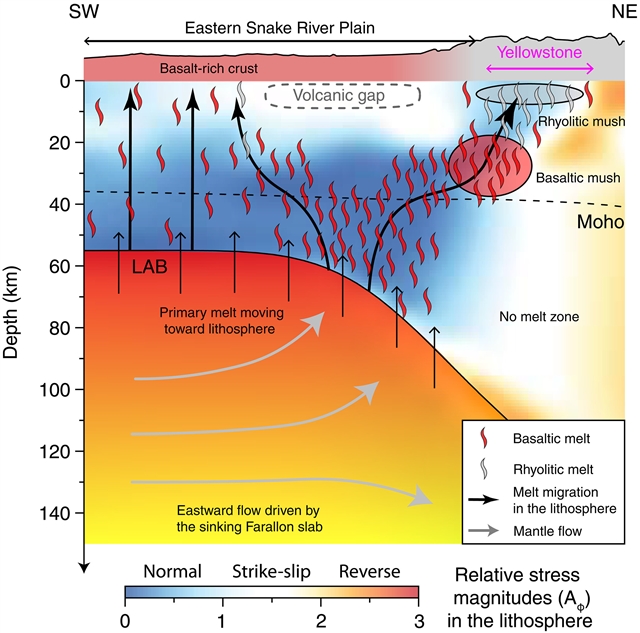
近日,中国科学院地质与地球物理研究所刘丽军团队研究了黄石跨岩石圈岩浆管道系统的构造起源。相关论文于2026年4月9日发表在《科学》杂志上。
黄石地区以其由软流圈熔体补充的地壳岩浆储库而广为人知。然而,原生熔体如何穿越刚性的岩石圈并演化为双峰式火山活动,至今尚不明确。
通过整合多学科观测数据并采用面向数据的地球动力学模拟方法,研究组证明黄石地区的岩浆生成与运移主要受岩石圈构造控制,地幔柱的贡献可忽略不计。该模型预测,在黄石下方存在一个西南倾的拉张带,该拉张带由岩石圈体积力和底部拖曳力共同塑造。
这一倾斜的穿岩石圈变形带与地球物理方法成像的岩浆管道系统相吻合,证实了构造拉张在将软流圈熔体引导至浅部过程中的关键作用。此外,研究组认为,穿岩石圈的岩浆管道系统促进了复杂的岩浆过程,最终驱动了地表的双峰式火山活动。
附:英文原文
Title: Tectonic origin of Yellowstone’s translithospheric magma plumbing system
Author: Zebin Cao, Lijun Liu, Bo Wan, Ling Chen, Craig Lundstrom
Issue&Volume: 2026-04-09
Abstract: Yellowstone is widely recognized for its crustal magma reservoirs replenished by asthenospheric melts. However, how primary melts traverse the rigid lithosphere and evolve into bimodal volcanism remains unclear. By leveraging multidisciplinary observations and a data-oriented geodynamic modeling approach, we demonstrate that magma generation and migration in the Yellowstone region are primarily governed by lithospheric tectonics, with negligible contribution from the mantle plume. Below Yellowstone, our model predicts a southwest-dipping extension zone, shaped jointly by the lithospheric body force and basal traction. This tilted translithospheric deforming zone resembles the geophysically imaged magma plumbing system, confirming the key role of tectonic extension in tapping asthenospheric melts to shallow depths. Furthermore, we suggest that the translithospheric magma plumbing system facilitates complex magmatic processes, ultimately driving surface bimodal volcanism.
DOI: ady2027
Source: https://www.science.org/doi/10.1126/science.ady2027