
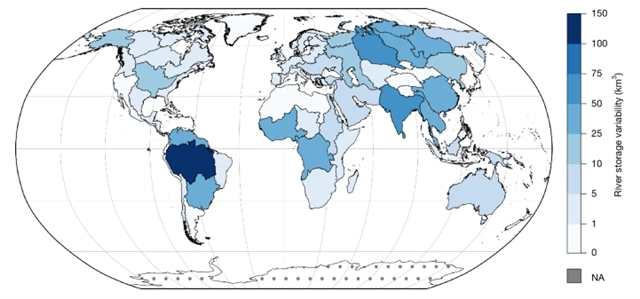
近日,美国加州理工学院A. Cerbelaud团队报道了宽幅高度计绘制了全球河流的河岸形状和蓄水量变化。2026年3月4日出版的《自然》杂志发表了这项最新成果。
河流是地球上可再生程度最高、最易获取的淡水资源,但全球尺度河流蓄水量的规模及其变化特征的估算仍存在数量少且相互矛盾的问题。现有对河流蓄水量变化的认识主要依赖两种途径:一是稀疏且非同步的遥感观测,二是受制于地表水平衡认知不足和河道特征数据匮乏的水文模型模拟。对河流蓄水量时空变化规律认知的缺失,严重制约着这一关键淡水资源的科学管理。
研究组基于地表水与海洋地形(SWOT)卫星任务首个水文年(2023年10月至2024年9月)的观测数据,在全球126,674个河段实现了近全球尺度活跃河道几何形态及逐月蓄水量变化的河段尺度反演。主要流域的河床形态与蓄水量变化规律清晰显现。SWOT观测显示,全球河流年蓄水量变化幅度为313.1±129.5 km3,较现有模型对同等尺度河段的最低模拟值低约28%。尽管2024年亚马孙河创纪录干旱、北极地区观测条件限制以及SWOT卫星重访周期等因素可能造成这一差异,但观测结果明确揭示了地表水科学领域存在的认知局限。这些发现为改进全球模型中地表水动力学的基础表征、提升大规模水资源管理与减灾决策的科学性提供了重要契机。
附:英文原文
Title: Wide-swath altimetry maps bank shapes and storage changes in global rivers
Author: Cerbelaud, A., Wade, J., David, C. H., Durand, M., Frasson, R. P. M., Pavelsky, T., Oubanas, H.
Issue&Volume: 2026-03-04
Abstract: Rivers are Earth’s most renewable and accessible freshwater resource1, yet global estimates of the magnitude and variability in river water storage have remained few and inconsistent1,2,3,4,5,6,7,8,9. Previous estimates of variability have relied either on sparse and asynchronous remote-sensing observations10 or on hydrological models constrained by incomplete understanding of surface-water balance and poorly known river channel characteristics2,3. The insufficient knowledge of temporal variations in river water storage across space hinders effective management of this critical freshwater resource11,12. Here we present near-global-scale observations of active river channel geometry and associated monthly changes in water storage at the reach scale derived from the first water year (October 2023 to September 2024) of the Surface Water and Ocean Topography (SWOT) mission at 126,674 reaches worldwide. Clear patterns of riverbed shape and storage variability expectedly emerge across major basins. SWOT reveals a range of 313.1±129.5km3 in global annual river storage variability, approximately 28% lower than the lowest previously modelled estimates for the same wide reaches. Although the Amazon’s 2024 record drought, the observational challenges in the Arctic and the revisit frequency of SWOT almost certainly contribute to the discrepancy, the observations point to distinct knowledge limitations in surface-water science. These findings highlight key opportunities to improve the fundamental representation of surface-water dynamics in global models and to better inform water resource management and disaster mitigation at scale.
DOI: 10.1038/s41586-026-10218-y
Source: https://www.nature.com/articles/s41586-026-10218-y
Nature:《自然》,创刊于1869年。隶属于施普林格·自然出版集团,最新IF:69.504
官方网址:http://www.nature.com/
投稿链接:http://www.nature.com/authors/submit_manuscript.html