
美国霍华德休斯医学院Ardem Patapoutian团队的研究开发出了PIEZO2力选择性的分子基础。相关论文于2026年3月4日发表在《自然》杂志上。
在这里,该研究团队将单分子MINFLUX荧光纳米显微镜与电生理学结合起来,将PIEZO2的构象状态与完整细胞中的通道门控联系起来。该课题组研究人员发现PIEZO2本质上比PIEZO1更刚性,并且不同的机械刺激矛盾地在每个通道中唤起相反的构象和门控反应。这些独特的门控特性部分源于与肌动蛋白细胞骨架的连接,研究小组将丝蛋白-B(FLNB)确定为这种相互作用所需的分子系绳。这种复合物改变了力传递给PIEZO2的方式,并赋予细胞压痕更高的灵敏度和选择性。这些发现有助于解释为什么PIEZO2是一种专门的机械传感器,并为理解细胞如何解码跨组织和器官系统的各种机械刺激提供了分子蓝图。
据介绍,压电陶瓷是机械门控离子通道,将力转化为电化学信号。PIEZO1响应多种刺激,包括膜拉伸和剪切应力,而PIEZO2通常用于检测细胞压痕。PIEZO2的功能专门化被认为是其独特生理作用的基础,包括介导触觉。尽管PIEZO2的结构与PIEZO1非常相似,但它是如何实现这种选择性的尚不清楚。
附:英文原文
Title: The molecular basis of force selectivity by PIEZO2
Author: Mulhall, Eric M., Yarishkin, Oleg, Hill, Rose Z., Koster, Anna K., Patapoutian, Ardem
Issue&Volume: 2026-03-04
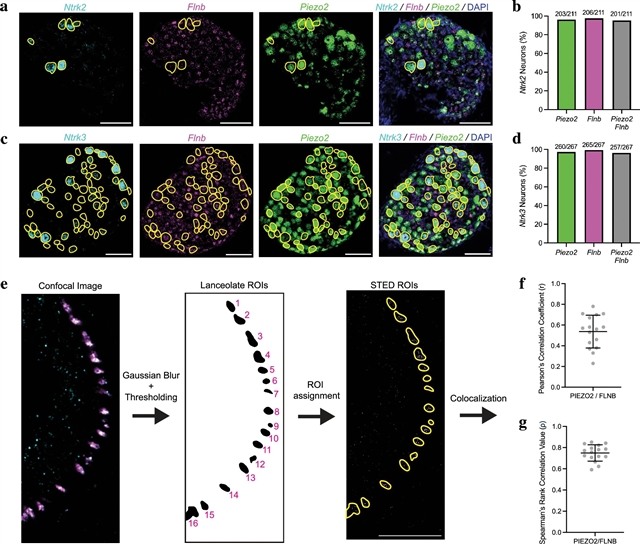
Abstract: PIEZOs are mechanically gated ion channels that transduce force into electrochemical signals1. PIEZO1 responds to diverse stimuli including membrane stretch2 and shear stress3, whereas PIEZO2 is generally tuned to detect cellular indentation4,5. The functional specialization of PIEZO2 is proposed to underlie its distinct physiological roles, including mediating the sense of touch6,7. How PIEZO2 achieves this selectivity despite its close structural similarity to PIEZO1 is unclear. Here we combine single-molecule MINFLUX fluorescence nanoscopy with electrophysiology to link the conformational states of PIEZO2 to channel gating in intact cells. We find that PIEZO2 is intrinsically more rigid than PIEZO1, and that disparate mechanical stimuli paradoxically evoke opposite conformational and gating responses in each channel. These unique gating properties arise in part from a connection to the actin cytoskeleton, and we identify filamin-B (FLNB) as a molecular tether that is required for this interaction. This complex alters how force is transmitted to PIEZO2 and confers heightened sensitivity to and selectivity for cellular indentation. PIEZO2 and FLNB are co-expressed in somatosensory neurons and colocalize within tens of nanometres at the end organs of cutaneous mechanosensory afferents. These findings help to explain why PIEZO2 is a specialized mechanosensor and provide a molecular blueprint for understanding how cells decode diverse mechanical stimuli across tissues and organ systems.
DOI: 10.1038/s41586-026-10182-7
Source: https://www.nature.com/articles/s41586-026-10182-7
Nature:《自然》,创刊于1869年。隶属于施普林格·自然出版集团,最新IF:69.504
官方网址:http://www.nature.com/
投稿链接:http://www.nature.com/authors/submit_manuscript.html