
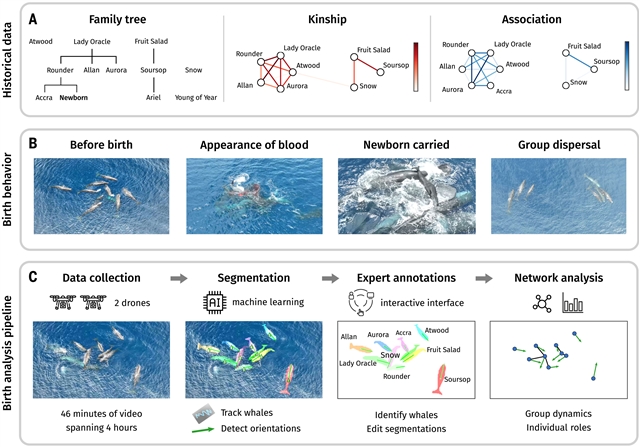
该研究组定量地记录了抹香鲸出生事件,揭示了跨亲属关系的集体支持行为。使用高分辨率无人机镜头,计算机视觉和多尺度网络分析,该研究团队研究了加勒比海抹香鲸单位内由两个母系组成的相互作用。他们的研究结果表明,一名女性家庭成员主导助产,分娩后,所有人都以协调的、跨亲属的方式轮流照顾和帮助新生儿。尽管历史上观察到觅食隔离,但随着所有单位成员的贡献,亲属关系障碍消失了。这些分析提供了非灵长类动物助产的证据,这种行为长期以来被认为是人类及其近亲的特征。
附:英文原文
Title: Cooperation by non-kin during birth underpins sperm whale social complexity
Author: Alaa Maalouf, Joseph DelPreto, Maxime Lucas, Simone Poetto, Jacob Andreas, Antonio Torralba, Shane Gero, Giovanni Petri, Daniela Rus, David F. Gruber
Issue&Volume: 2026-03-26
Abstract: We quantitatively document a sperm whale birth event, revealing collective support behaviors across kinship lines. Using high-resolution drone footage, computer vision, and multiscale network analysis, we studied the interactions within a Caribbean sperm whale unit comprising two matrilines. Our results suggest that a female family member led birth assistance and that after delivery, all individuals oriented toward and helped lift the newborn, taking turns in a coordinated, cross-kin effort. Despite historically observed foraging segregation, kinship barriers dissolved as all unit members contributed. These analyses provide evidence of birth attendance, or assistance, in a nonprimate species, a behavior long considered characteristic only of humans and their close relatives.
DOI: ady9280
Source: https://www.science.org/doi/10.1126/science.ady9280