
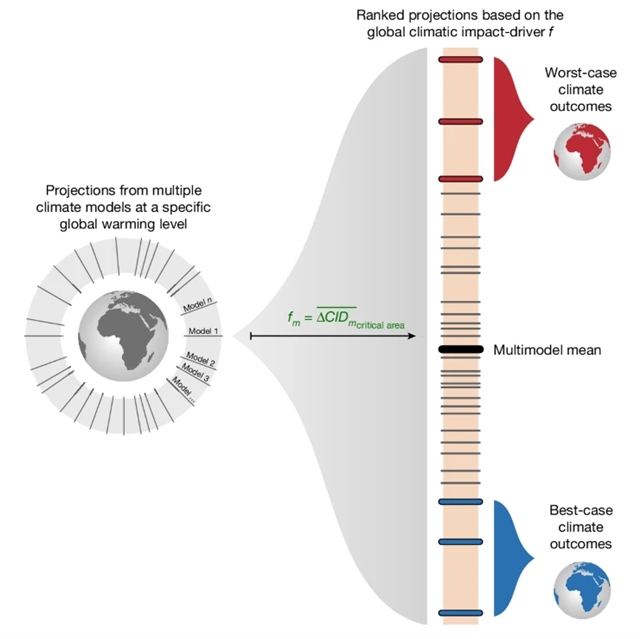
近日,德国亥姆霍兹环境研究中心Emanuele Bevacqua团队报道了温和全球升温并不能排除全球极端气候状况的可能性。这一研究成果发表在2026年3月25日出版的《自然》杂志上。
有效传达全球未来气候的最坏情景预测(以下简称“最坏气候结果”)对于风险评估以及制定应对全球升温的稳健适应策略至关重要。然而,目前用于确定空间一致性气候结果的方法存在局限性,最糟糕的全球气候状况通常是通过在高全球升温水平(如比工业化前时期高出3℃或4℃)下气候模型预测的平均值来呈现。
研究组表明,即便在2℃中等升温情景下,某些区域的全球极端气候状况仍有可能出现。对于全球主要粮食产区的干旱情况、人口密集地区的极端降水情况以及森林地区的极端火灾而言,在全球升温2℃的情况下,全球气候影响驱动因素的强度可能会比在升温3℃或4℃时的模型平均预测结果更为极端。
研究组通过在全球关键区域对与特定行业相关的气候影响驱动因素进行空间平均处理,确定了特定行业、空间一致的潜在高影响和低影响的全球气候结果,并得出上述结论。该方法可便捷应用于众多领域,助力提升特定行业的气候风险评估,并为气候政策提供参考依据。随着全球升温逼近1.5℃,这些发现凸显了迅速采取减排措施以将升温幅度控制在2℃以下的紧迫性,因为即便仅升温2℃,也可能带来严重的后果。
附:英文原文
Title: Moderate global warming does not rule out extreme global climate outcomes
Author: Bevacqua, Emanuele, Fischer, Erich, Sillmann, Jana, Zscheischler, Jakob
Issue&Volume: 2026-03-25
Abstract: Effectively communicating worst-case projections of global future climate—hereinafter referred to as worst-case climate outcomes—is essential for risk assessment and developing robust adaptation strategies to global warming1,2,3,4,5,6,7. Yet, current approaches for identifying spatially consistent climate outcomes are limited, with worst-case global climates typically communicated via the average of climate model projections at high global warming levels, such as 3°C or 4°C above the preindustrial era8,9. Here we show that extreme global climate outcomes may occur even under moderate 2°C warming for several sectors. For droughts in global key breadbasket regions, precipitation extremes over highly populated areas and fire weather extremes across forests, global climatic impact-drivers at 2°C of global warming may turn out to be much more extreme than model-averaged projections at 3°C or 4°C warming. We derive these results by identifying sector-specific, spatially consistent potential high- and low-impact global climate outcomes through spatially averaging projected sector-relevant climatic impact-drivers across key global regions. Our approach can easily be adapted to a wide range of sectors to support the improvement of sector-specific climate risk assessment and to inform climate policy. As global warming approaches 1.5°C (ref. 10), these findings underscore the urgency of rapid mitigation to limit warming well below 2°C, as even a 2°C world may entail severe impacts.
DOI: 10.1038/s41586-026-10237-9
Source: https://www.nature.com/articles/s41586-026-10237-9
Nature:《自然》,创刊于1869年。隶属于施普林格·自然出版集团,最新IF:69.504
官方网址:http://www.nature.com/
投稿链接:http://www.nature.com/authors/submit_manuscript.html