
美国西奈山伊坎医学院Andrew L. Ji小组的一项最新研究揭示人体皮肤解剖的单细胞空间转录组学分析。相关论文于2026年3月23日发表在《自然—遗传学》杂志上。
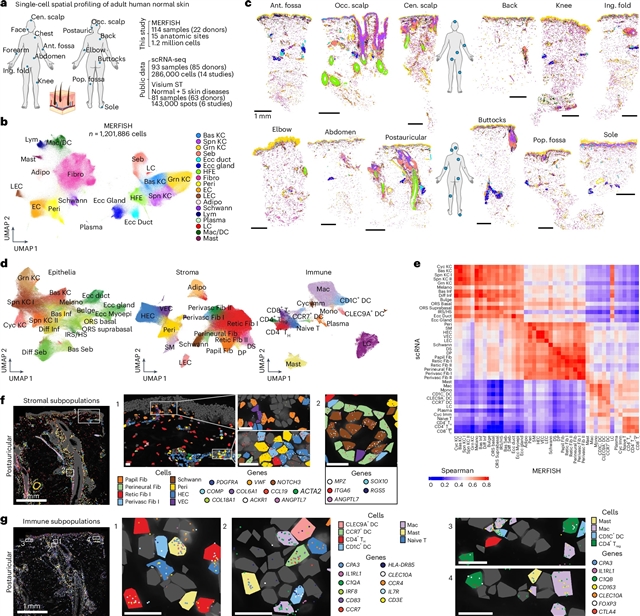
在这里,小组构建了来自正常成人皮肤的约120万个细胞的全器官单细胞空间图谱,解决了114个样本中包含15个解剖部位的45种细胞类型的位置。研究组发现了位点特异性的刻板细胞类型组成及其组织成10个多细胞社区,最显著的是血管周围区,让人想起皮肤相关淋巴组织。在这个邻域内,配体受体(L-R)分析确定了肿瘤坏死因子在维持CCL19+血管周围成纤维细胞中的核心作用,突出了稳态免疫-基质串扰。最后,通过比较皮肤疾病空间转录组学的邻域动态,课题组人员发现血管周围邻域存在泛疾病免疫改变,表明致病活性存在空间区隔性。它们是皮肤多尺度分子到宏观解剖组织的基础,协调细胞间相互作用和解剖位点特化,并在疾病中表现出结构破坏。
据介绍,皮肤是人体最大的器官,也是重大疾病负担的部位,但其在全身的细胞和分子组织在很大程度上是不确定的。
附:英文原文
Title: Single-cell spatial transcriptomic analysis of human skin anatomy
Author: Restrepo, Paula, Wilder, Alexis, Houser, Aubrey, Sandhu, Harkirat Singh, Ramirez, Angie, Grace Hren, M., Gill, Raman, Kazmi, Abiha, Chen, Larry, Nigro, Alexandra, Imanishi, Ichiro, Demircioglu, Deniz, Hasson, Dan, Soto, Alan, McQuillan, Stephanie, Gonzalez-Kozlova, Edgar, Brody, Rachel, Ungar, Benjamin, Kasper, Maria, Lu, Catherine P., Torina, Philip, Lewin, Jesse M., Gnjatic, Sacha, Ma, Sai, Ji, Andrew L.
Issue&Volume: 2026-03-23
Abstract: The skin is the largest human organ and a site of substantial disease burden, yet its cellular and molecular organization across the body is largely undefined. Here we construct an organ-wide single-cell spatial atlas of ~1.2 million cells from normal adult human skin, resolving the location of 45 cell types across 114 samples encompassing 15 anatomic sites. We uncover site-specific stereotypic cell-type composition and their organization into ten multicellular neighborhoods, most notably a perivascular neighborhood reminiscent of skin-associated lymphoid tissue. Within this neighborhood, ligand–receptor (L–R) analyses identify a central role for tumor necrosis factor in maintaining CCL19+ perivascular fibroblasts, highlighting homeostatic immune–stromal crosstalk. Finally, comparing neighborhood dynamics in spatial transcriptomics of skin disease, we find pan-disease immune alterations in this perivascular neighborhood, suggesting spatial compartmentalization of pathogenic activity. Thus, multicellular neighborhoods underlie the skin’s multiscale molecular to macroanatomic organization, orchestrate cell–cell interactions and anatomic site specialization and exhibit architectural disruption in disease.
DOI: 10.1038/s41588-026-02552-8
Source: https://www.nature.com/articles/s41588-026-02552-8
Nature Genetics:《自然—遗传学》,创刊于1992年。隶属于施普林格·自然出版集团,最新IF:41.307
官方网址:https://www.nature.com/ng/
投稿链接:https://mts-ng.nature.com/cgi-bin/main.plex