
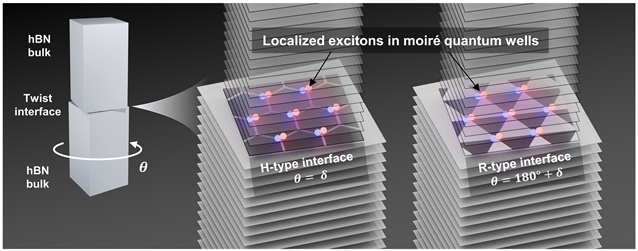
近日,韩国浦项基础科学研究所Jonghwan Kim团队报道了高效、深紫外发光的hBN莫尔
二维范德华半导体的扭曲堆叠能够形成莫尔超晶格,为量子态及其光与物质相互作用提供了前所未有的调控手段。
研究组表明,在两块六方氮化硼单晶块体之间构建一个简单的扭转界面,即可形成嵌于三维范德华结构中的莫尔量子阱。六方氮化硼莫尔量子阱在光激发和电注入条件下均能对载流子产生强限域效应。尽管其带隙为间接带隙,该材料仍可在215至240纳米的极短波长波段发射出强烈的深紫外发光,其强度比当前最先进的传统氮化铝镓多量子阱高出一个数量级以上。此外,通过调控扭转角度,莫尔量子阱的发光能量与效率可实现广泛可调。
附:英文原文
Title: Highly efficient, deep-ultraviolet luminescence in hBN moiré quantum wells
Author: Chengyun Hong, Fangzhou Zhao, Su-Beom Song, Sangho Yoon, Seong-Joon Jeon, M. Ajmal Khan, Ye Tao, Dong-Hwan Yang, Wanhee Lee, Junho Kim, Sera Yang, Hyungseob Cho, Sumin Lee, Seok Young Min, Kenji Watanabe, Takashi Taniguchi, Seunghyup Yoo, Changsoon Cho, Si-Young Choi, Hideki Hirayama, Lede Xian, Moon-Ho Jo, Angel Rubio, Jonghwan Kim
Issue&Volume: 2026-03-19
Abstract: Twisted stacking of two-dimensional van der Waals (vdW) semiconductors creates moiré superlattices, which provides unprecedented control over quantum states and their light-matter interactions. We demonstrate that a simple twist interface between two single-crystalline bulks of hexagonal boron nitride (hBN) creates moiré quantum wells (QWs) embedded in a three-dimensional vdW structure. hBN moiré QWs strongly confine charge carriers under both optical excitation and electrical injection. Despite their indirect bandgap, they emit intense deep-ultraviolet luminescence in the extreme wavelength bands from 215 to 240 nanometers, exceeding that of state-of-the-art conventional aluminum gallium nitride (AlGaN) multiple QWs by more than an order of magnitude. Furthermore, the twist angle control allows wide tunability of luminescence energy and efficiency in moiré QWs.
DOI: aeb2095
Source: https://www.science.org/doi/10.1126/science.aeb2095