
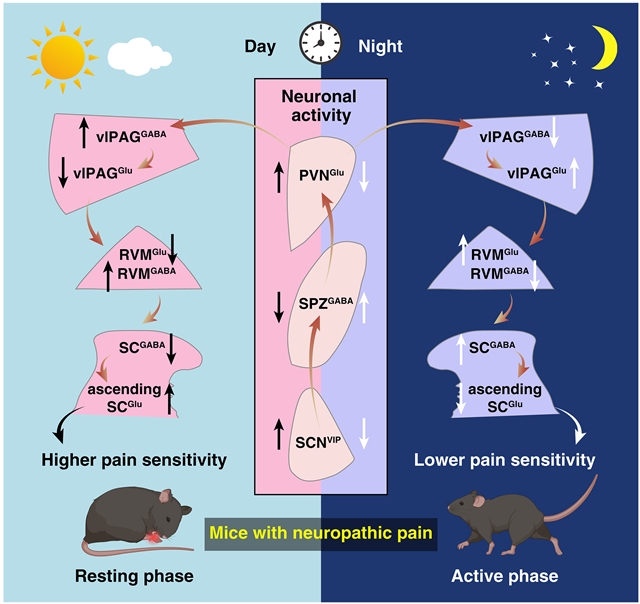
该团队发现,在神经性疼痛的母主题模型中,由下丘脑主时钟到下行镇痛系统的节律电路驱动的伤害阈值每日振荡。在白天(静息期),视交叉上核(SCNVIP)中较高的血管活性肠肽(VIP)神经元活性激活了一条涉及室旁核(PVN)和腹外侧导水管周围灰质(vlPAG)的信号通路,最终增加了伤害性敏感性。在夜间(活动阶段),SCNVIP神经元活动的减少通过这种多突触回路降低疼痛敏感性。这项研究确定了一个调节疼痛节律的回路,可能是改善慢性疼痛管理的目标。
据悉,慢性疼痛在人类中表现出昼夜节律,但这种节律背后的机制尚不清楚。
附:英文原文
Title: Hypothalamic clock governs circadian pain
Author: Hong-Rui Wei, Qianqian Lou, Le-Xian Li, Lan Tang, Run-Jie Wu, Hong-Yu Li, Ai-Jun Jiang, Xin-Lu Yang, Wei Gao, Xin-Yi Zhao, Liuhu Han, Yu Mao, Sen Qun, Yanli Luo, Junchao Qian, Yan Jin, Zhi Zhang
Issue&Volume: 2026-03-19
Abstract: Chronic pain exhibits circadian rhythms in humans, but the mechanisms underlying such rhythmicity remain unclear. Here, we found daily oscillations in the nociceptive thresholds in a mouse model of neuropathic pain, driven by a rhythmic circuit from the master clock in the hypothalamus to the descending analgesia system. In the daytime (resting phase), higher vasoactive intestinal peptide (VIP) neuronal activity in suprachiasmatic nucleus (SCNVIP) activates a signaling pathway involving the paraventricular nucleus (PVN) and the ventrolateral periaqueductal gray (vlPAG), ultimately increasing nociceptive sensitivity. At night (active phase), reduced SCNVIP neuronal activity decreases pain sensitivity through this polysynaptic circuit. This study identified a circuit for regulating pain rhythmicity that might be targeted to improve chronic pain management.
DOI: ady6455
Source: https://www.science.org/doi/10.1126/science.ady6455