
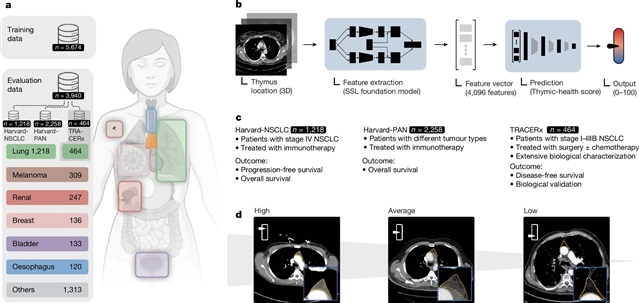
哈佛医学院Hugo J. W. L. Aerts小组近日取得一项新成果。经过不懈努力,他们提出了癌症患者的胸腺健康和免疫治疗结果。相关论文于2026年3月18日发表于国际顶尖学术期刊《自然》杂志上。
胸腺是一种关键的免疫器官,对T细胞成熟,该研究组假设胸腺功能与免疫治疗结果相关。
在这里,小组表明胸腺健康(胸腺功能的放射学测量)与几种癌症类型的免疫治疗结果密切相关。使用应用于常规计算机断层扫描图像的深度学习框架,研究小组量化了3476名接受免疫检查点抑制剂的泛癌症队列患者的胸腺健康状况。在非小细胞肺癌患者中,胸腺健康程度越高,进展风险越低,全胸腺癌死亡率越低。且这种关联在程序性死亡配体1(PD-L1)表达水平和肿瘤突变负荷的临床相关分层中仍具统计学意义。
在前瞻性TRACERx肺癌研究中,胸腺健康与T细胞受体多样性和T细胞受体切除圈呈正相关,并与免疫系统信号通路相关,支持胸腺放射学健康作为胸腺活性和适应性免疫能力的代理。对黑色素瘤、乳腺癌或肾癌患者的分析显示出泛癌症相关性。总之,这些发现确定了胸腺健康是免疫治疗疗效的一个以前未被认识到的、与肿瘤无关的决定因素,这对精确免疫肿瘤学中患者分层、治疗时机和免疫恢复策略的发展具有潜在的意义。
据了解,尽管免疫疗法已经彻底改变了癌症治疗,但许多患者的获益仍然有限,这凸显了对改进生物标志物的迫切需求。尽管免疫疗法是建立在释放T细胞,大多数现有的生物标志物仍然以它们为中心,主要忽略宿主的免疫能力。
附:英文原文
Title: Thymic health and immunotherapy outcomes in patients with cancer
Author: Bernatz, Simon, Prudente, Vasco, Pai, Suraj, Attermann, Asbjrn K., Di Federico, Alessandro, Rowan, Andrew, Veeriah, Selvaraju, Dyrskjt, Lars, Nrnberg, Leonard, Alessi, Joao V., Ott, Patrick A., Sharon, Elad, Hackshaw, Allan, McGranahan, Nicholas, Abbosh, Christopher, Mak, Raymond H., Bitterman, Danielle, Awad, Mark, Ricciuti, Biagio, Swanton, Charles, Jamal-Hanjani, Mariam, Birkbak, Nicolai J., Aerts, Hugo J. W. L.
Issue&Volume: 2026-03-18
Abstract: Although immunotherapy has revolutionized cancer treatment, many patients still experience limited benefit, highlighting the urgent need for improved biomarkers1. Although immunotherapy is founded on unleashing Tcells2, most existing biomarkers remain tumour-centric and mainly overlook host immune competence. The thymus is a key immune organ that is crucial for Tcell maturation, and we hypothesized that thymic functionality is associated with immunotherapy outcomes3. Here we show that thymic health, a radiographic measure of thymic functionality, is strongly associated with immunotherapy outcomes across several cancer types. Using a deep-learning framework applied to routine computed tomography images, we quantified thymic health in a pan-cancer cohort of 3,476 patients receiving immune checkpoint inhibitors. In patients with non-small cell lung cancer, higher thymic health was associated with reduced risks of progression and all-cause mortality. These associations remained significant across clinically relevant levels of programmed death ligand1 (PD-L1) and tumour mutation burden. In the prospective TRACERx lung cancer study, thymic health was positively associated with T cell receptor diversity and T cell receptor excision circles, and correlated with immune-system signalling pathways, supporting radiographic thymic health as a proxy for thymic activity and adaptive immune competence. Analysis across patients with melanoma, breast cancer or renal cancer demonstrated pan-cancer relevance. Together, these findings identify thymic health as a previously unrecognized, tumour-agnostic determinant of immunotherapy efficacy, with potential implications for patient stratification, treatment timing and the development of immune-rejuvenating strategies in precision immuno-oncology.
DOI: 10.1038/s41586-026-10243-x
Source: https://www.nature.com/articles/s41586-026-10243-x
Nature:《自然》,创刊于1869年。隶属于施普林格·自然出版集团,最新IF:69.504
官方网址:http://www.nature.com/
投稿链接:http://www.nature.com/authors/submit_manuscript.html