
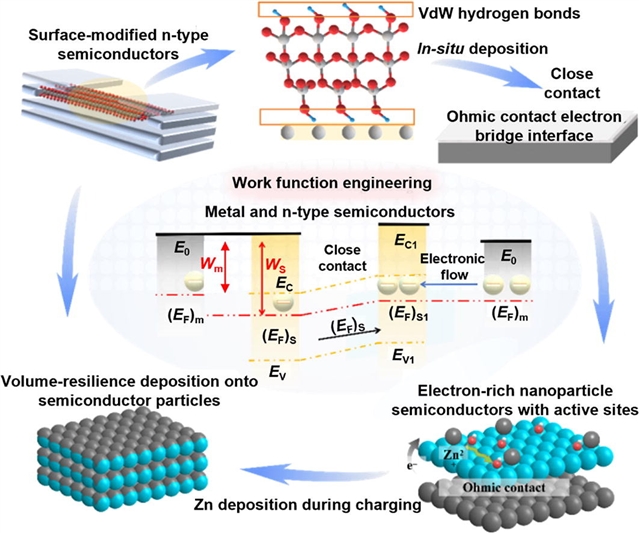
近日,中南大学方国赵团队报道了化学转换体积-弹性界面实现高容量锌阳极。相关论文于2026年3月16日发表在《科学通报》杂志上。
开发高放电深度下高度稳定的锌负极对于水系锌金属电池的实际应用至关重要。然而,界面处局部电子积累或耗散导致的锌金属负极无序沉积/剥离行为,严重阻碍了其在高面容最条件下的实用性。
该工作报道了一种面向高面容量锌负极的功函引导化学界面。通过界面功函差异诱导,欧姆接触在能带排列过程中构建了电子桥。这种电子传输为界面处均匀的Zn2+沉积/剥离提供了丰富的反应位点,从而抑制了界面开裂。最终,该设计界面在30毫安时每平方厘米(52%放电深度)和50毫安时每平方厘米(85%放电深度)的容量下实现了稳定循环,且界面形貌无明显恶化。作为实用性验证,一枚370毫安时的锌||碘软包电池在4.625毫安时每平方厘米的显著面容量下高效运行,凸显了以特定电子传输模式进行界面设计对提升负极实际性能的促进作用。
附:英文原文
Title: Chemically converted volume-resilience interface enables high-capacity zinc anode
Author: Zhexuan Liu b, Yaping Wang c, Guozhao Fang a
Issue&Volume: 2026/03/16
Abstract: The development of highly stable zinc (Zn) anodes under high discharge depth (DOD) is crucial for the practical application of aqueous zinc metal batteries (AZMBs). However, the disordered plating/stripping behavior of Zn metal anodes caused by localized electron accumulation or depletion at the interface significantly hinders their practicality under high areal capacity conditions. This work reports a work-function-guided chemical interface for Zn anodes with high area capacity. Induced by the interfacial work-function difference, the ohmic contact constructs an electron bridge during band alignment. This electron transport provides abundant reaction sites for uniform Zn2+ plating/stripping at the interface, suppressing the cracking of the interface. As a result, the designed interface ensures stable cycling at a capacity of 30 mAh cm2 (52% DOD) and 50 mAh cm2 (85% DOD) without obvious interfacial morphology deterioration. As a practical validation, a 370 mAh Zn||iodine (Zn||I2) pouch cell operates effectively at a remarkable areal capacity of 4.625 mAh cm2, highlighting the advancement of interface design in a specific electron transport mode for practical anode performance.
DOI: 10.1016/j.scib.2026.03.035
Source: https://www.sciencedirect.com/science/article/abs/pii/S2095927326002689
Science Bulletin:《科学通报》,创刊于1950年。隶属于SciEngine出版平台,最新IF:18.9
官方网址:https://www.sciengine.com/SB/home
投稿链接:https://mc03.manuscriptcentral.com/csb