
近日,广东工业大学雷彩红团队报道了酰胺基和酰腙基成核剂诱导聚乳酸结晶行为差异。2026年3月10日,《中国高分子科学杂志》发表了这项成果。
虽然基于酰胺和酰肼的成核剂已广泛用于提升聚乳酸的结晶性能,但结构相似的成核剂在促进结晶效率上存在显著差异,其背后的机理尚不明确。
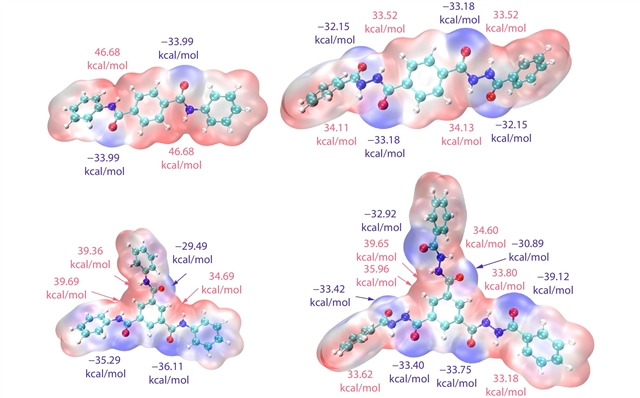
研究组设计合成了一系列成核剂,包括N,N-二苯基对苯二甲酰胺、N,N,N-三苯基-1,3,5-苯三甲酰胺、N,N-二苯基对苯二甲酰肼和N,N,N-三苯甲酰基-1,3,5-苯三甲酰肼,旨在探究它们对聚乳酸结晶性能影响的差异。密度泛函理论和分子动力学模拟表明,DBTA具有较小的静电势差(66.2 kcal/mol)。在冷却过程中,DBTA能与聚乳酸稳定形成更多的分子间氢键,并表现出更高的相互作用能,因此理论上能更有效地促进聚乳酸结晶。进一步的差示扫描量热结果显示,当DBTA添加量为0.5 wt%时,聚乳酸-DBTA复合材料在冷却过程中的结晶峰温度达到118.1 °C,而纯聚乳酸在相同条件下无明显结晶峰。
复合材料的结晶度显著提高至58.4%,而纯聚乳酸为14.6%。此外,在130 °C等温结晶条件下,DBTA将聚乳酸的半结晶时间缩短至2.9分钟,而纯聚乳酸的半结晶时间为27.4分钟。时间分辨傅里叶变换红外光谱结果也证实,DBTA在结晶过程中促进了聚乳酸gt构象异构体的形成。该研究从分子静电势和氢键相互作用的角度,阐明了结构相似成核剂在调控聚乳酸结晶方面存在性能差异的机理,为高效成核剂的分子设计提供了理论依据。
附:英文原文
Title: Study on the Differences in Crystallization Behavior of Poly(lactic acid) (PLA) Induced by Amide-based and Hydrazide-based Nucleating Agents
Author: Jiang-Hua Lin, Wen-Hao Xiao, Jing-Bo Wu, Jia-Le Wu, Rui-Jie Xu, Cai-Hong Lei
Issue&Volume: 2026-03-10
Abstract: Although amide- and hydrazide-based nucleating agents have been extensively used to enhance the crystallization performance of poly(lactic acid) (PLA), structurally similar nucleating agents exhibit significant differences in their crystallization-promoting efficiency, and the underlying mechanism remains unclear. In this study, a series of nucleating agents, including N,N-diphenylterephthalamide (DPTA), N,N,N-triphenyl-1,3,5-benzenetricarboxamide (TPTA), N,N-diphenyl terephthalohydrazide (DBTA), and N,N,N-tribenzoyl-1,3,5-benzenetricarbohydrazide (TBTA), were designed and synthesized to investigate the differences in their effects on the crystallization performance of PLA. Density functional theory (DFT) and molecular dynamics (MD) simulations showed that DBTA had a smaller electrostatic potential difference (66.2 kcal/mol). During the cooling process, DBTA could stably form more intermolecular hydrogen bonds with PLA and exhibit a higher interaction energy, thus theoretically enabling more efficient promotion of PLA crystallization. Further differential scanning calorimetry (DSC) results revealed that at a 0.5 wt% loading of DBTA, the crystallization peak temperature of the PLA-DBTA composite reached 118.1 °C during cooling, whereas no distinct crystallization peak was observed for pure PLA under identical conditions. The crystallinity of the composite was significantly increased to 58.4% compared to 14.6% of pure PLA. Moreover, under isothermal crystallization at 130 °C, DBTA reduced the half-crystallization time of PLA to 2.9 min, while the half-crystallization time for pure PLA was 27.4 min. Time-resolved Fourier transform infrared spectroscopy (FTIR) results also confirmed that DBTA promoted the formation of gt conformational isomers of PLA during the crystallization process. This study elucidates the mechanism behind the performance differences between structurally similar nucleating agents in regulating PLA crystallization from the perspective of molecular electrostatic potential and hydrogen bonding interactions, providing a theoretical basis for the molecular design of efficient nucleating agents.
DOI: 10.1007/s10118-026-3575-z
Source: https://www.cjps.org/en/article/doi/10.1007/s10118-026-3575-z/
Chinese Journal of Polymer Science:《中国高分子科学杂志》,创刊于1983年。隶属于中国化学会,最新IF:4.3
官方网址:https://www.cjps.org/
投稿链接:https://mc03.manuscriptcentral.com/cjps